
The issue of immigration is central to many countries in Europe and also the United States in today’s political environment. At its heart is whether a country has a right to maintain its cultural identity and therefore limit immigration in order to preserve that identity.
Read more Why Liberals Should Vote Republican — Just Once
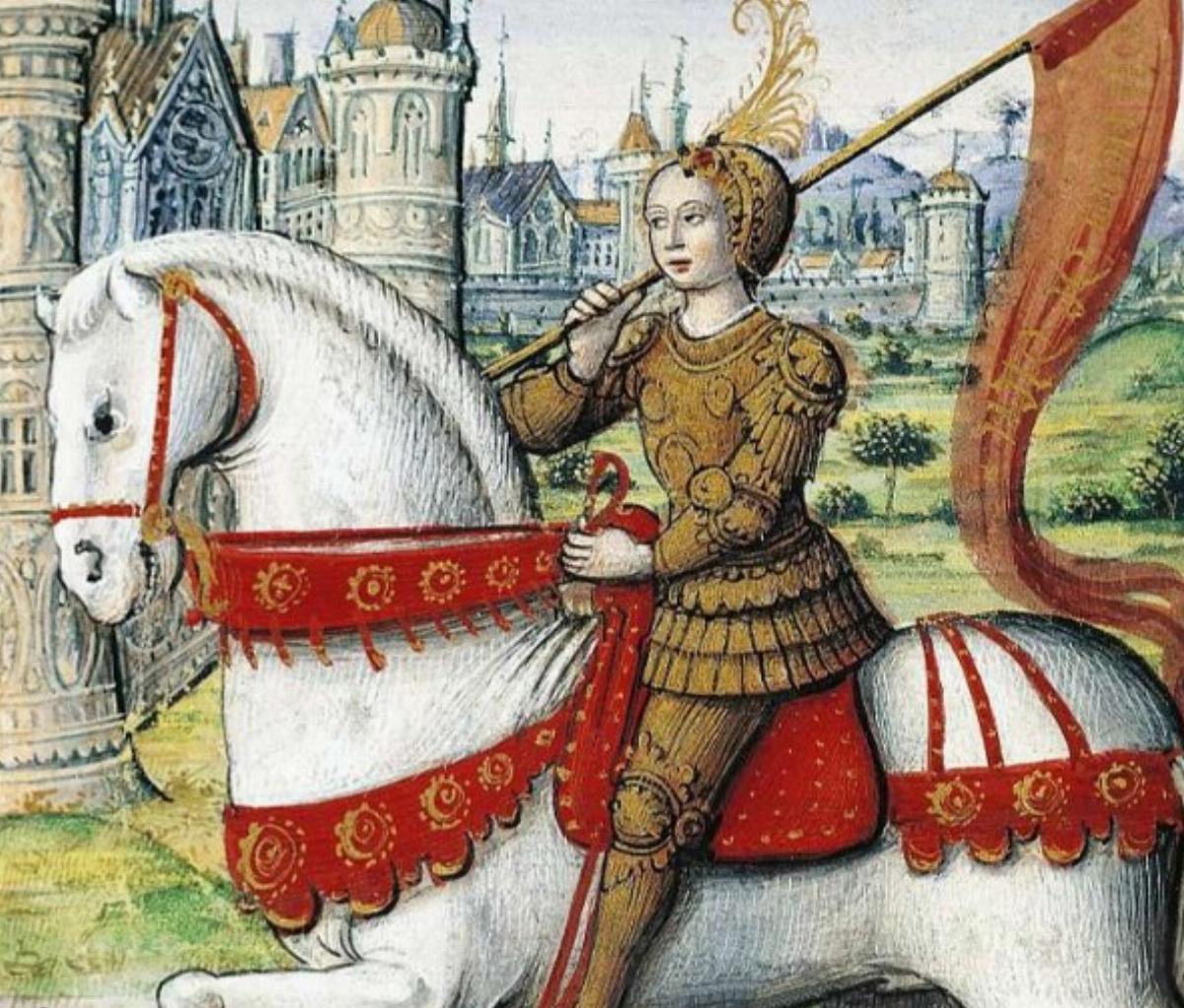
What if there were a historical example that shed light on that topic and included a note of divine consent? There is such an example, and that is the story of Joan of Arc.
Joan came out of nowhere as a woman in the medieval era and led an army to eject the English from her land. The lesson here is twofold. First, no country has a right to maintain occupation or domination over another. This message in itself is quite relevant to today’s political theater. Second, a country has a right to maintain its cultural identity free from foreign domination — in this case, English domination over France
May 30 is the celebration of Joan’s feast day of Joan. Maybe it’s time to take a second look at her life story and see what connections can be made.
What is interesting about the Joan of Arc story is that Joan claimed that her deeds were done with divine assistance. She frequently claimed that she had received inspiration by means of voices from St. Margaret, St. Catherine, and St. Michael the Archangel. This is an incredible claim. However, what she accomplished was an incredible feat in its own right. She became the leader of the French army in the Middle Ages at a time when the concept of women as warriors was preposterous. Perhaps this is a case where her deeds proved her claims of divine assistance.
The key fact that allowed her to ascend to such heights was a secret she told King Charles VII. Neither the king nor Joan ever revealed this secret, so historians can only speculate what it was. But the king knew that the secret was true and therefore believed in Joan’s divine mission.
The second fact about Joan’s life that proves the validity of her claims is that she was willing to die rather than renounce and recant everything she did. People don’t die for a lie. This is one of the great arguments used for the spread of Christianity. The early Christians experienced Christ in a spiritual manner, and they were willing to die because of that experience. The voices were real for Joan: They were the saints, beckoning her to defend the cultural identity of France. Historically, Joan did recant briefly, but later she rebuffed that momentary weakness and remained faithful to the truth she was presented with.
Think about the consequences of this. We have an example of divine intervention by means of a humble maid, as she referred to herself, taking a definitive side in a concrete instance of history. Many times during a conflict, both sides claim to have God on their side, but in this case, God, by means of his celestial messengers, took a definite side. The French had the right to their own king, their own country, and their own cultural identity. The English were on the wrong side, attempting to dominate and master the French by means of force. The English knew what this meant, and this is the reason they had to destroy Joan of Arc. Allowing God to be on the side of the French in the person of this peasant girl meant they were committing evil. This is something Joan constantly reminded them of by her very existence.
Read more Damning data: Foreigners are taking all our jobs
Joan wrote a letter to the king of England, which we still have today. In this letter, she said, “You will not withhold the kingdom of France from God. … King Charles, the true inheritor, will possess it, for God wills it.” In other words, God, according to Joan, took the side of France in this 100-year war.
This is why the example of Joan is relevant for today’s world. Joan said she had divine affirmation that it was necessary for France to retain its king, its country, and its culture. The English needed to leave France, as she said: “As for the English, the only peace with them is by their return to their own country, to England.”
What Joan was defending is what I would call a soft nationalism. It’s not a nationalism that speaks of dominating other cultures or claiming superiority; it’s a nationalism that speaks of sovereignty and freedom to determine a nation’s own path. Joan’s main goal was to free France from English domination and to maintain the French monarchy.
When I read about Joan of Arc on the internet, I see that she is celebrated for her courage, her faith in God, and her purity. Rarely do I see the theme of defending France from the English by means of the lance!
Joan was a warrior who used the sword as a legitimate act of self-defense. There is plenty of ethical support for the right of self-defense in the face of aggression, including the use of arms if necessary. The French definitely had the right to defend their homeland, and Joan was there in the midst of battle. When you read the original text of her trial and what witnesses said about her, you can see that she had no bones about doing battle with the English if they did not voluntarily leave.
Today, many people in Europe and the United States are concerned about preserving their cultural identity from excessive immigration. They fear that the character of their country is disappearing. The message behind Joan of Arc is a reminder to affirm their cultural identity. There is no need to apologize, as Joan shows us that God ‘s blessing were on the side of France. This implies that it is a moral good to maintain that identity whatever it may be for each nation in question.
George Matwijec is an adjunct philosophy teacher at Immaculata University who specializes in teaching knowledge and logic. He authored a book entitled My Interview with AI. He can be reached at iteacher101.com.
Read more Park pervert alert: Arab (presumed) migrant starts aggressively masturbating in front of everyone
Image via Picryl.