
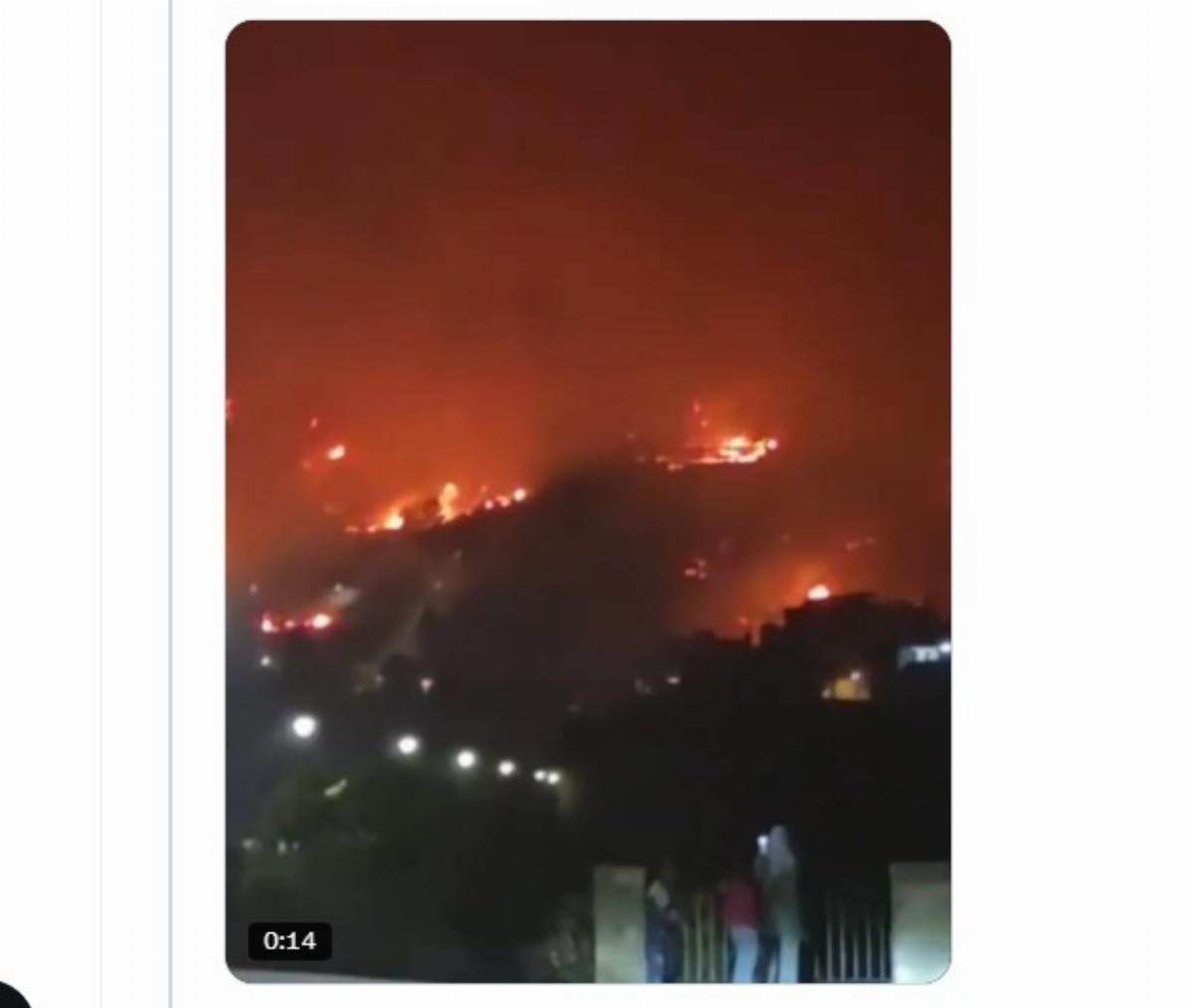
Global warming enthusiasts are having a field day as wildfires ravage western Europe, with Spain, Italy, France and Scotland hardest hit.
Read more DNC lacks money — and respect
It’s climate change, the europress crowed.
A sampling of some European headlines:
France, Spain wildfires: Climate change increasing frequency, intensity of extreme weather events –France 24
Inferno in Europe: Climate Change Fuels Devastating Wildfires –Devdiscourse (with agencies)
Why Europe is Getting so Hot –DW
A sad inevitability’: after decades of climate warnings, why is Europe so unprepared for rising heat? –The Guardian
Better stop those air conditioners as the temperature tops 100 degrees Fahrenheit, and no straws for that cold drink then.
Other headlines were just as bad from the Australian, U.S., Canadian and Chinese presses.
Obviously, a heat dome brought on by a slow moving high-pressure system to the west, apparently the work of an super El Niño weather system, plus another heatwave coming up from the Sahara desert, have ushered in the extreme heat which has created the perfect conditions for a fire to break out on hot dry mostly Mediterranean landscapes in Western Europe. That’s known as the ‘weather’ but who needs weather when there’s climate change to promote, which always comes with a heaping helping of government intervention?
In case any of these boobs have been paying attention, the phrase ‘El Nino,’ meaning, Christ child, is an old one, dating back to when Europeans and their colonized subjects had religion. It was first observed by Peruvian fishermen who named it that in 1578. There have always been El Niños, out there creating too much rain or too much heat, which Europe has now.
It’s called weather.
What’s more, two other factors combine to create the disastrous conflagration: forest management, done in the name of environmental sustainability, and arson, likely by migrants.
What are some European forest management practices?
In Spain, according to five scientists — Enric Vadell, Jesús Pemán, Pietr Johannes Verkerk, Maitane Erdozain and Sergio de-Miguel — who published a 2022 paper in ScienceDirect:
However, it was not until the second half of the 20th century that forest regeneration efforts in Spain intensified with the creation of a national-level policy on large-scale reforestation and afforestation during Franco’s dictatorship (i.e., the period 1939–1975) (Vadell et al., 2016). The National Reforestation Plan of 1938, which concurred with the rural exodus triggered by industrialization, aimed to mitigate the impacts (erosion, floods) of deforestation and forest degradation, to meet the growing demand for timber and energy from emerging industries as well as to boost the economy and tackle the high unemployment rate of rural areas. As a result, 5.6 million hectares of new forests were established between 1940 and 2006 in Spain (Vadell et al. 2016).
Hence, forest management became a cornerstone to ensure a stable wood production for the industry sector. The emergence of new materials and fuels and the opening to foreign markets during the second half of the 20th century, however, changed the demand for national wood products (Zavala et al. 2008). Over the last few decades, forest management has evolved to adapt to this changing demand, but also to incorporate the modernization of the forestry sector and to consider the new societal demands from forests such as biodiversity conservation, recreation and climate change mitigation.
Might that have led to a lot of deadwood and uncleared brush? Maybe a fire-conscious policy would have made a difference?
In France, the story seems similar. This is a from summary translation from Google ai from the original French Ministry of Ecology document:
Ecological Prioritization: National mandates favor the preservation of deadwood and mixed-species stands to balance industrial logging with biodiversity goals.
Read more The ayatollahs mistook American restraint for weakness
Fine and dandy, until the heat done moves in.
In the U.K., the Woodland Carbon Code incentivizes the planting of trees:
- Aggressive Expansion Targets: Government grants heavily subsidize landowners to plant millions of new trees annually to reach the UK’s net-zero carbon target by 2050.
- Private Finance Integration: The Woodland Carbon Code serves as a government-backed standard, matching private corporate buyers with estate owners for carbon offset credits.
Probably more trees than the Scottish heaths are used to. Again, a big heat dome can create a lot of fuel.
Italy’s National Forestry Strategy, known as TUFF, explicitly limits timber harvesting to prevent mudslides:
Hydrogeological Defense: Policy directly limits timber harvesting along the steep Apennine and Alpine slopes, using the dense tree cover to protect valleys from landslides and flash floods.
Meaning, there may have been a forestry management issue there, too. If brush and deadwood were allowed to accumulate, the forests would be easy targets for a heat wave even if the aim of preventing erosion were a worthy one.
The other problem is the human factor.
Here’s one explanation from the leftside that notes the role of human activity in the initiation of big fires, with an analysis I don’t agree with:
A simple(ton’s) guide to understanding climate change and wildfires:
Yes, the Biscarrosse wildfire was started by a van that caught fire. The flames spread to roadside vegetation before moving into the forest. That is a fact.
What isn’t true is the claim that this means climate… pic.twitter.com/4I9JEdwbPf
— Volcaholic 🌋 (@volcaholic1) July 24, 2026
The argument against that line of reasoning is that if global warming is all over, why is only Europe (and Australia, Canada and the U.S.) experiencing this level of conflagation? Why aren’t nearby Morocco or Libya having the same fire problems, or for that matter, Mexico which abuts California? How about China?
It seems the climate change is selective, choosing only those countries which experience overweening green policies for its big burnouts which happen to occur near populated areas.
Meaning, it’s green policies and forest mismanagement that enable these new and huge fires, which up until now, we have not seen in Europe to any major extent.
The last factor is migrants, There are plenty of suspected cases of migrants starting fires across Europe:
WILDFIRES IN EUROPE 🔥
Arson.
ITALY 🇮🇹 (Calabria region): Authorities are investigating fires near Pollino National Park found clear evidence of deliberate arson.
Investigators discovered CATS with rags soaked in flammable liquid tied to their tails; the animals were set…
— Lozzy B 🇦🇺𝕏 (@TruthFairy131) July 27, 2026
🇪🇸 Meanwhile in Costa Brava, Spain
Both Spain & France are on fire like never before right now.
44 people wanted for Arson in France, 16 in Spain – this is coordinated & deliberate. pic.twitter.com/BO3Ci050v0
— Concerned Citizen (@BGatesIsaPyscho) July 27, 2026
Islamist terrorists in the past have been caught in electronic chatter discussing setting wildfires, so the possibility should not be ruled out. Other migrants, with little respect for the nations they aspire to live in set fires, too, just look at the recent wave of ancient church burnings, particularly in France. And like the fires, the migrant phenomenon is a recent one, meaning, the link should not be overlooked. Maybe migrant control, not climate control, is part of the the answer, too.
Whatever it is, it’s not climate change. It’s an inability to adapt to conditions and a failure to prioritize fire eventualities until the fuel load gets so big it’s hard to stop any fire. One can only hope that Europe can get these fires out before the damage destroys the historic vineyards and cities of its beautiful civilization. They need to get serious about dumping the climate change myths.
Read more Besmirching American History on our Dime
Image: Screenshot from X video