
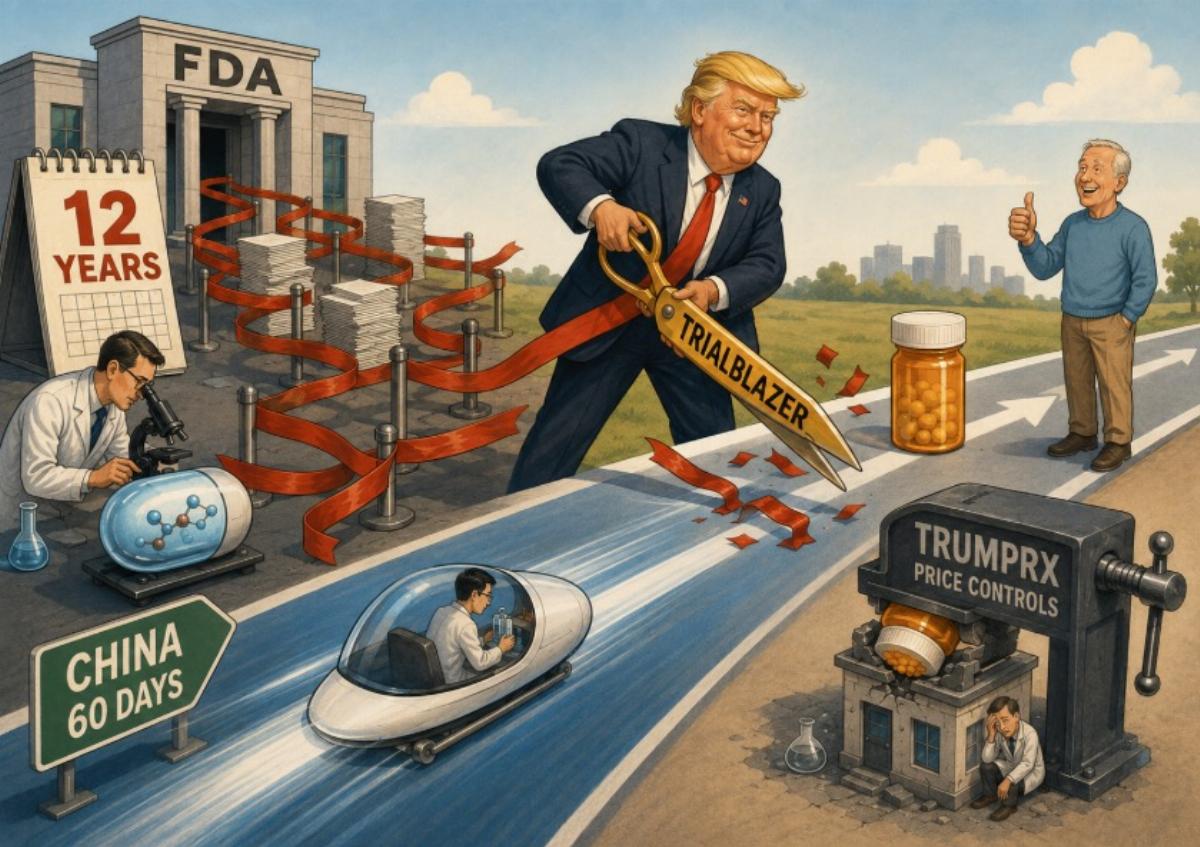
One reason pharmaceuticals cost so much: the Food and Drug Administration’s approval process takes up to twelve years to bring a new drug to market. The Trump Administration has launched Operation Trialblazer to shorten that timeline. It’s one of Trump’s best healthcare proposals so far, one that reduces the government’s footprint in U.S. healthcare. It is a welcome departure from some of the Trump Administration’s other prescription drug initiatives that, unfortunately, expand the role of government.
Read more Pasta pass
The FDA approval process is divided into three phases. Phase 1 determines if a drug can be used safely in humans and at what dosage. Completing Phase 1 takes an average of 380 days and, in some cases, can stretch to 700 days.
Other countries are taking advantage of the FDA’s slower pace. China has reduced its Phase 1 process to 60 days while Australia’s is about 70 days. The U.S. has lost its competitive edge as a result. In 2024, the number of drug trials registered in China was over 16,600 versus 9,100 in the U.S., according to the Journal of Clinical Epidemiology — the first time China exceeded the U.S.
China is seeing a surge of investment capital as a result. Out-licensing is the process by which a pharmaceutical company that develops a drug grants the rights to another company to further develop it. In 2023, pharmaceutical companies made $38 billion worth of out-licensing deals with Chinese firms. In 2024, that rose to nearly $52 billion, and it more than doubled to over $137 billion in 2025.
To shorten Phase 1, Operation Trialblazer is clarifying the requirements for starting drug trials. “The absence of explicit, phase-specific requirements has left sponsors to guess what data is necessary,” to the FDA. Drug companies often “err on the side of submitting too much data, conduct[ing] months of unnecessary studies.” Operation Trialblazer is also reducing the amount of animal testing companies must conduct before submitting a drug application.
The administration is reforming later stages too. Under Operation Trialblazer, Phase 3 now requires one clinical trial instead of two.
The potential savings are considerable. Animal testing costs anywhere from $15 to $100 million. Phase 3 clinical trials cost an average of $282 million.
Those are savings that can benefit patients. Lowering the cost of testing drugs makes it easier for new pharmaceutical companies, especially smaller ones, to enter the prescription drug market. Smaller companies account for over 65 percent of drugs that are in the development stage. Of the first-in-class cancer drugs approved by the FDA in the previous decade, smaller companies originated 46 percent of those drugs versus 14 percent from larger companies. Larger companies tend to focus on making incremental improvements to existing drugs rather than developing new ones. More pharmaceutical companies means more competition, which means lower drug prices.
Read more Hasan goes to a costume party
Economist Tomas Philipson, former acting chairman of the White House Council of Economic Advisers, examines the economic benefits of reducing the FDA approval process in a new Unleash Prosperity Now report. His report estimates cutting FDA review timelines by one to six years could generate between $4 and $61 trillion in combined value to consumers and drug producers.
Hopefully Operation Trialblazer represents a rethinking by the Trump Administration of its approach toward prescription drug prices. Regrettably, the administration’s other signature initiative, TrumpRX, has imported drug price controls.
To be fair, TrumpRX deserves credit for providing patients with a transparent, direct-to-consumer way to shop for the best cash price on their medications, reducing the confusion that’s long surrounded drug pricing. However, it also employs Most-Favored Nation drug pricing, which requires drugmakers to charge a price equal to the lowest price among selected high-income countries. Many of those countries are in Europe, where drug prices are lower due to price controls.
Price controls make it harder to make a profit on a drug because governments often impose prices that don’t cover the cost of producing a drug. In the long run, that will mean fewer small companies. Smaller companies sell fewer drugs, and unprofitable drugs can easily put them in the red. That is good for larger drugmakers. They will increase their market share as smaller companies in financial distress either go out of business or are acquired by larger competitors.
When the Trump administration reduces the government’s role in drug development, as with Operation Trialblazer, it will produce savings that will reach patients. By contrast, TrumpRX leans on government to set prices rather than to get out of the way and let competition do it. The administration has proven with Trialblazer that it knows how to do the latter. The task now is to apply that same approach across the rest of its healthcare agenda.
Image created using AI.
David Hogberg, Ph.D., is a freelance healthcare columnist. He is a former reporter and former adjunct fellow for the National Center for Public Policy Research, where he specialized in healthcare policy.
Read more True gun rights get a new lease on life in the Third Circuit