
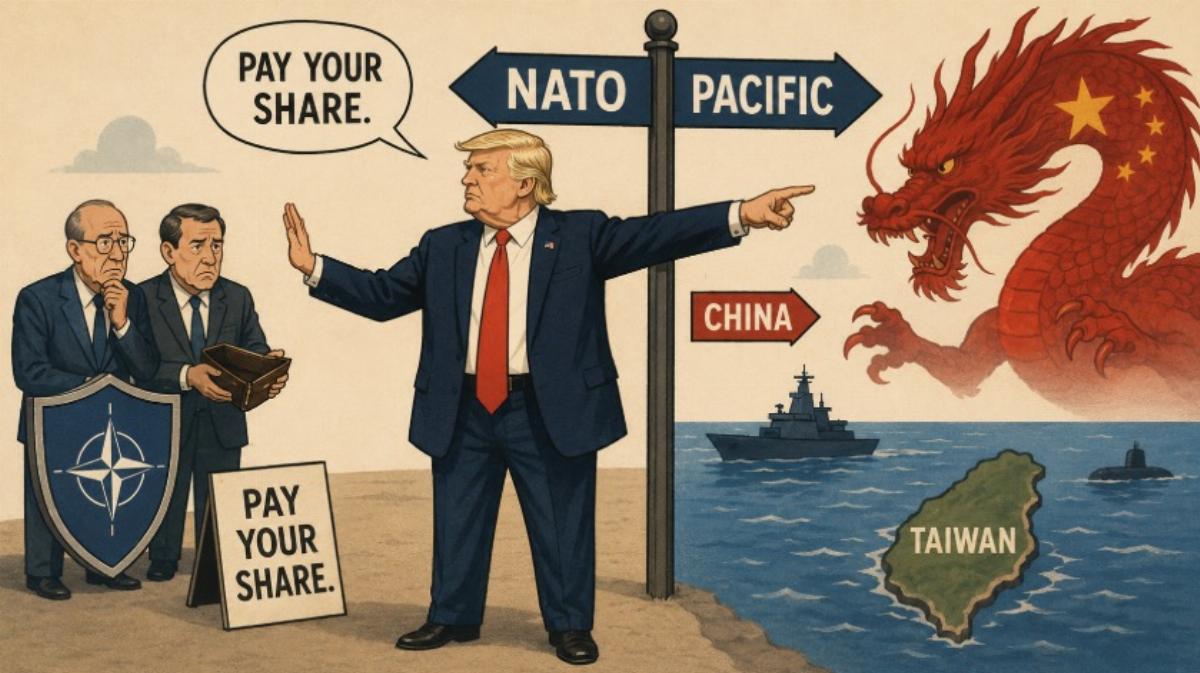
For three decades after the end of the Cold War, the transatlantic relationship rested on an implicit bargain: America guaranteed European security while the EU and its satellites concentrated on economic and political integration and drastically expanded their generous welfare states.
Read more Pyongyang Kim getting nervous?
The latest NATO summit in Ankara demonstrated that this bargain is falling apart. A new one is emerging, one in which Europe is expected to assume far greater responsibility for its own defense while the United States increasingly shifts its strategic focus toward containing China in the Indo-Pacific. Europe appears reluctant to accept it, but eventually, it will need to get used to it. NATO’s latest summit demonstrated such a need.
Firstly, the new bargain rests upon the fundamental assumption that Europe cannot continue to outsource its security indefinitely. During his first campaign for president, stretching for the entirety of his first term, President Trump demanded that America’s allies on the other side of the Atlantic spend more on their defense.
Up until that point, NATO’s 2006 defense minister agreement established a 2% of GDP requirement for all members to spend on defense. And despite that agreement, only Poland and the United States had achieved that goal, leaving behind powerful and wealthy European states such as Germany, France, and even the United Kingdom (at the time, an EU member). Such a discrepancy suggests deep-rooted and structural unfairness, as wealthier and more influential countries must be willing to spend more on defense, which hasn’t happened until this summit.
While the American left idolized European welfare states and the robust social safety nets that came with them, it was clear that those welfare states would have been impossible to finance without the American taxpayer bankrolling European defense.
Needless to say, when America needed Europe the most, in the aftermath of Operation Epic Fury, European allies repeatedly refused to join the United States in military activity designed to reopen the Strait of Hormuz from the Iranian blockade—which, ironically enough, would benefit Europe more than it would America—due to Europe importing much of its oil and natural gas through the Strait of Hormuz. When a conflict began with Iran, Europe once again proved reluctant to shoulder a larger share of the burden.
Donald Trump understood that this posture is unsustainable, which is why he asked Europeans to raise their defense spending in his first term, while raising the requirement to a historic 5% of the GDP for all NATO members throughout this ongoing second term. The bargain is clear: Europe must not be allowed to outsource its defense spending to the United States, at least not without increasing defense spending and implementing serious changes to its economic, political, and social model.
The current American administration correctly understands that a weak Europe is a threat to the future of the transatlantic alliance and to the alliance’s security in the face of looming threats from Russia, China, and growing competition from the Global South.
Secondly, as outlined in the published in early December, the U.S. is diverting its attention away from continental Europe to the Indo-Pacific. There, Chinese control of the South China Sea and a looming invasion of Taiwan are seen not just as geopolitical inconveniences but as to the United States and its strategic interests in the region.
For that reason alone, Europe must spend more on its defense to deter potential Russian aggression, while the United States deals with China. The notion that the United States should be left dealing with the Sino-Russian axis alone, while the EU goes down the drain of unfettered leftism, at the expense of its civilization and the NATO alliance at large, represents an absurd and unsustainable model of alliance maintenance—and, I should add, grave political malpractice.
Read more Mamdani stumbles, bumbles trying to define ‘working class’
If the United States were to continue on the liberal path of relationship building with Europe, it would have to concede the chips race to China, as a successful Chinese invasion of Taiwan would give the CCP control of over 80% of the world’s semiconductors, leading to almost complete Chinese control of global supply chains and a consequent economic disaster for America and Europe alike.
It is clear that the liberal bargain of the US-EU relationship needs to be replaced by a pragmatically realist approach that preserves the alliance while deterring foreign adversaries. The latest NATO summit did exactly that.
Lastly, Europe must become strategically stronger without becoming strategically separate. Ursula von der Leyen’s political flirtations with India and Turkey, all while the EU bought record levels of liquefied natural gas (LNG), ironically enough, from Russia, demonstrate a clear frustration of European officials with America and a desire to replace America as Europe’s principal ally and senior partner on the global stage.
That is, of course, a direct result of Europe’s reluctance to course-correct its strategic mistakes, as seen in Europe’s difficulties in rearming and innovating, and in European businesses struggling to become competitive on the global stage.
At such a time, we should not be surprised that an autocratic regime like Turkey became the host of the 2026 annual NATO summit, as in all likelihood, Turkey, despite all of its issues, is the only reliable partner of America in NATO right now. Europe simply isn’t, and for that reason, a new bargain is needed. And a new bargain is indeed emerging.
The critics of this new bargain belong to two distinct schools of thought. The liberals on both sides of the Atlantic, including officials of the Democrat party and of center-left parties in Europe, believe that America’s commitment to liberal democracy is indispensable and that, in the name of such indispensability, America should essentially turn a blind eye to Europe’s mischief and strategic misalignment. As long as America and Europe defend democracy, China’s rise can be ignored according to American leftists and Brussels bureaucrats.
On the other hand, European sovereigntists in France and Spain are using the friction in the wake of this new bargain to propose increased European autonomy to the United States, leading to long-standing French ambitions for a European army, which would bring about the end of NATO and the rise of nationalist ambitions in France and elsewhere. Two world wars were enough to tell us how badly those ambitions usually end up.
The NATO summit will ultimately be remembered less for the percentage points pledged on defense spending than for the strategic reality it acknowledged. The age of an American-protected Europe is gradually giving way to one of shared responsibility. If Europe embraces that challenge while preserving the alliance’s political cohesion, NATO will emerge stronger than before. If NATO members mistake greater responsibility for strategic separation, the greatest beneficiary will not be Europe, but its adversaries. The new bargain is not a choice but the choice.
Read more The left’s latest tactic: ‘nostalgia’ blinds conservatives to the Constitution’s defects
Image created using AI.