
If you’re like my family, leading up to America 250, you’ve read articles and books, and watched a number of documentaries, Netflix series, and movies about colonial and revolutionary America — the time period from about 1750 until around 1800. Those articles, movies, and videos discuss the events that led up to the Revolutionary War, the war itself and various battles, the Declaration of Independence, the difficulties of trying to forge a country together, writing the Constitution and the Bill of Rights, ratifying both, and the decade (or so) after ratification to include President George Washington’s two terms as president. I feel like I’ve had several semesters of American history crammed into the past few months.
Read more ‘Citizen Vigilante’ Shows Why Hollywood is Collapsing
That said, in honor of America 250, the Veterans of Foreign Wars (VFW) sent out a “Land of the Free” word-search puzzle that had a number of words associated with patriotism and America’s founding. Searching for each word, I thought about how that word related to early America, especially as I related the word to recent books I’ve read and movies/videos I’ve watched about our country’s founding. The puzzle words were terms such as Founding Fathers, E pluribus unum, Bill of Rights, Manifest Destiny, American Dream, civil rights, and about forty others — pioneers, allegiance, sacrifice, reign, Washington (the only name on the list), independence, democracy, republic, constitution, revolution, patriot, statesman, service, suffrage, honor, duty, colony, settlement, Congress, and on went the list. I realized, taken together, the words convey much of our country’s history and the character traits of the men and women who settled a continent and founded a nation.
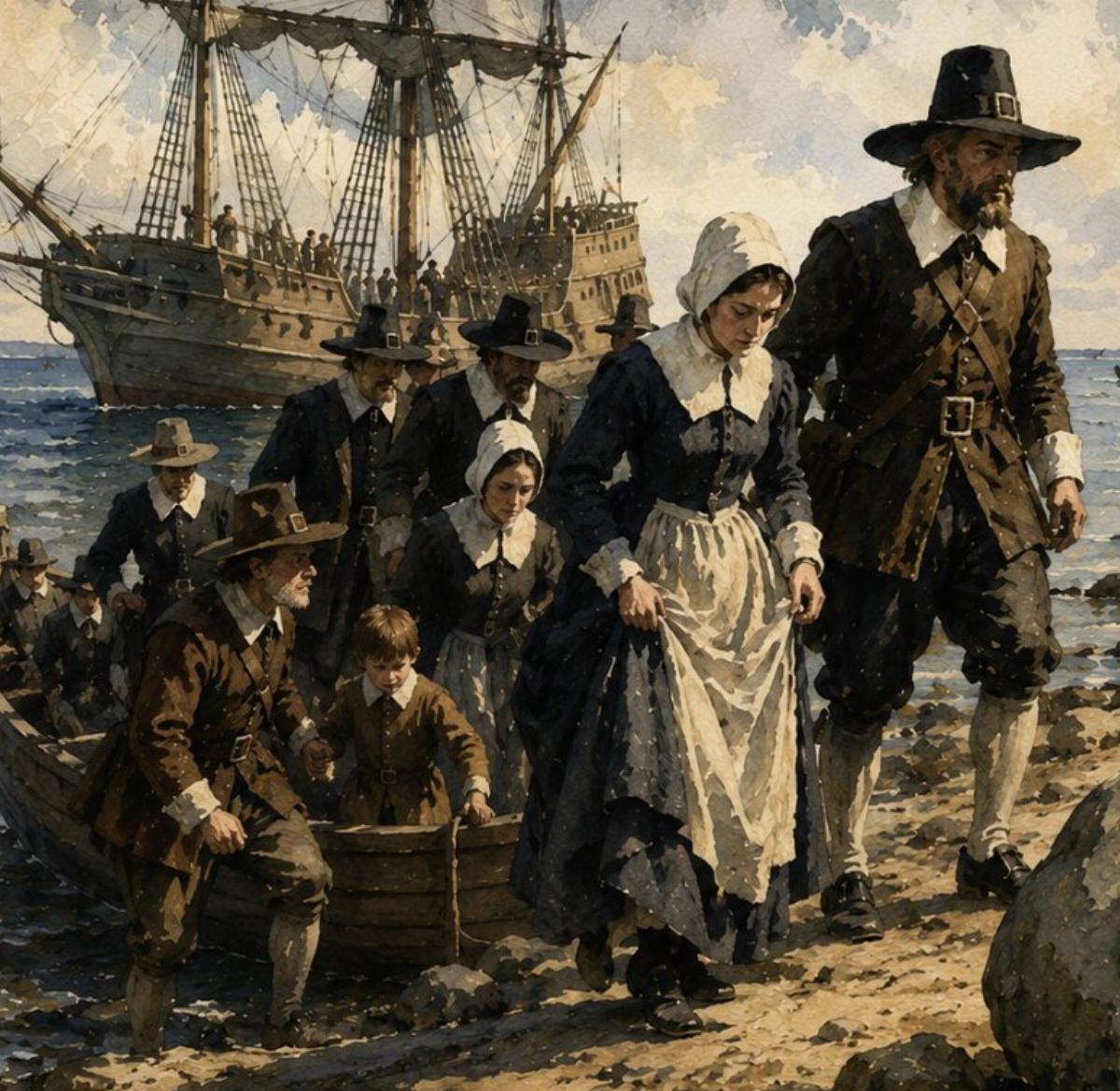
When you think about the early settlers to our shores, each one made a bold decision in which they declared, “I have confidence that, on the other side of the ocean, on a new continent I know nothing about, except that it’s a wilderness, inhabited by savages, I can do better for myself and family.” Based on their faith in God and the freedoms denied back home, especially freedom of religion, they severed all ties and set sail, crossed an ocean and settled a continent. Wow, talk about having some gonads. Today in 2026, we know how their stories unfolded, but nobody knew how it would back in 1607 (Jamestown), 1620 (Pilgrims in Plymouth), or as late as 1733 (Oglethorpe in Georgia). When I think of those early settlers, and the individual traits required to do what they did, words and terms that come to mind include bold, courageous, adaptable, ambitious, tough, resilient, independent spirit, confident, religious, resourceful, self-sufficient, and valorous.
Along with the challenges and struggles of settling a continent, we cannot overlook the European societies they departed from. In the 17th and 18th centuries, Europe was ruled by monarchs and nobles — who maintained closed societies tied to rigid class structure. For 90% of the population, there were no freedoms (as we know them today), no voting, no land ownership, and a very stratified society controlled by the elites. The average person led a miserable life of permanent poverty and servitude. However, that was the culture and society the early settlers knew and somewhat attempted to create here in America, at least at first. But there was one huge difference that changed everything — land ownership. In Europe, only the nobles and very wealthy owned land. Commoners owned nothing.
Land was perhaps the single most powerful attraction for early settlers. Land ownership required a great deal of labor to clear, improve, settle, and farm the land. And labor, meaning people to work the land, was hard to find in the New World. Natives would have none of it and resisted, to their abilities. Indentured servants became one answer and slavery, another. Much of the struggles over the centuries can be tied to people seeking land. Terms associated with those land struggles include colonial charters, frontier, pioneers, hard work, opportunity, disputed territory, homestead, settlements, hostile natives, compromise, weather extremes, water rights, and agriculture.
Read more America’s Iran War Is Now A War On Risk
Colonies attracted new settlers by offering land. As the new settlers arrived, they expanded beyond the initial settlements and in the process, became pioneers who progressively drove out the Natives, pushing the frontier ever westward. To establish communities, rules and laws were needed. So, the colonists began to form early self-ruling bodies with voting restricted to land-owning males. Only land-owning males could vote, how undemocratic? It is undemocratic based on 2026 standards, but not based on 18th-century European societal standards.
Early American society was greatly influenced by Enlightenment theories of “fundamental rights of life, liberty, and property;” rights that government cannot violate because they come from God, not man. Furthermore, political authority was based on a social contract between the governed and those who govern (the government.) When one thinks of the government system that developed from these new ideas, terms such as Founding Fathers, revolution, republic, democracy, statesmen, rights, debate, justice, Congress, branches of government, checks and balances, patriot, suffrage, and equal opportunity come to mind.
Not all the VFW’s puzzle words were associated with early America. Words and terms such as Northwest Ordinance, Manifest Destiny, Civil War, Union, Confederacy, slavery, abolition, emancipation, American Dream, and civil rights lead one to consider all 250 years of U.S. history — the good and the bad. While American Dream was first coined by James Truslow Adams in his 1931 bestseller The Epic of America, all pioneers, settlers, miners, homesteaders, ranchers, and immigrants dreamed of the unlimited opportunities available in America on the frontier, long before their dreams ever received an official name.
I spent several hours finding, and thinking about, the words in the puzzle. As I did, I was reminded of how difficult it must have been for the early settlers. They had no “blue print” that told them how to settle a continent, when they should declare independence, how to establish a government, how to write a constitution and what it should contain, how to guarantee the people’s God-given rights, and how to ensure the government they established doesn’t become tyrannical. They did the best they could and established a new government based on Judeo-Christian principles and teachings. Personally, I think the Founding Fathers did a “helluva” good job. Now, 250 years later, and based on thousands of social media comments from recent World Cup visitors, most of the world seems to agree.
Read more Almost half of U.S. Muslims favor Hamas
Image generated by ChatGPT.