
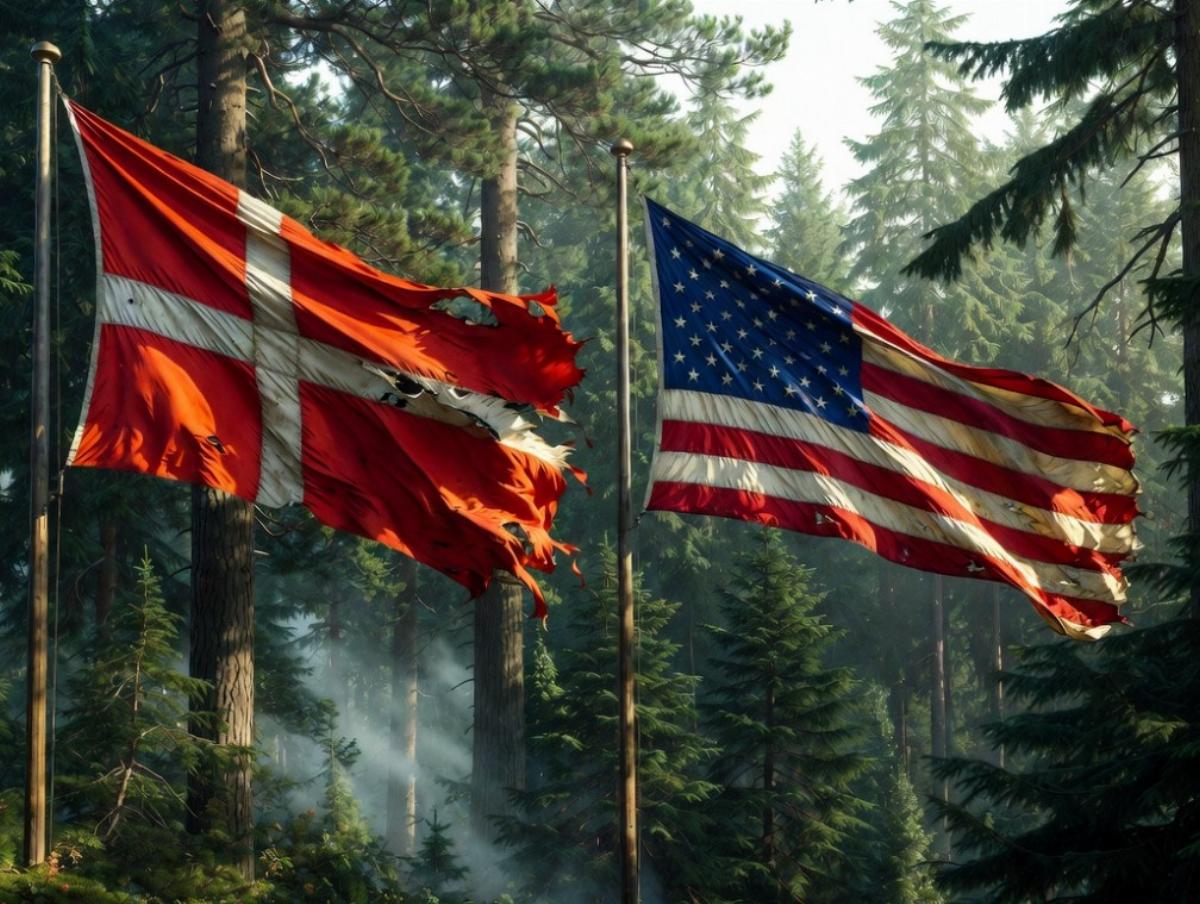
America’s 250th birthday has come and gone, but the taste of hot dogs has been replaced by the acid reflux of one Danish municipality’s act of political pay to play.
Read more Is America traveling down the road to another Holocaust?
The Rebild Festival in Denmark is the oldest and largest American Independence Day celebration held outside the United States.
The festival traces its origins back to 1912 when a Danish philanthropist purchased 200 acres of land not far from the Danish town of Aalborg and donated it to the Danish state. The gift came with one important condition. It was that the area should remain protected and serve as the site of an annual celebration of America’s Independence Day as a symbol of the friendship between Denmark and the United States.
Ever since then, the festival in the hills of Rebild has come to be a place for Danish-Americans to congregate.
For decades it has been customary for the U.S. ambassador to Denmark, selected embassy representatives, and sometimes a U.S. military band to participate in the program. I myself attended when I was the Commercial Counselor at the American Embassy some years ago. It was a wonderful, non-partisan, non-political event.
In 2026, however, the municipality of Aalborg decided it would place one big condition on its financial support of DKK 400,000 (approx. $60,000) for the event. It would only give the Rebild Society the money if it excluded all official U.S. government representatives, including the ambassador and U.S. military personnel because of the Trump administration’s policy toward Greenland.
The Rebild Society reluctantly accepted that condition in order to preserve the municipal grant, breaking with more than a century of tradition. (It should also be noted that President Trump’s written greeting had already been omitted in 2025 and again in 2026.)
Before we go any further and talk about the obvious “he who pays the piper chooses the songs,” it is important to remember that the Rebild Society continues to describe itself as a “non-political Danish-American friendship organization” whose mission is to promote friendship and cultural ties between the peoples of Denmark and the United States, not between governments.
That said, it makes Aalborg’s decision to exclude the American ambassador even more difficult to rationalize knowing that the organisation and the event are non-political.
Let’s break down the components of the issue: Does the municipality of Aalborg have the right to use taxpayers’ money to support cultural events? Of course it does. But should its decisions to withhold or disburse funds be based on a monolithic view of a foreign government whose current administration it disagrees with even when the organisation that would receive its support is non-political and non-partisan?
No, in my opinion, it should not.
Aside from the unfairness of the decision, it must be said that healthy democratic societies are not afraid of free speech and they depend on independent cultural organizations that are free to make their own decisions without political pressure from local or national governments.
Read more A word to the wise: Do not live near a snake farm
Of course, governments have the right to choose whether to support an event or not, but they should be cautious about using their financial support to shape events’ content or guest lists. If they do, then they are simply rewarding conformity and discouraging independence (the whole point of the Rebild festival is to promote independence, free speech and most of all, friendship).
It is ironic that the very thing that the city of Aalborg is protesting (the Trump “pay to play” concept by favoring some groups or key influential people over others) is the thing they, themselves, are guilty of by conditioning their funding on excluding official Americans from the event.
It is like hosting a birthday party for a friend but not allowing them to come to the party.
The hypocrisy is staggering. The city council’s decision has shown their willingness to politicize an event whose members have gone out of their way to be non-political for over a century. In doing so they created a double standard. It is that while all men are created equal, some are apparently more equal than others when it comes to promoting a particular point of view.
It is perfectly all right to dislike Donald Trump and to disagree passionately with his actions and statements, but to deny access to one of the festival’s two partner countries because of disagreement with an administration’s style or policies is most certainly a slap in the face of the American president (its obvious intention).
However, it is also, regrettably, a clear signal to millions of Americans in the U.S. and those in Denmark who proudly claim Danish heritage and who value the friendship between our two countries that our mutual relationship is now so fragile that a few small-minded people can destroy it without regard for a century of amity.
It is true that those who provide funding often expect influence. That may be perfectly legitimate in a private business relationship, but public grants are different. They are not private investments; they are taxpayers’ money intended to support activities that serve the public interest.
If a municipality conditions its support on who an organization may or may not invite, it moves beyond supporting culture and begins controlling and directing it. That raises an important question: Where is the line between responsible stewardship of public funds and political interference?
Today it may be the exclusion of an American ambassador. Tomorrow it could be a Ukrainian, Israeli, Palestinian or even a Danish politician. Once public entities begin deciding who is an acceptable guest, the precedent extends beyond the immediate controversy. The Rebild scandal is less about the Rebild Festival than about insuring the proper role of government in civil society. That goes for the US a.s. well as Denmark. Public funding should never become a tool for political conformity.
Stephen Helgesen is a retired American diplomat specializing in international trade. He has lived and worked in 30 countries over the course of 25 years under the Reagan, G.H.W. Bush, Clinton, and G.W. Bush administrations. He is the author of fifteen books, seven of them on American politics. His latest book deals with the Danish-American relationship, written in both Danish and English. He has written more than 1,500 articles on politics, economics, and social trends. He now lives in Denmark and is a frequent political commentator in Danish media. He can be reached at: [email protected].
Read more A military officer turns useful idiot
Image: Grok, ai-generated illustration