
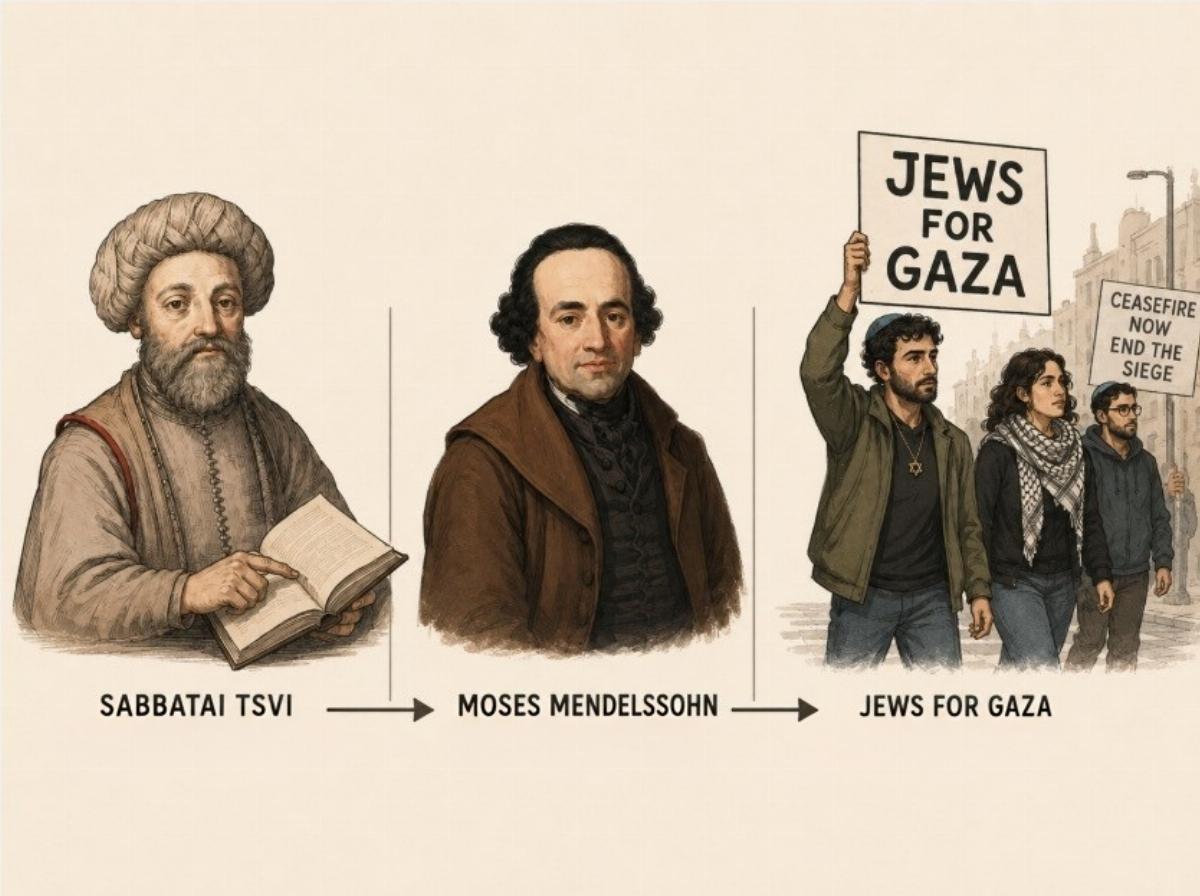
It seems strange that some Jews are antagonistic toward Judaism and Israel. They will demean Jews or the Jewish state and promote enemies of Judaism and Israel. Jews are also so associated with atheism, communism, and other “isms” that, even though they’re a minority in those movements, they seem prominent. Much, if not all, of that behavior is contrary to Jewish teaching but can be explained by examining Reform Judaism’s early days.
Read more Nolan’s Odyssey — Heading for a shipwreck?
Intriguingly, the Reform movement’s origins are shrouded. Many people know Martin Luther, Karl Marx, Thomas Jefferson, and others, what they wrote and started. Who were the early Reformers in Judaism, and what did they write?
This essay explains what Reform was, who started it, when, and what they were thinking. It should also explain why some modern Jews have radical, counterculture, and anti-establishment values. This is not meant to paint all Reform Jews with the same broad brush. The debt the world owes to the achievements of many individual Reform Jews is immense.
Still, it matters who the first Jews were to open the shop on Saturday or go to the theater on Friday night. This is a story about a few gods and maybe a reason for obeying the Commandments from Mount Sinai.
Jews have always believed that God chose Israel to be a nation of laws. Jewish teaching says that He created the heavens, the earth, man, a lawful teaching, and everything else.
We are told about a paradise and how man was banished from it. The teaching called Torah says the God of Israel is wrathful when His laws are disobeyed and especially wrathful when His people worship other gods.
In the 16th century, a Jewish mystic, Isaac Luria, formulated a system to explain existence. It came to him that when existence began, in a first epoch, there was a perfect mystical structure symbolic of an ideal. Then, because of Adam’s mistake, the structure shattered, and shards fell.
After that, the second epoch—our epoch—began. Luria believed Jews, by obeying Jewish laws, could retrieve the fallen shards. Retrieval would restore the structure and return paradise. Defiance—not obeying the ritual laws—would be called sin. Because of sin, man would continue to live in this second epoch, enduring reward, punishment, and death.
In the mid-17th century, Sabbatai Tzvi, an adherent of Luria’s system, believed he was the Jewish messiah who would bring about paradise. Ultimately, he committed the gross sin of converting to Islam, but his followers remained faithful.
To bring positive meaning to the apostasy, his followers began to interpret the Lurianic system differently. Knowing a rabbi in Gemara Sanhedrin (a commentary completed in the Fifth Century) believed the messiah would bring redemption if the Jewish people were either totally compliant or totally sinful, Tzvi’s followers chose ritual sinning to justify Tzvi. They behaved contrary to Jewish law as their path to redemption. They believed that, by his example, a third epoch, like the first paradise, would manifest itself.
Thus, because their messiah committed one of the worst sins in Jewish law, they believed that defiance should become a new ritual. His disciples believed that this behavior would retrieve the shards and restore the Lurianic structure like the first epoch.
They also believed that, like seeds that need to be concealed, they should conceal their behavior. This is one reason the origin of Reform was hidden. Families in this sect would meet in secret. In public, many appeared to be model citizens and even the most observant.
Tzvi’s followers thought that the God of redemption would be the same as the God of the first epoch, a time when there was no law, so no sin. Theirs was solely a God of creation, differing from the later God of Israel, who commanded obedience to moral and ritual laws and demonstrated wrath.
For generations, Jewish families would hide their Sabbatean roots, fearing to expose their disobedience. This helps explain Reform’s hidden origin. As the movement secretly grew, members became Maskilim (assimilationists), ushered in the Jewish expression of the Enlightenment (the Haskala), and led reforms defined by defiance.
Read more Could Deep-Sea Mining Break China’s Stranglehold On Critical Minerals?
In the early eighteenth century, in Dessau, Germany, there was a book publisher named Benjamin Wulff, who had earlier been banished from another town for promoting a Sabbatean. Wulff was an older relative of Moses Mendelssohn, widely considered the “father” of reform.
Mendelssohn moved to Berlin as a youth and came under the Maskilims’ tutelage. He became interested in the new rational philosophy and became a disciple of Gottfried Wilhelm Leibniz and Christian Wolff, neither of whom was Jewish.
Leibniz and Wolff’s non-Biblical “natural” philosophy inspired disciples who created a new god. This god supposedly created the world with natural laws. The logical perfection of mathematics was one proof of its intelligence. They believed that this god ultimately abandoned the world, indifferent to its creation.
Mendelssohn later met a non-Jewish deist named Gotthold Ephraim Lessing. Deism had been created a few decades earlier and, as part of its belief system, had a hand in creating this non-Biblical, nature-centered god. It was Lessing who published Mendelssohn’s first philosophical writings.
The Deist god was like a watchmaker. Deists believed their god created the world with motion and that it could be understood through human reason. To them, reason alone could explain existence and unify mankind.
When debating Christians about Deism’s superiority, Deists ridiculed miracles in the Torah (aka the Old Testament). Ridiculing Jewish teaching was a tenet of Deism because miracles defy reason. Deists attacked Judaism to discredit Christianity. Just like the god of Leibniz and Wolff, the Deist god was indifferent.
Moses Mendelssohn found fame by writing a book that explained the immortality of the soul in a rational way consistent with the new philosophy. The book introduced non-Jewish beliefs to a wide audience of Jews and Christians.
Mendelssohn tried to transform the concept of the wrathful God of Israel into an indifferent god akin to the Deist one. He believed that the God of Israel was actually two gods: the God of creation associated with the first epoch, and the moral, judgmental God of the Noahide period and the Exodus.
Mendelssohn combined Deistic and Sabbatean thought. The indifferent Deist god was like his relative’s Sabbatean god. Either way, there would be no commandments, no defiance, and no sin. Both the Sabbatean and Deist gods were indifferent to human behavior. There would be no punishment or fear of wrath.
Mendelssohn taught Jews that they could behave according to their own “reason” as opposed to Jewish law. According to these new god concepts, Jews were encouraged to defy Jewish ritual law as they pursued life aligned with individual reasons. Mendelssohn’s writings, which blended Deistic and Sabbatean thought, created Reform Judaism. By rejecting Jewish ritual and a moral God in favor of an amoral natural world created by an indifferent God, Mendelssohn laid the foundation for Reform’s permission to counter other forms of establishment and cultural norms for any reason.
Note, too, that these new ideas were not confined to Jews. They reached all Western societies, which happily rejected morality and the Jews, as demonstrated by both pogroms and the Holocaust. God’s moral imperatives and his wrath were replaced in matters both large and small with a natural law that said God didn’t care, so why should we?
Rather than ‘Who is a Jew?’ the question today should be, ‘Who is your God?’ When miracles and the wrath of the God of Israel were demeaned, fundamental Jewish concepts were forgotten. Fear of God became legend and myth. Jewish law became tradition.
Institutionalized violation of Jewish ritual law helps explain why some modern Jews have antipathy to Jewish rituals and Israel. The reforms defied first Jewish law and then convention in general. This explains why some of today’s Jews behave contrary to what otherwise might be expected of a Jew.
Read more Why I Still Believe In America
Image created using AI.