
I have a friend I hold in high esteem: well-read, worldly, educated, and ever-thoughtful. Recently, she told me she has lost faith in America. In part, she wrote:
Read more Don’t Waste America’s Best Chance to End the Opioid Crisis
“America saved the Jews during WWII, but my point is that for all our blood and sacrifice, the world has thrown it away in the last 20 years. Is the world now better than it would have been but for America? I don’t think so—and I would have given a different answer before the year 2000.”
She’s not alone.
Arguably, this is one of the most pessimistic periods in our history. More than half of us have concluded that the country has passed its peak. Our institutions are failing, culture is unraveling, politics are irreparably broken, and the world America built after World War II is no longer recognizable.
I understand why they feel that way.
We see rising hostility toward our institutions, growing antisemitism, contempt for success, attacks on capitalism, and a political culture increasingly attracted to movements promising to tear everything down. We watch leftist candidates with remarkably shallow records of accomplishment defeating incumbents. Experience is dismissed as disqualifying rather than evidence of competence. Accomplishment is condemned where it should be admired.
America has lost its bearings.
I understand the temptation to believe my friend is right. I simply think she’s reached the wrong conclusion. America has never been great because it has avoided periods of turmoil. It has been great because it possesses an extraordinary capacity for self-correction.
That capacity is not an accident.
By the end of World War II, America stood as the undisputed leader of the free world. In prior decades, we had broken from Britain, established a constitutional republic centered on the revolutionary ideas of individual liberty and God-given rights, and then proceeded to build the most prosperous society the world had ever known. Millions who chafed under the rigid hierarchies of the Old World risked life and limb to come here because America rewarded initiative, work, risk, and personal responsibility, not birth or privilege.
Success was never guaranteed, but opportunity was everywhere for those willing to seize it. Those principles—America’s secret sauce—remain firmly in place.
Yet those same principles have never restrained Americans from making poor political choices. History suggests we sometimes become frustrated enough to embrace dead-end ideas.
The rise of today’s progressive movement should not surprise us. It’s built on poor Uniparty policies that have made housing unaffordable, healthcare incomprehensible, higher education both overpriced and unable to guarantee marketable skills, government unresponsive, and opportunity uneven.
While those frustrations are real, bear in mind that frustration is an impulse while judgment requires discipline. Political movements gain power by leveraging public anger, but can remain in power only if they can deliver.
Running a campaign and running a country are entirely different. Campaigns reward passion, slogans, and the ability to exploit grievances. Governing rewards competence, judgment, and experience; balancing budgets; management skills; and accepting responsibility for outcomes rather than intentions.
This is where I believe today’s progressive movement reveals its greatest weakness. Many of its rising stars arrive in positions of responsibility with little to no managerial experience. Their backgrounds reveal advocacy, activism, campaigning, and rhetoric, not building organizations, creating jobs, or managing complex budgets.
Criticizing institutions and leading institutions require entirely different skill sets.
Representative AOC’s opposition to Amazon’s proposed headquarters in New York City illustrates the distinction. Governing should have required weighing the thousands of jobs, billions in private investment, future tax revenues, and the signaling it would send to others. Governing is not merely opposing; it requires accepting responsibility for the consequences of those decisions.
History repeatedly demonstrates that ideology, moral certitude, and verbal skills cannot substitute for competence. Ultimately, every political movement encounters the same test: reality. Results, not intentions, become the standard by which citizens judge their leaders.
Americans are not alone in choosing leaders who reflect frustrations more than qualifications. Passion masquerades as competence, and rhetoric can temporarily substitute for results. Governing, however, exposes the difference. Governing is an unforgiving teacher. Elections are promises; governing is performance. When performance falls short, Americans will throw the rascals out.
If my friend is right, then America has lost the very quality that once made it exceptional. I don’t believe it has.
Read more Hubris Sinks Canada
That, more than anything else, explains my optimism.
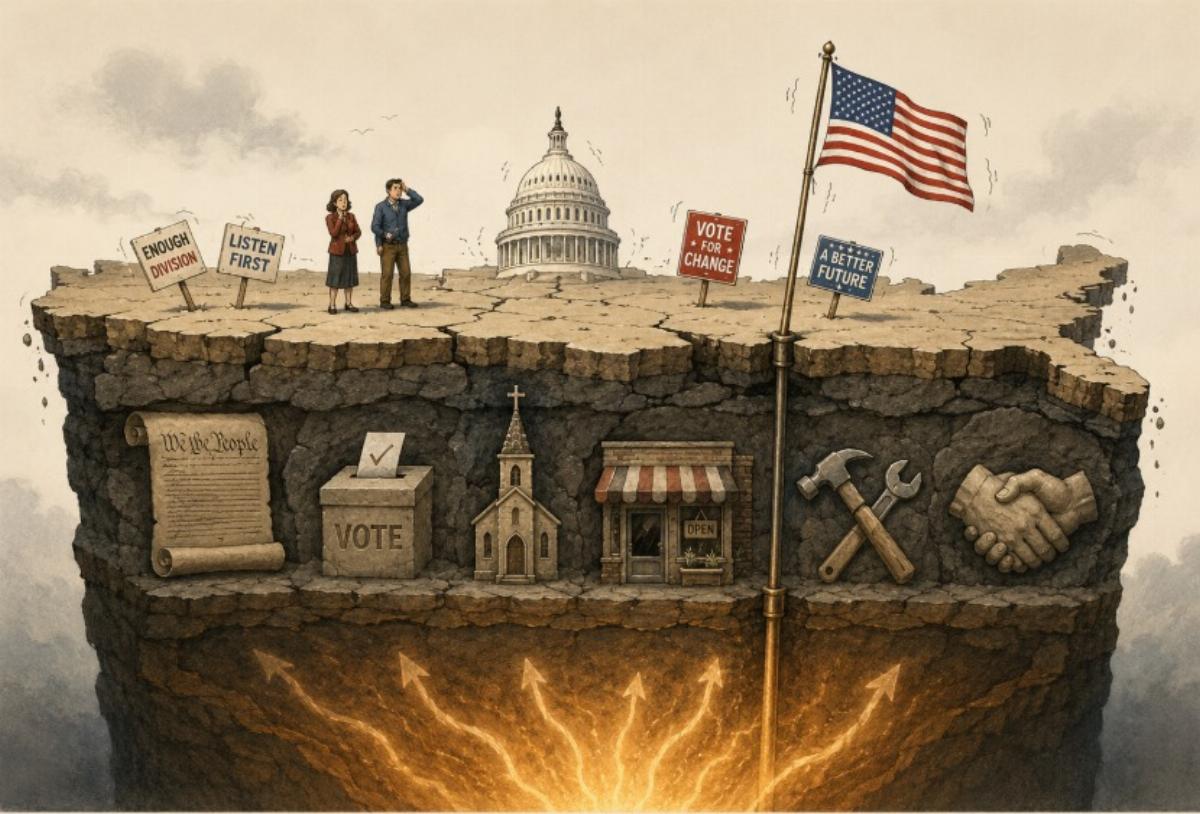
Visualize America as a continental plate. Massive. Consequential, fixed. Surface events create the illusion that everything is changing overnight, when in reality the country’s deepest strengths evolve over generations, not election cycles.
That is why our history matters.
Again and again, Americans have concluded that something fundamental had to change—not through revolution, but through sustained civic action.
When the government failed veterans after World War I, they became the Bonus Army.
When millions of Black Americans concluded the government would never change, they organized the Civil Rights Movement.
When taxpayers believed the government had become insatiable, they launched one of the largest tax revolts in American history back in the 70s and 80s.
Causes may differ, but the pattern remains consistent generationally.
Americans organize. They mobilize. They persuade. They vote. They sometimes take to the streets. And eventually, they force institutions to respond. That recurring pattern is one of the least appreciated features of American history.
America’s greatest strength is not that we always choose wisely; it is that we eventually discover when we have chosen poorly.
We can survive bad ideas because we are free to reject them, replace poor leaders through elections, and abandon failed policies once reality exposes their shortcomings.
That is why I remain optimistic.
My friend is looking at roughly the last twenty years.
I am looking at the last 250.
We’ve endured revolution, civil war, economic depression, political corruption, racial injustice, social unrest, assassinations, foreign wars, terrorism, and moments when thoughtful people lost faith in our system.
Yet the country repeatedly found a way to correct itself—not because our leaders were always wise, but because free people eventually demanded better.
General Douglas MacArthur once recalled that a senior Japanese officer told him:
“You Americans are so easy to underestimate. You have a strength that does not show on the surface.”
I believe he was right.
Our adversaries—and, unfortunately, many Americans—mistake today’s turmoil for permanent decline, misunderstanding our history.
Think of America as a continental plate.
Slow to move. Difficult to redirect. Seemingly immovable—until enough pressure builds beneath the surface. Eventually an earthquake resets our table.
I believe that pressure is building once again.
Americans eventually recognize when promises prove hollow, when ideology collides with the realities of governing, and when competence matters more than slogans.
When that moment comes, they do what they have always done; they correct course. I believe they will again.
God Bless America.
Image created using AI.
Author, Businessman, Thinker, and Strategist. Read more about Allan, his background, and his ideas to create a better tomorrow at 1plus1equals2.com.
Read more They want reparations, and they’ve come to collect