
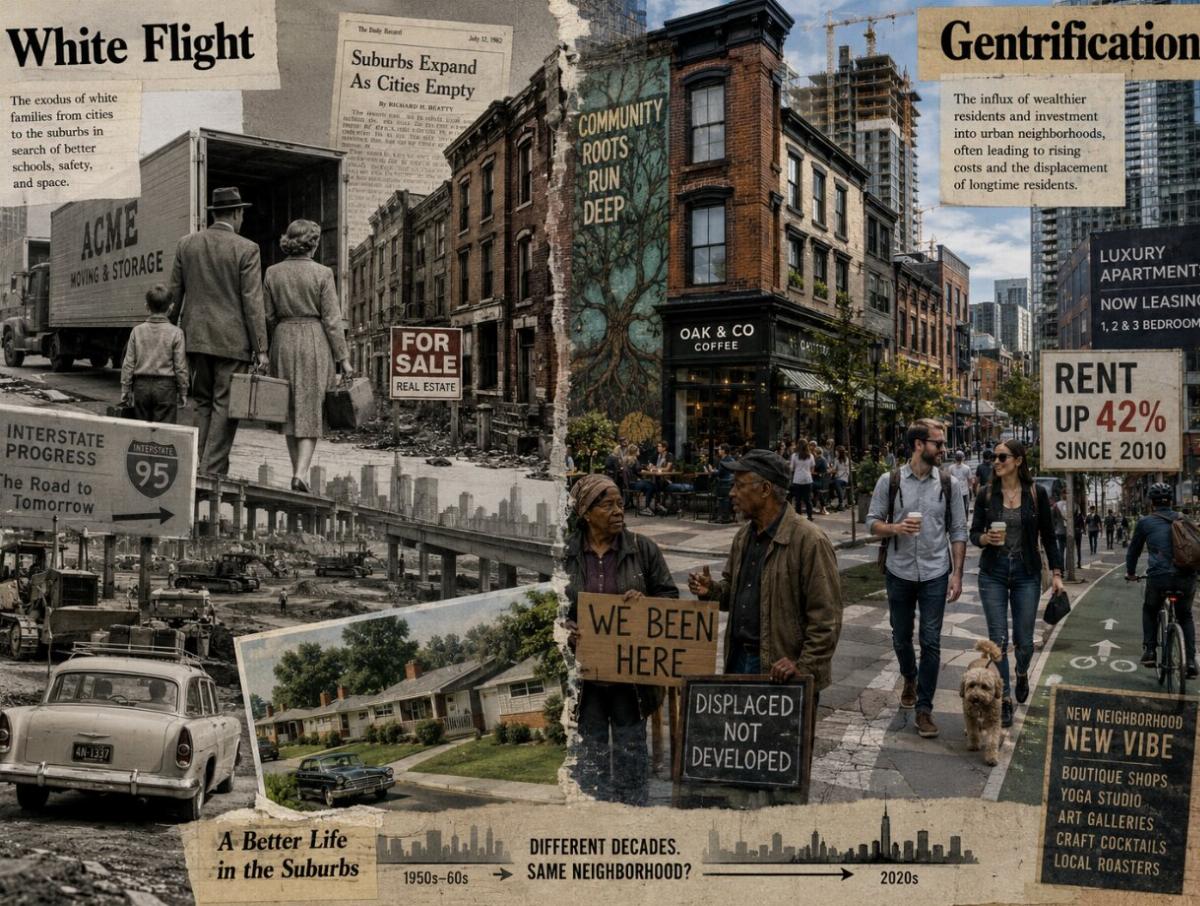
Nothing has been lied about more than the cause and impact of white flight. Likewise, the same could be said about the reverse tide under gentrification. In both cases, a history of these tsunami-like demographic transformations has yet to be honestly recounted. I will try to provide a condensed account of this history, describing the factors driving its course.
Read more Here’s why women like gay movies
To start, one must get a feel for the radical transformation our cities have undergone from the 1940s onward. A glimpse at a yearbook circa 1938, of any city school, will inform you that the demographic makeup of the student body was predominately white. In less than 50 years, with the migration of Southern rural blacks into Northern urban cores and the exodus of whites to outlying suburbs, the same high school yearbook would show a predominately black student body.
How could such a transformation happen in such a relatively short period of time? The answer is not particularly flattering to the new arrivals. Contrary to the popular wisdom behind the white flight myth, white homeowners’ fear was not unfounded. Evidence was accumulating in subtle and not so subtle ways that life in these once comfortable neighborhoods was deteriorating. Subtle in that, your new neighbor’s yard might show signs of neglect, not so subtle in that tools might mysteriously disappear from your garage. When it advances to your kids being shaken down for their milk money at school and your car or home getting broken into, you start to reassess your options. One of those might be moving to a new home in the suburbs, and many did.
White flight was often uneven in its flow. Young families were the first to leave and older couples were the last, but inevitably the neighborhoods became unlivable for even the staunchest diehard.
With physical deterioration, crime, and eroding city services, the older core neighborhoods lost their appeal to their original inhabitants, but not to everyone. By 1980, many potential investors started to sniff a bargain. A logic was forming that if there were some way to entice the new black residents to move, these neighborhoods might be restored to their former glory. However, it would take a new breed of homeowner to pull it off. It would take a pioneer. So, it was left to young single professionals who could tolerate more disorder than families, to fuel the first adopter stage of the gentrification movement.
One must remember in those early days that it was risky business sinking money into restoring a dilapidated brownstone in Brooklyn with welfare-dependent neighbors looking on your endeavor with stupefying disbelief. Although we now hear only of the success stories, gentrification efforts could stall as investors despaired of ever seeing a return. Many pioneers received arrows in their back since crime would not decline until critical neighborhood mass was reached in the 1990s.
Read more Point of no return
One knew that gentrification had reached a mature level when in 2014 movie director Spike Lee became one of the most vocal, high-profile critics of gentrification, particularly in his hometown of New York City, condemning the displacement of long-time black residents in historic neighborhoods like Brooklyn’s Fort Greene, Harlem, and Bedford-Stuyvesant, while criticizing the lack of respect shown by affluent, mostly white newcomers.
Spike’s condemnation is humorous if one considers what blacks did to make all those areas “theirs” to begin with. Brooklyn wasn’t always black; they drove out the white people through violence. Now Spike Lee claims “their” area is sacrosanct?
I might poke fun at the white hipster crowd moving into the city displacing the former black residents, but at least they buy up a neighborhood legally, instead of terrorizing the inhabitants to flee through criminal violence.
So, there you have it, the condensed version of the history of white flight and gentrification. I am sure that there are many who would refute my version, but placing blacks as victims in a narrative about white flight and gentrification is laughable.
Read more Yesterday’s purges, today’s primaries
Image generated by ChatGPT.