
As late as 2025, the governments of Russia and Pakistan (you know, the country that’s now brokering peace between the US and Iran) offered verbal defenses for Iran’s right to establish and develop a nuclear energy project “for peaceful purposes.” Also, as late as 2025, UN Undersecretary-General for Political Affairs Rosemary DiCarlo called for diplomacy and dialogue to ensure the peaceful nature of Iran’s nuclear program. And many listened.
Read more Declaration of Independence – A reminder of its importance
A casual exercise in simple logic might cause one to arch one’s eyebrows here, for one might ask why a country sitting on oceans of provable petroleum reserves would want to generate electricity by nuclear means, with the risks involved? Ask any resident of Fukushima or Chernobyl.
But then came the devastating attacks on the Iranian nuclear program infrastructure, first by Israel and then, more immensely, by the US in 2026. One might think that if one wanted nuclear power plants— as opposed to oil- and gas-powered plants—to keep Tehran well lit and warm, one might seriously reconsider things, given the supremely escalating costs of such power per kilowatt hour, courtesy of airstrikes.
And yet the world sees an Iranian hierarchy that steadfastly refuses to give up its nuclear fuel and its nuclear enrichment program. The “peaceful nuclear program” gambit is getting long in the tooth, one might say. Even for the most compliant elements of the US and World media.
I have heard the relativistic arguments asking who the U.S. thinks it is to refuse a country’s nuclear desires, given our own nuclear arsenal. Aside from the moral bankruptcy of relativism, one always needs to ask the person who insists on a gun whom they intend to shoot.
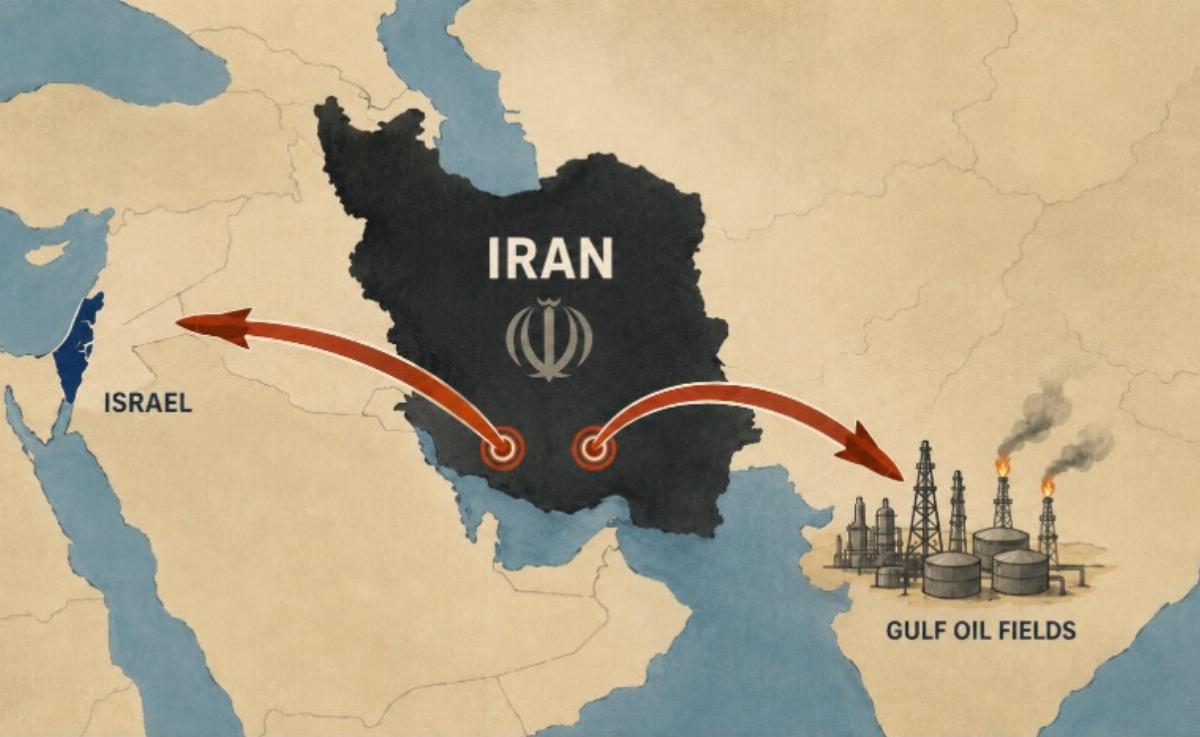
In the case of a nuclear Iran, there are only two targets—one that gets a lot of attention and another that gets none. The target most discussed is, of course, Israel.
For geography-challenged Americans (~97%), consider that Israel is only about 3 times the size of the state of Delaware, and 1/3 is useless desert. Moreover, its major metropolitan center—Tel Aviv, with 1.5 million people—accounts for almost 20% of its whole population, a concentration that no US city comes close to holding.
In other words, a nuclear detonation above or in Tel Aviv decimates Israel…twice, actually. This one simple overlooked fact accounts nicely for any Israeli leader’s seeming obsession with a nuclear-defanged Iran.
Read more The American World Cup: 78 Super Bowls
But that’s potential target #1. Just an Israeli problem for sure, if one wishes to be cavalier concerning 1.5 million Jews.
The world, however, might want to focus on Door #2. This would be the Saudi oil fields. Sounds extreme, but consider the implications of a nuclear detonation over a sea of crude oil.
A nuclear detonation in Saudi Arabia (or Kuwait, or the UAE, or Iraq) would contaminate, if not incinerate, a huge portion of the earth’s oil reserves. And consider that Iran has demonstrated no compunction in sending missiles and drones against its Arab neighbors. In a millisecond, the Middle East Islamic balance of power would be forever shifted to Shia Islam and away from Sunni Islam. Score two for the Iranian mullahs.
Score three, actually. Overnight, the price of oil would triple. The treasuries of Tehran—and Moscow—would also then grow enormously. And for decades.
Of course, there’d also be an environmental catastrophe of biblical proportions, but then again, Tehran and Moscow don’t have powerful Green Parties to distract their leadership.
In summary, a total take-down of the Iranian nuclear program isn’t merely an Israeli problem or a US problem. It is a world problem. And the world’s inability and/or unwillingness to deal with it—fully and finally—should terrify all.
Read more That bonded minute
Image created using AI.