
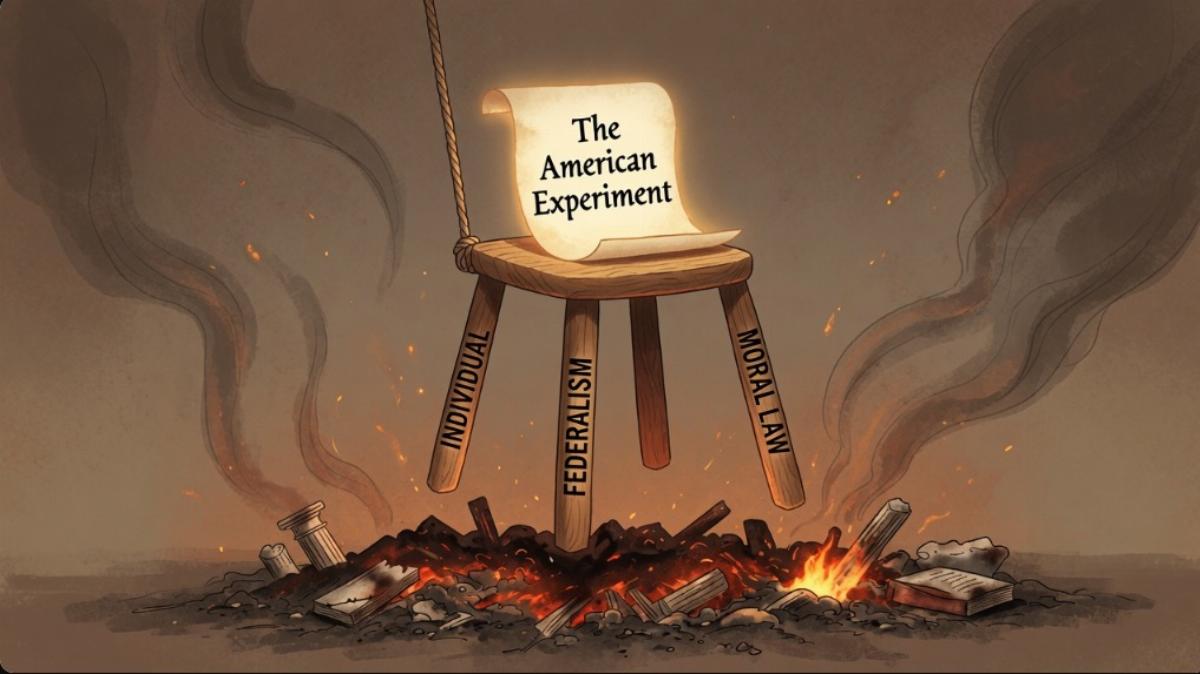
Dangling atop the smoldering burn pit of history is the American experiment of 250 years. It dangles atop what history we know, not what history has, unfortunately, been lost over time.
Read more The Climate Scenario Behind A Decade of Alarmism Is No Longer Considered Plausible
What is that experiment? What do we mean by the phrase “the American experiment”?
We mean three separate philosophical legs to the stool of governance and civil society:
1. The development of the person, not the group to which the person belongs
2. Moral Law as the highest law of the land
3. Federalism as the governing structure most amenable to liberty
Certain historic figures stand out in the development of this experiment.
Basil Cardinal Bessarion (1399?-1472)
When the Catholic Church split by schism in 1054 into the Latin (Western) version and the Greek (Eastern) version, it was militarily weakened. The debate causing the break involved whether the Holy Spirit comes from the Father alone or from both the Father and the Son as equals.
While the distinction may seem small to us now, it was not small then. The Eastern church in Constantinople (now Istanbul in Turkey) could not withstand a Muslim attack in 1453 (even with some help from Rome) and was destroyed. This event marks one of the large turning points in the development of the West, not for its sheer devastation, but for its inadvertent nudge to a backward Europe toward a prolonged journey in search of human betterment.
From around 3 BC to 1 BC, original scripts authored by Greek philosophers, poets, and mathematicians, among others, were housed at the Library of Alexandria in Egypt. After several centuries, these precious documents began to be slowly transferred to the eastern Catholic Church in Constantinople and would have been destroyed in the attack of 1453 but for the efforts of Cardinal Bessarion who helped remove them from harm’s way. Lost would have been Plato, Homer, Sophocles, just a few of the Greek geniuses of their time, and lost would have been the impact of these minds on Europe and the emergence of the Renaissance.
It is the Renaissance—1400 to 1600—with its acceleration in scientific observation, intellectual excellence, and innovative invention, that forms one basis of the philosophical undergirding of the American experiment. By saving Greek intellectual thought, Cardinal Bessarion brought Plato to the discussion in Europe regarding the development of the person, and that discussion and debate guided America’s Founders as they tried to create a realistic governing system for the new nation.
Read more Queers for Palestine
William Bradford (1590-1657)
Heading for northern Virginia but landing in rocky Massachusetts on November 11, 1620, it is not only William Bradford’s revolutionary leadership of the Pilgrims that matters, but it is also the effect on America of the book he brought with him: the Geneva Bible.
Virtually forgotten until a painstaking revision was published in 2007 to commemorate the settlement of Jamestown, Virginia, in 1607, the Geneva Bible is the first English translation of the Old and New Testaments and was first published in 1560 and dedicated to Elizabeth I of England. Its uniqueness is not just the painstaking translations, but also the annotations in the margins that helped everyday readers understand Biblical meaning in what was called at the time the “vulgar tongue.” And so, with an angry crew ready to mutiny and return home, William Bradford, with the Geneva Bible in mind, created the first founding document of the American experiment, the Mayflower Compact:
“We do covenant and combine ourselves into a civil body politick.”
We do ordain and establish this Constitution
“For our better ordering and preservation.”
To ensure domestic tranquility, [p]rovide for the common defense
“To enact such just and equal laws”
Establish justice
“For the general good of the colonie”
To promote the general welfare
While wrapped in Christian overtones, this is basically a secular governing contract asking those consenting to it submission and obedience to the rule of law. William Bradford led the struggling Christian commune with the Geneva Bible in one hand, burial shrouds in the other, and left no doubt that one basis of the American experiment is a belief in and an adherence to the Moral Law of the Old and New Testaments of the Bible. The Bible, in its many versions, remains the basis of how we know right from wrong as individuals in a “civil body politick.”
Also, certain concepts developed by many historic figures, including ancient Greek philosophers, stand out in the development of this experiment.
One of those concepts is Federalism. The American experiment is not about democracy. Democracy was feared by the Founders, who knew that ochlocracy was as dangerous as tyranny. The US Constitution protects minority geography through the Electoral College and the even number of Senators for each state. Without the concept of Federalism, with its horizontal (separation of power) and vertical (state vs national) divisions of power, mobs might rule America under the guise of the democratic. This unique governing concept was weakened by the US Supreme Court. It should be restored and applied by the current Supreme Court as we celebrate our 250th year dangling atop the smoldering burn pit of history.
Read more Mamdani accused of ‘laundering antisemitism’ in AIPAC attack
Image created using AI.