
Allow me to deliver the good news about antidepressant usage. After being on a sustained climb upwards since 1990, antidepressant usage has leveled off and even shows signs of abating somewhat (see Figure 1). Antidepressant usage, which peaked at almost 20% of the female population and 10% of the male population, has now dropped to 15% and 7.5%, respectively. However, one must put this news in perspective since antidepressant usage was under 2.5% for females and 1.25% for males in 1990, according to the CDC (here, here, and here).
Read more Peak media hypocrisy: Outrage at Trump’s deportations, silence on Biden’s secret flights
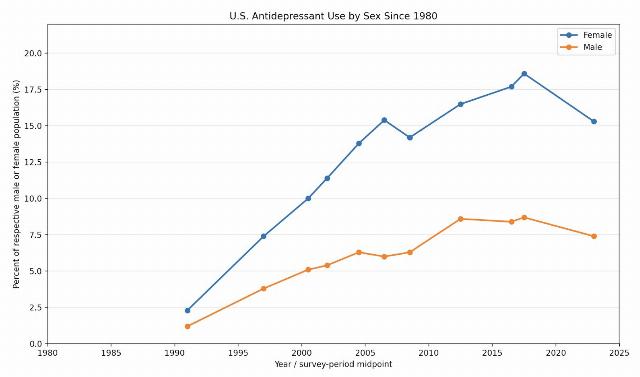
Figure 1
My theory has been and remains that antidepressant usage is a social contagion. Young women and men (to a lesser degree) were influenced by a societal craze that espoused:
- That feelings of sadness, depression, and hopelessness were aberrant emotions indicative of a chemical imbalance in the brain,
- That pharmacological wonders, such as SSRIs, could correct this imbalance,
- That societal stigma about mental illness was holding people back from receiving the treatment that they needed, and
- That the current family of antidepressant drugs came with none of the risks associated with past antidepressant treatments.
All four of those premises on which the current wave of antidepressant usage was greenlighted were false.
For one, where does someone come up with the notion that life is not filled with sadness? Writers in the past often referred to life as being viewed through a “veil of tears,” meaning a state of sorrow, suffering, or grief that obscures one’s view of life—as if tears form a veil over the world. Why would anyone be immune to the disappointments and tragedies that come with living? Paradoxically, as these decline in society at large, individuals inflicted with one of them feels resentful that they have been singled out by fate. However, just try to imagine the pain and suffering our forbearers must have experienced with the death of a child, which was an all too common experience prior to the modern era?
Secondly, I guess one could refer to all emotions as chemical in nature, but as for referring to a particular emotion, like sadness, as a chemical imbalance, that is pushing definitional limits. It may be that sadness plays a vital role in evolutionary psychology and maintaining social fitness in a way that we do not fully fathom.
Read more Can Spencer Pratt win?
Thirdly, where is all the test data proving the serotonin hypothesis regarding the biochemical basis of depression? There never was any convincing evidence. The serotonin theory of depression is not empirically substantiated.
Fourthly, the premise that societal stigma about mental illness was holding people back from receiving treatment is conceivably true, but if the treatment is worse than the disease, then the societal stigma served a purpose, just as societal stigma against single motherhood, promiscuity, and homosexuality serves a useful purpose. I refer the reader to the reference about Chesterton’s fence in Smoking, obesity and Chesterton’s fence.
Lastly, the hope that a new family of antidepressant drugs would carry none of the risks that accompanied its predecessors was just wishful thinking on the part of medical authorities. We now know that these drugs have terrible risks from long-term usage.
However, my all-time favorite is the incidence of medical professionals prescribing SSRIs to young women who shun the idea of childbirth because of their fear of global warming. I refer the reader to Using climate change as an excuse.
Read more Big Oil strikes back
Please read in addition: The Prozac craze and the chemical imbalance myth.
Image generated by ChatGPT.