
As regular readers know, I’ve been completely off from work for almost three weeks so that I could travel to the Far East to help with my new (and first) grandchild. Helping with a newborn tends to put everything in perspective because that fragile little being’s survival is the single most important thing on the agenda. Paying attention to the news took second place to offering whatever practical help I could.
Read more How a bad capitalist handles competition
Nevertheless, because I’m compulsive, I tried to stay abreast of developments in the Middle East whenever I had downtime. That meant I was about 80% aware of the Memorandum of Understanding (“MOU”) with Iran, JD Vance’s (and, apparently, Trump’s) attacks on Israel, and the raging debate about whether the MOU is a good thing, a meaningless thing, or a disaster. I’d like to think that my emotional distance from the whole thing may offer some perspectives that could assuage people’s concerns.
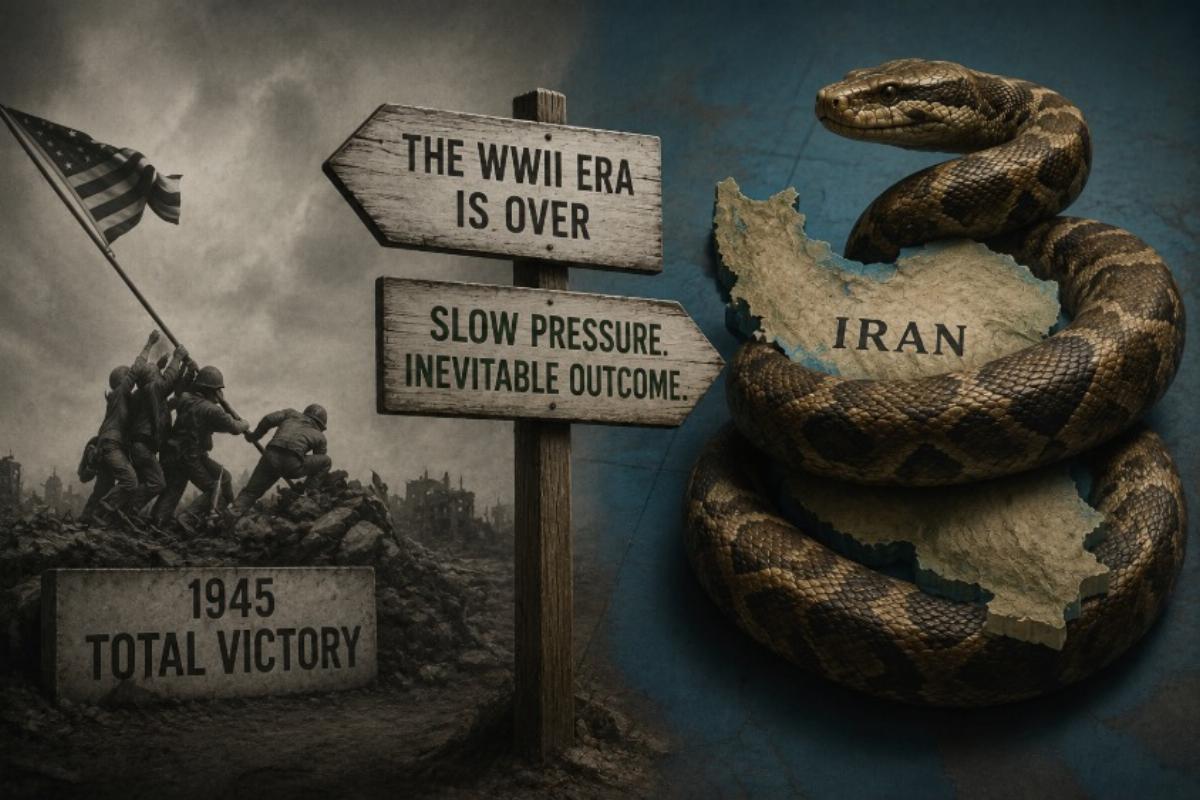
Those of us who saw Iran as an existential threat wanted a total victory (Hitler’s bunker suicide or Hirohito’s complete surrender). Then, we imagined, the free people of Iran would dance in the streets, the Strait would become an uncontested thoroughfare, and all would be joyous across the world.
However, we don’t live in 1945. During WWII, most Americans supported the war and were willing to fight for total victory. It wasn’t until the Korean War that America embraced the idea of fighting not to victory but to unsatisfactory stalemates. This was, in part, because communists began to make inroads into the Democrat party. By the Vietnam era, large segments of young America—people who became the next generation of politicians, teachers, journalists, and entertainers—had concluded that America and its values were not worth defending.
Their views were reflected in a Democrat political class that refused to fund or otherwise support our wars. Democrats, whether in Congress or the White House, snatched defeat from the jaws of victory in Vietnam, Iraq, and Afghanistan. On the battlefield, our military won wars; in Washington, our politicians lost them.
Moreover, thanks to our experiences in Iraq and Afghanistan, we learned that occupying Muslim countries after incomplete, sort-of victories is a dead end. Because we cannot rebuild those cultures from the ground up as we once did (political correctness makes that impossible), we are never more than an alien force hanging on by our fingernails, just waiting for a Democrat president to give away the blood and treasure.
Donald Trump went into Iran (something he couldn’t have done without Israel) with a goal that he achieved and a hope that proved false. The goal was to defeat Iran militarily, and, for the most part, the American and Israeli militaries achieved that goal. Iran’s weapons industry, including its nuclear program, lies in ruins; its air force and navy have been almost destroyed; and three levels of political and military leaders have been killed. (Destroying Kharg Island’s oil infrastructure would have been satisfying, but Trump couldn’t risk the political fallout from a collapse in part of the world’s oil supply, not with the midterms coming up.)
But after the military victory, then what? The Democrat half of the country, including those in Congress, believes that Iran is the good guy and America the bad guy, and that view has support from the Tucker Carlson wing of the Republican party. Trump’s articulate vice president seems to have an affinity for that wing, including its hostility toward Israel. With the midterms coming up, Trump cannot afford to wage a winning but increasingly unpopular war.
The Iranian people, despite America’s military victory, are too fearful to rise up, given that the IRGC still wields deadly power—and, apparently, regional allies didn’t help. (Moreover, as someone smart—although I can’t remember who—pointed out, most Iranians know nothing other than the mullahs’ rule. It’s their normal.)
Read more How Do We Balance the Federal Budget?
That leaves Trump with only one option: a slow squeeze, coupled with the continuous threat that the Iranians will go too far, thereby justifying renewed military operations against key infrastructure. In that regard, I think that James Lindsay is on to something:
I’m still chewing on this “deal” and trying to figure out what the strategy is supposed to be, obviously given a shortage of information. I’m starting to think it’s similar to Reagan’s strategy that choked the Soviet Union, which Aleksandr Dugin describes as an Atlanticist… pic.twitter.com/24uJqx2aWi
— James Lindsay, anti-Communist (@ConceptualJames) June 16, 2026
(This is a really long tweet, so I won’t reproduce it here, but the gist is that, while the deal looks as if it favors Iran, it actually locks the regime into a box from which there is no escape. Do try to read the whole thing.)
As for the “war” between the Trump administration and Israel, I wonder whether it’s real or whether it’s a deception operation. Iran was always going to be more willing to sign the MOU if it believed doing so would isolate Israel.
Maybe I’m naïve, but I have trouble believing that Jared Kushner and Steve Witkoff, both Jewish, would negotiate an agreement that threatens Israel. Moreover, the deal forces the Gulf states to have skin in the game, and that is going to push them closer to Israel, strengthening rather than weakening Israel’s position. If I’m right, JD Vance is the bad cop rather than a Tucker Carlson cutout. (And gosh, I hope I’m right.)
In the face of all the guesswork and confusion, I hang on to a few things: Total WWII-style victory was never going to happen; Trump is dealing with a domestic fifth column that comprises almost half of Congress; Iran’s mullahs are significantly weakened; Trump must get fuel prices down to win the midterms; Iran will never abide by the agreement, in which case Trump can (and must) attack its infrastructure; and, while all three negotiators put America’s interests first (as they should), two of them are unlikely to sell Israel down the river.
UPDATE: It seems I wasted my time writing this essay. I was listening to Victor Davis Hanson while I was walking the dog, and discovered that he pretty much said what I wanted to say, only better, of course:
Read more What the Iran MOU Is Really All About
Image created using AI.