
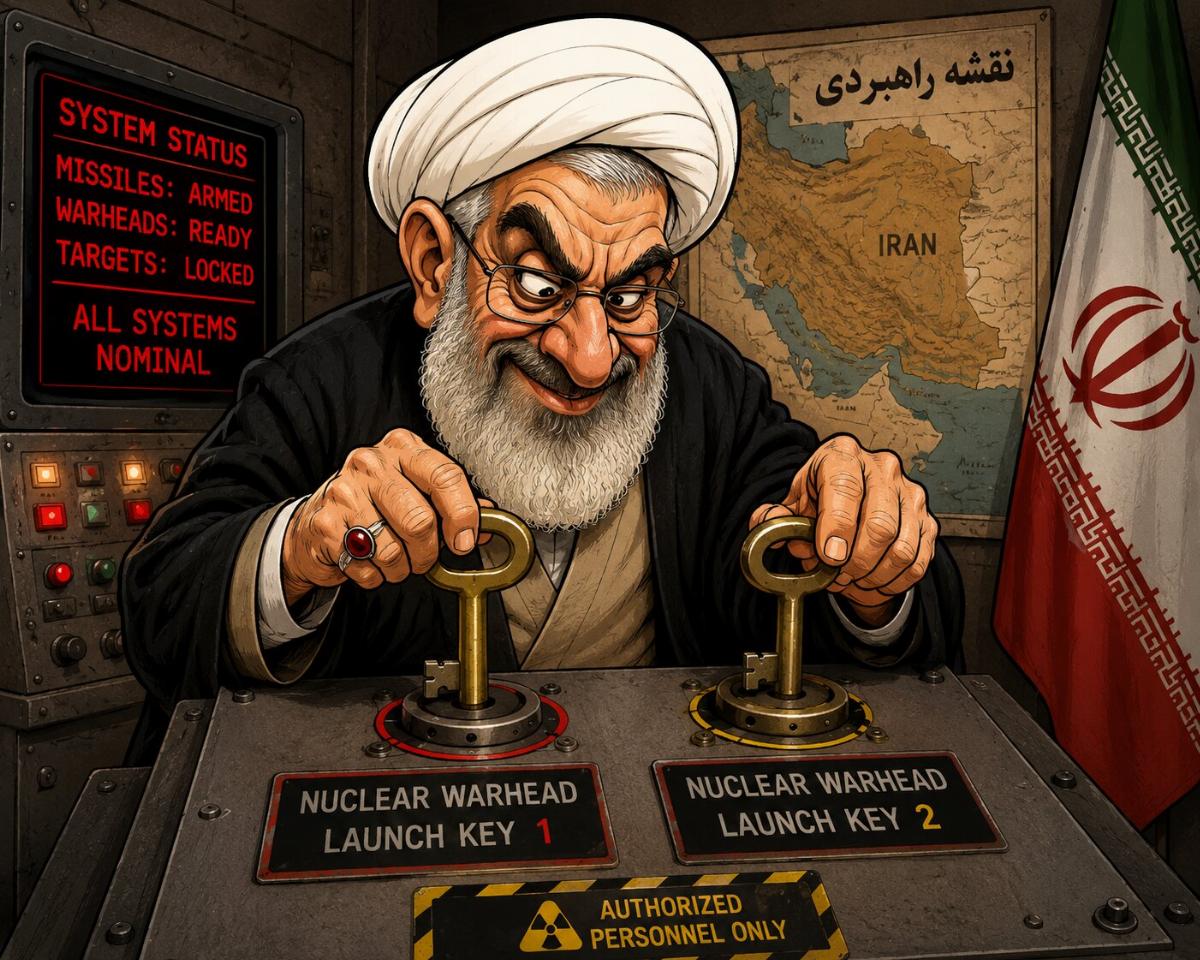
If a former CIA agent’s report is accurate, Iran may find itself making a decision the U.S. was faced with making in 1945. The agent, Larry Johnson, revealed that Pakistan’s Foreign Minister personally delivered a disturbing, secret message to Secretary of State Mark Rubio claiming that Iran does possess a nuclear weapon. He also reports Tehran intends to demonstrate soon this capability to the world community. The immediate question obviously is just how Iran intends to demonstrate it?
Read more Democrats cheating again, sun still setting in the West
In 1945, during World War II, the U.S. had to decide how to demonstrate to Japan it possessed an atomic weapon, developed under the Manhattan Project. Due to the weapon’s never-before-seen destructive power, President Harry Truman weighed all options on how best to do this, as Japan was a country historically known for its unwavering warrior mentality that defied surrender.
One of those options was to invite Japanese officials to witness the weapon’s testing, allowing them to see its destructive capability firsthand. While such an option would avoid killing thousands of Japanese civilians, Truman opted not to do so for one reason. As the weapon was yet to be tested, a test failure would prove to be an embarrassment that only encouraged Japan to continue fighting.
The U.S. only had three atomic weapons, with one to be used for testing, leaving only two for use against Japan. And, it was believed it might take as many as twelve such bombings before Japan capitulated.
Truman decided the risk of a test failure was too high. Thus, after its successful testing in New Mexico, the remaining two were destined to target the cities of Hiroshima and Nagasaki. This decision proved to be the right one as Japan ultimately submitted to an unconditional surrender—on August 15, 1945—only six days after the second bomb was dropped on Nagasaki.
If Pakistan’s claim is true, in addition to how Iran intends to “demonstrate” its weapon, is the question of just how many such devices Iran might have? Pakistan’s report is contrary to what U.S. intelligence has long indicated—repeatedly telling us Iran was only on the verge of a breakthrough concerning the technology. But, if it is so armed, there is no room for error in predicting what its leadership now might do.
Read more California Cheatin’: Is Gavin Newsom starting to ‘break the glass’?
While Iran lacks an intercontinental missile capability and thus is unable to target the U.S. mainland, other options remain available to effect such a demonstration. This includes targeting Israel, or a U.S. base closer to home. It could even include attacking a fellow Muslim country as Iran has already shown by striking out at Kuwait—claiming it was in retaliation for an earlier U.S. attack.
In light of this development, the last thing the U.S. should be doing is restricting President Donald Trump’s range of options against Iran. Yet that is exactly what the House voted to do in limiting his war powers authority in Iran. At a time when Trump is negotiating with the mullahs to end the conflict, the House gives them reason to hold off making any such agreement in hopes of improving their negotiating position.
An important warning to the West was left behind by Iran’s first Supreme Leader—the Ayatollah Ruhollah Khomeini (1979–1989)—about not fearing nuclear retaliation by the West. He declared, “We do not worship Iran, we worship Allah. For patriotism is another name for paganism. I say let Iran go up in smoke, provided Islam emerges triumphant in the rest of the world.”
Let us hope and pray Pakistan’s claim is nothing more than the mullahs’ false bravado.
Read more The future is now — but it was never planned
Image generated by ChatGPT.