
Common sense tells us that crime would be lower if fewer criminals were walking free. Yet across the country, millions of offenders are on the street rather than behind bars. Some were never prosecuted. Others got probation, a light sentence, or parole when they should have stayed locked up.
Read more I Walked Through A ‘Peaceful’ French Protest. Hours Later The Same Street Was On Fire.
The usual explanation is cost. Prisons are expensive, so states lock up only as many people as it takes to keep voters from getting up in arms about crime, and not one more.
Consider what new prison space costs today. Alabama just committed $1.3 billion to build two prisons holding 4,000 inmates each—more than $160,000 per bed. The U.S. Department of Homeland Security is spending $950 million to acquire existing detention facilities with 2,644 beds—more than $350,000 per bed. At those prices, no state can afford to expand capacity in any serious way.
So, let’s approach incarceration from an entirely different angle.
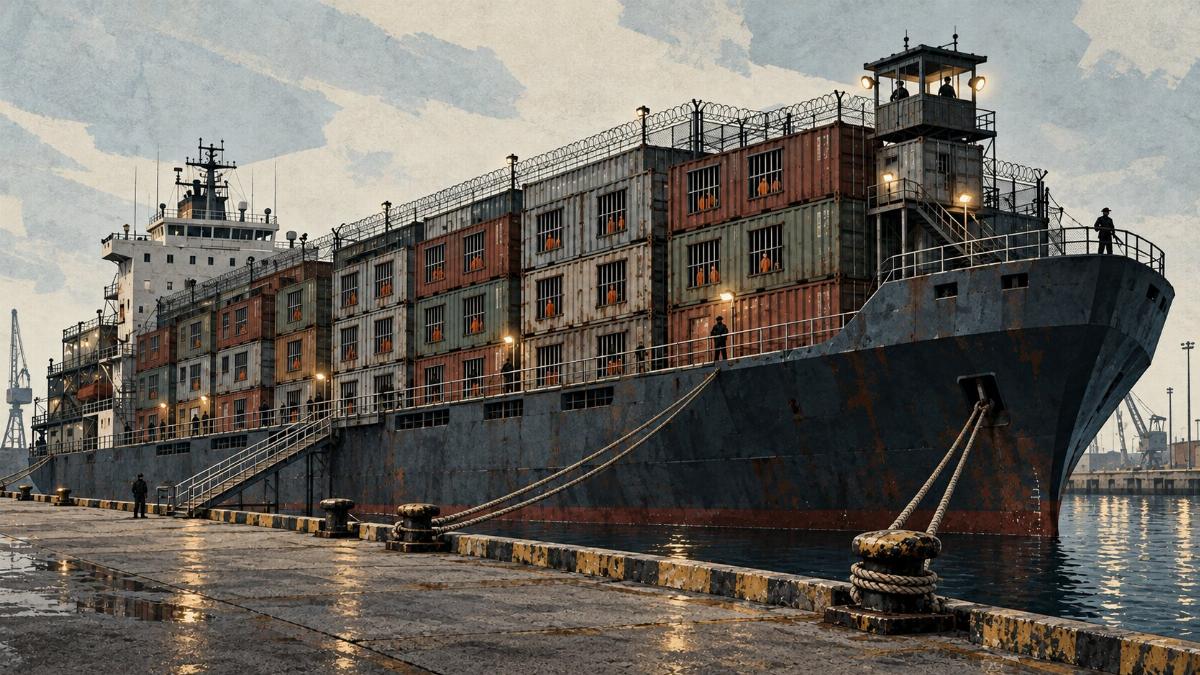
The floating prison
A small used container ship, under 10,000 deadweight tons, can be bought for about $5 million. A used 40-foot shipping container costs around $1,250. Fitted with plumbing, wiring, insulation, drywall, ductwork, windows and doors, each container becomes a spartan (but decent) housing unit for roughly $8,500. With bunks stacked three-high in two rows along each side, one container would sleep about 30 inmates, and still have room for a shower, toilet, and sink.
A small ship holds about 250 such units, enough for roughly 7,500 inmates. The total cost of ship and housing is just over $7 million, or under $1,000 per inmate. Compare that with $160,000 in Alabama or $350,000 at DHS. The money Alabama is spending on 8,000 beds could, in principle, house more than a million inmates afloat.
Conditions need not be harsh. Container roofs can host a basketball court. Connected containers can become a gym, library, dining hall, chapel, visiting area, or classrooms for trade instruction.
Moored on a lake or river near a town that can supply staff, a floating prison needs no land purchase and takes no property off the county tax rolls. Security is straightforward: perimeter lighting, video surveillance, and motion-detection lights. An escapee has nowhere to go but into the water.
Inmate labor can hold costs down further. When I worked for the Arizona Department of Corrections, many inmates had construction skills and maintained and remodeled the prison themselves. To avoid undercutting construction wages, the state could budget the prevailing wage, but direct most of it to a victims’ compensation fund.
What it means for a large state
Illinois holds about 30,000 inmates. Fifteen ships would add room for more than 100,000 more, at a cost of roughly $105 million. That is about 0.2 percent of the state’s $56 billion budget.
The ships bring other savings. Their engines can generate electricity and heat. Much of the hull sits below the waterline, insulated from extreme temperatures, and onboard systems may handle water purification and sewage treatment. Since the ships never sail, maintenance on propulsion equipment largely disappears.
They can even earn money. Moored near busy bridges and highways, the sides of the containers are roughly billboard-sized. Billboards rent for $1,500 to $30,000 per four-week period. A well-placed ship with just one side facing traffic could plausibly bring in $500,000 every four weeks.
Operating costs would rise, I grant. But much of what we spend on inmates’ food, housing, and medical care is already being spent through Medicaid and other public assistance. Incarceration largely moves that cost from one budget column to another.
Read more I would rather vote for a human than a robot
Best of all, the program can be tested incrementally. A state could start with one ship and a few containers. If it fails, sell the ship. If it works, expand.
Changing the criminals’ math
Prison space matters most because of how chronic offenders think. At one prison where I worked, I was told the average inmate had six felony convictions before his first state prison sentence. A chaplain once quipped that many inmates were serving a life sentence on the installment plan.
To such offenders, prison is a cost of doing business, like the electric bill to a pizza shop owner. Before committing a crime, they weigh the odds of a plea deal, probation, a short sentence or early parole. They know judges receive daily notices of how many state prison beds are open. A judge facing a full system will often choose probation, and the offender knows that too.
Change the message to “We will always have room for you,” and the math changes. Some offenders will give up crime. Others will leave for states without such a system, which is why one state’s success would quickly pressure its neighbors to follow.
Longer stays also serve behavioral health. Counselors can break an addict’s habits only while they control his environment. I once saw a parolee leave our prison in Winslow, Arizona, under orders to stay out of bars. Before our shift ended, he was back in custody in Tucson after getting drunk in a bar and starting a brawl. More capacity lets counselors hold offenders long enough for treatment to take hold.
What safety is worth
A family friend born around 1900 used to describe riding the streetcar home in Chicago at 10 p.m. and walking alone from the stop on the South Side, on streets with few and dim lights. She never gave it a second thought. Today most women hesitate to go out alone after dark, even by car.
We can measure crime in dollars and cents, but the real cost is human. What would you pay for a society with one less rape, one less murder, one less child molested? With container ships, the answer may be pennies on the dollar.
Some argue for abolishing prisons or decriminalizing so-called victimless crimes. Few of them have worked inside one. A man serving time on a drug charge is often also a burglar, car thief, or robber whom the prosecutor couldn’t convict on the more serious offense.
We cannot return to 1900. But we can stop going the wrong way. A state willing to lead would soon find others following. The time to start is now.
Larry Joyce is a retired pharmacist and attorney. He worked as a prison pharmacist for the Arizona Department of Corrections and on contract for the California Department of Corrections and Rehabilitation and served on Capitol Hill as legislative director of the Juvenile Justice Reform Project. He lives in Poplar Grove, Illinois.
Read more A Deplorable debunks the ‘blue wave’
Image generated by ChatGPT.