
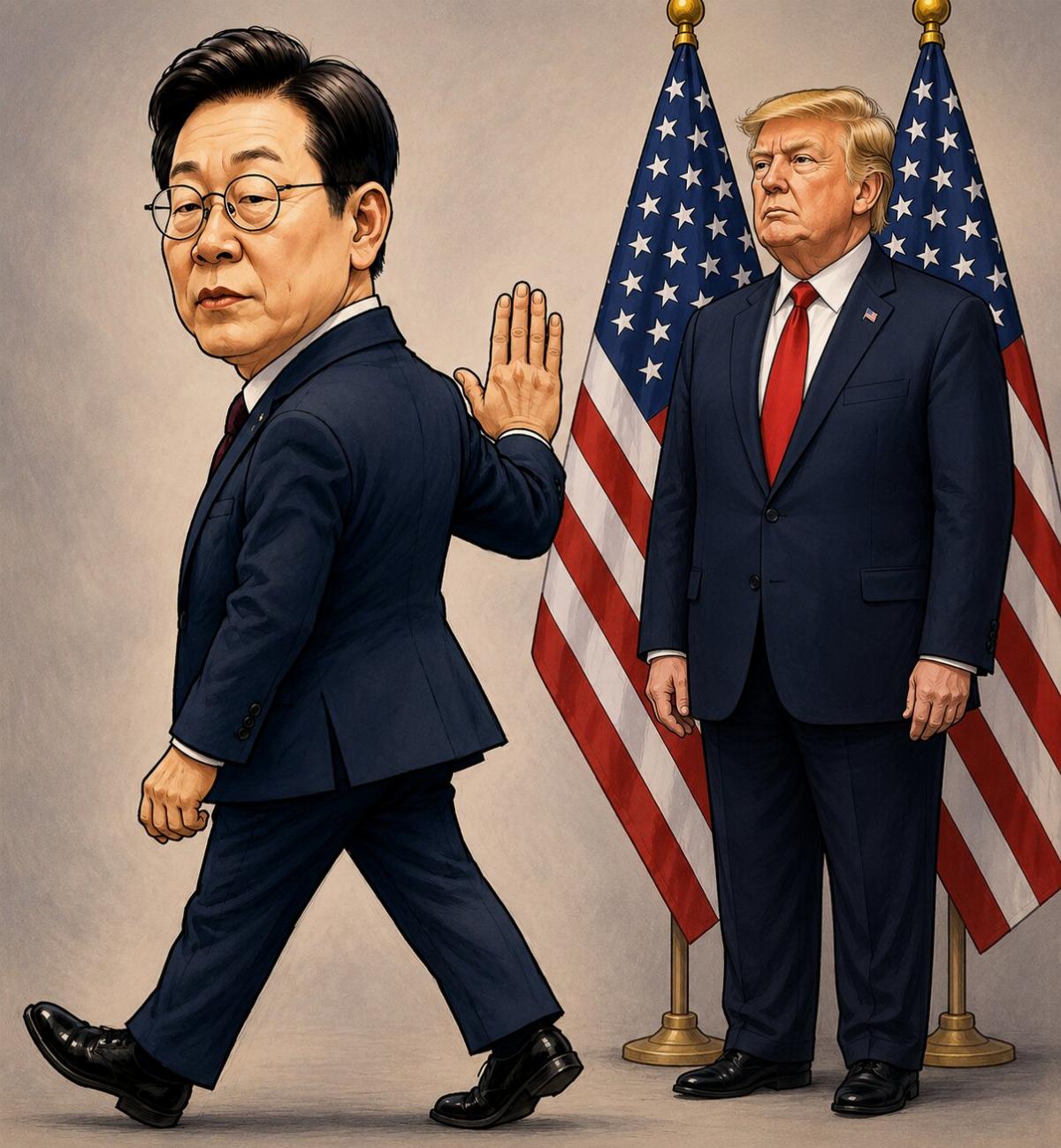
National alliances do not last forever. Iran is a prime example of this. Half a century ago, as a monarchy, it was a strong American ally in the Cold War—led by Shah Mohammad Reza Pahlavi who stood as a bulwark against communism. Forced into exile in 1979, the Shah was replaced by an extremist Islamic theocracy that labelled America as “the Great Satan.” It aggressively sought our demise through proxies, transitioning our relationship from friend to foe.
Read more Are Americans Enabling Our Enemies?
As painful as it was to lose the Iranian alliance—in effect for over eight decades and established by American blood to save Iran from communism and put it on the road to democracy—more painful was the dismissal of those sacrifices we made.
As national interests change, so too do alliances. But seldom does the change involve one democracy berating another, choosing to edge closer to a communist enemy both fought together earlier as allies.
This is what is happening in the Republic of Korea (ROK) where a liberal presidential candidate (a member of its Democratic Party of Korea, also known as the Minju Party) took office last year. He is President Lee Jae Myung who, by constitution, is to serve only a single five-year term. Unfortunately, however, he seems to be doing all he can, as fast as he can, to negate the relationship the U.S. and ROK have long enjoyed while solidifying his power. It is important to understand how this bond evolved before explaining what Lee is doing to destroy it.
In 1910, Japan had taken control of the Korean Peninsula—surrendering it due to its World War II defeat. The Soviet Union in the North, and the U.S. in the South (ROK)—were supposedly to work towards unification. But, such division gave rise to two separate Korean governments, each claiming legitimacy over the other.
Thus, when the U.S. pulled its forces out of the South in 1949, the North—well-armed by the Soviet Union—saw an opportunity to invade and unify the peninsula under its rule. Its June 25 invasion triggered the Korean War, leading to UN forces, under U.S. command, deploying in response.
Within three days, before U.S. forces arrived, the North captured the South’s capital city of Seoul. While American forces eventually helped retake Seoul permanently in March 1951, we suffered heavy casualties during the early part of the war—a war China joined to help the North less than four months later.
The U.S. eventually suffered 36,500 casualties before all parties agreed to an armistice (no peace treaty was ever signed) in July 1953. It has left the two Korean states permanently divided at the 38th parallel.
It was the U.S. effort during the Korean War that saved the South, allowing it to traverse the road to democracy. It was the ROK’s recognition of America’s sacrifice during that conflict that gave rise to a close bond between Seoul and Washington—at least until the Lee administration took office.
Lee has made it clear he “respects” the North’s system of government and has no intent to effect a forced change, claiming he will restore the inter-Korean military pact and work for peaceful unification. He should not expect a similar declaration from the North, which remains fully committed only to reunification under its control. Lee undertook a noticeable foreign policy change from his predecessor who made the call to spread freedom northward while rooting out “anti-state forces” in the South.
Lee has taken a softer approach in dealing with the North—a country which has never demonstrated a reciprocal approach since the war’s end. Pyongyang has constantly pursued a foreign policy challenging the South. It has involved secretly sending agents into the ROK via submarine, killing the South’s First Lady during an assassination attempt against her husband, sinking a destroyer, launching ballistic missiles over ROK territory, kidnapping its citizens, etc.
Read more The West Owes Islam Nothing
Lee has undertaken efforts to secure his position beyond the five-year limitation by effectively seeking to turn the government into a one-party system via constitutional revisions. Meanwhile, both subtly and not-so-subtly, he demonstrates his anti-American persona. Subtle included disclosing secret information about North Korea only shared by the U.S. with Seoul in confidence; not so subtly included embracing a pro-China anti-U.S. foreign policy and distancing the ROK from Taiwan.
Even before the Minju Party won the presidential election in 2025, it had made clear its pro-China proclivities. In 2021, it joined in celebrating the 100th anniversary of the Chinese Communist Party. Its flag flew alongside China’s as well as those of other authoritarian parties. Its activist leaders have long reviled the U.S. presence in the ROK while never criticizing the North’s brutal regime.
Interestingly, before taking office, Lee was on trial for allegedly funneling $8 million secretly to the North. However, upon becoming president, he also became immune to prosecution. He has submitted, for his legislature’s consideration, a bill that would dismiss the case.
After the U.S. war with Iran began, further demonstrating his anti-Americanism, Lee offered Tehran humanitarian assistance and proposed it undertake a separate diplomatic dialogue with the ROK.
Lee’s anti-American sentiments stem, in part, from his displeasure over U.S. influence in ROK affairs and our military presence there today, believing it negatively impacts on the South’s sovereignty. But this demonstrates a serious naivete on his part to understand the Korean War’s history.
Born ten years after that war ended, Lee ignores two facts about an ally he now condemns:
- First, America clearly demonstrated its willingness for complete ROK sovereignty when it voluntarily removed all its forces in the South in 1949.
- Second, it was that U.S. force removal which triggered the North’s invasion, as it sensed the South was defenseless.
- Third, our men died so that ROK remained free of the communist regime in the North.
Lee seeks to cleanse the South of what he perceives to be a “submissive mindset” vis-a-vis the U.S., redefining his country’s strategic identity. He has vowed before leaving office—if he does—to transfer operational control of U.S. forces from Washington to Seoul. Such a control transfer—with this anti-American diehard in office—is unacceptable.
Lee’s actions demonstrate he is a New York City Mayor Zohran Mamdani equivalent on a national level, similarly seeking to implement unwise political changes for his people that effectively endanger them. New Yorkers are already striking back at Mamdani’s bad decisions. Hopefully the South Koreans will do the same with Lee. Perhaps we can help that process along by drawing down on our forces there—just like President Donald Trump is doing in Germany.
With his anti-American and pro-Pyongyang policies, Lee is increasing the divide in a once indivisible US/ROK alliance. Doing so only increases the North’s motivation to unite the peninsula under its own leadership while de-motivating any U.S. willingness to help the ROK if it does.
Read more Jim Crow and the Cost of Crying Wolf
Image generated by ChatGPT.