
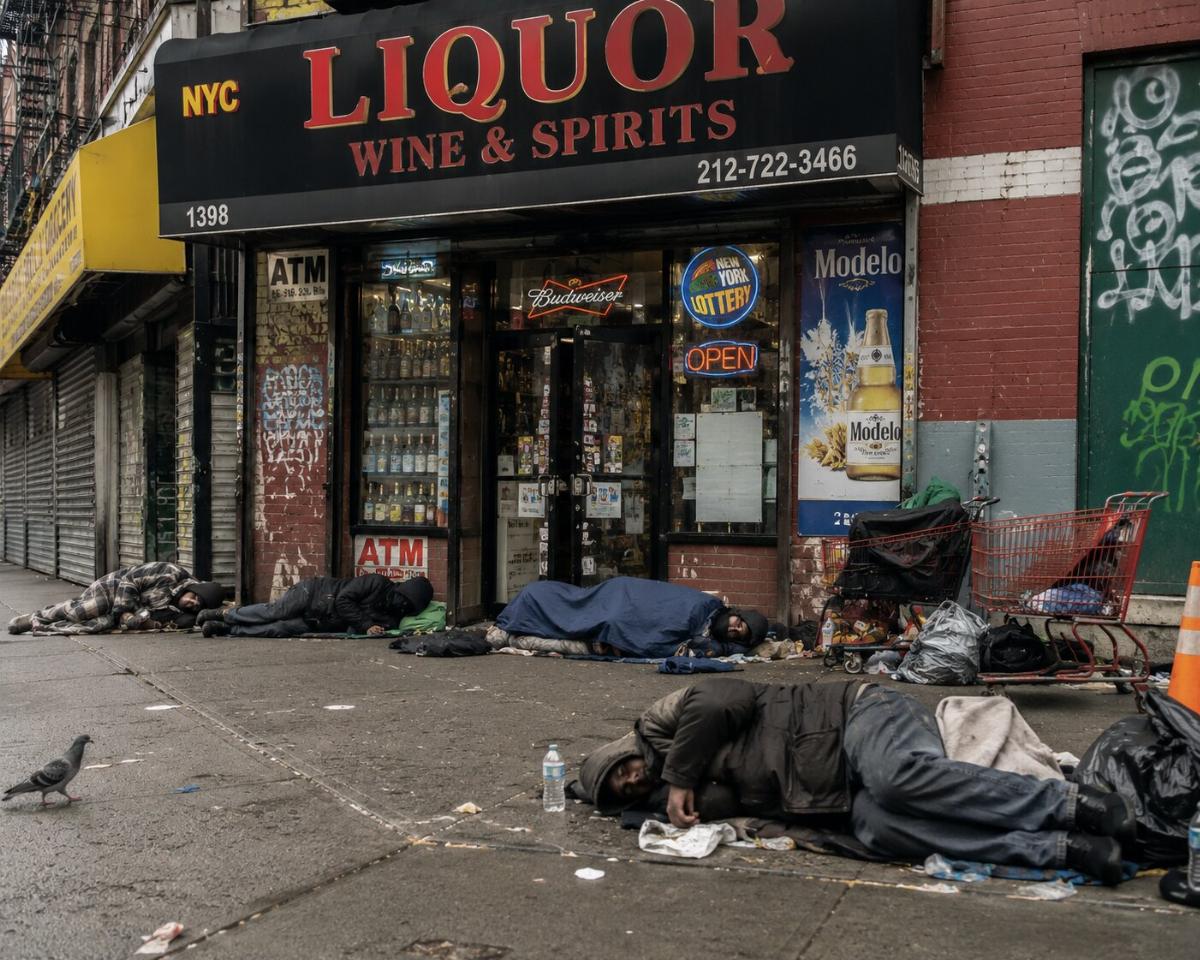
New York City has long been a laboratory for progressive policy experiments, but some proposals defy even basic common sense.
Read more Emergence of the distributed energy resource
Consider the current plan for a homeless shelter at 1587 Third Avenue in Yorkville. The chosen location literally shares a wall with Mister Wright Fine Wines & Spirits, a large liquor store. The site sits on an extremely narrow sidewalk in one of the densest residential corridors in the country, surrounded by families with young children, schools, dance studios, and elderly residents.
A Change.org petition opposing the project has already gathered more than 4,200 signatures in a few short weeks. Local residents have submitted detailed demographic reports highlighting the high concentration of strollers, schoolchildren, and seniors who walk past this exact spot every day.
This is not “compassion.” This is bureaucratic incompetence mixed with ideological blindness.
For years, New Yorkers have watched the city’s shelter system swell, especially after the migrant crisis. Many residents support helping those truly in need. What they oppose is the repeated decision to drop poorly planned facilities into dense, family-heavy neighborhoods with little regard for practical outcomes or community input.
The City has refused to publicly disclose what population this shelter would serve. But placing any shelter directly next door to a major alcohol retailer raises operational and planning questions that should be answered before, not after, contracts are signed. If any portion of the population includes individuals in addiction recovery — and the City has not ruled this out — the adjacency is not compassionate urban planning. It is reckless. It is the policy equivalent of building a casino next to a Gamblers Anonymous meeting and calling it “holistic integration.”
This is not speculation about how badly the City handles these decisions. In August 2025, Manhattan Supreme Court Justice Arthur Engoron blocked the City from opening a 106-bed shelter at 320 Pearl Street, ruling that the City’s approval process was “significantly and fatally flawed.” The court rejected the City’s argument that community opposition was based on stigma. A judge of the New York Supreme Court has already concluded, on the public record, that this is how the City does business: by ignoring the very laws meant to ensure equitable, sensible siting of public facilities.
Even more troubling is the apparent lack of transparency. Residents report learning about the project only after surveyors appeared and organizing had already begun. Elected officials, including Council Speaker Julie Menin (whose district this is) and Mayor Zohran Mamdani (whose Gracie Mansion is just four streets away), have fallen back on the familiar refrain of being “just informed” about the proposal.
And the question of who profits should also be asked. The proposed building’s owner, David Levitan, was the subject of a 2021 New York Times investigation titled “He Made the ‘Worst Landlords’ List, but New York Relies on Him.” The Times — not exactly a conservative outlet — documented the City’s pattern of contracting for shelter space with landlords whose own buildings rack up serious violations. This is the dynamic at work here. The City is poised to write a rent check to a documented bad landlord and to drop the consequences onto Yorkville residents and the small businesses next door.
Read more Does ‘pay it forward’ really work?
This pattern is all too common in New York: decisions are made quietly, the impacts are externalized onto neighborhoods, and residents are expected to absorb the consequences without complaint.
The arguments in favor of scattering shelters across the city — “integration,” “access to services,” and so on — sound noble in theory. In practice, they often result in concentrated social problems in areas least equipped to handle them. Yorkville is not “integrating” anything new. Within roughly a half-mile of the proposed site there are already at least seven existing or planned shelters and supportive housing facilities, including a 434-unit complex now opening at 1760 Third Avenue that will house 261 formerly homeless residents. The neighborhood is, by any honest measure, already doing its share. The City’s answer is to add more.
A 20-foot-wide sidewalk in a dense residential block is not the place to test these theories.
New Yorkers are right to demand better. They are right to ask basic questions. What is the exact population this shelter will serve? What is the operator’s track record? What security measures will be in place? Why this specific location when other options exist? And why is the City prepared to do business with a landlord the New York Times has already profiled as one of its worst?
The fact that these questions are met with evasion rather than answers tells us everything we need to know about how seriously city officials take neighborhood concerns.
Compassion without wisdom is not compassion — it is ideology. New York City needs more than slogans. It needs realistic, responsible policies that balance help for the vulnerable with the right of existing residents to safe, functional neighborhoods.
Yorkville residents are not asking for the shelter to disappear. They are asking for basic competence in its placement, transparency about who would live there, and accountability for the landlords being enriched in the process. That should not be too much to expect.
Michael Harlan is a pseudonym for a longtime Upper East Side homeowner concerned with quality-of-life issues, transparency in city governance, and sensible urban policy in New York City.
Read more Almost 40% Of Democrats Support Hamas Over Israel
Image generated by ChatGPT.