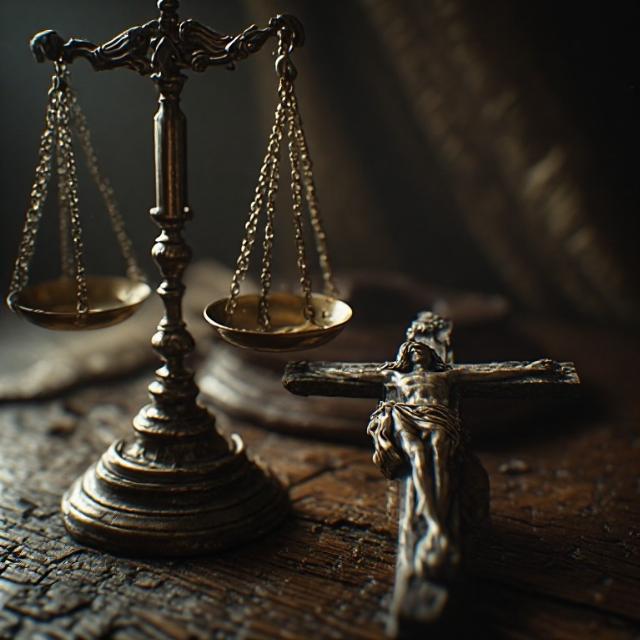
One of the most significant moral and political debates of the modern era concerns the distinction between justice and social justice. Although the two concepts are often treated as synonymous, they frequently operate according to different principles and priorities. This tension has become increasingly visible within the Catholic Church, where debates over doctrine, charity, equality, and social reform have exposed competing visions of the Church’s mission. A remarkably similar tension can be observed within the American justice system, where traditional understandings of law and impartiality increasingly compete with demands for equity, historical redress, and social outcomes.
Read more A challenge to good Democrats to form a third party or join the GOP
At its core, justice is concerned with giving each person what is due. In both the classical philosophical tradition and Catholic moral teaching, justice is rooted in objective standards that apply equally to all individuals. It assumes that laws, rules, and moral principles should be applied consistently regardless of status, group identity, or political considerations. Justice seeks fairness through impartiality.
Social justice, by contrast, emphasizes the conditions that shape people’s opportunities and life outcomes. It focuses less on equal treatment under a common standard and more on correcting perceived inequalities among groups. Social justice advocates often argue that historical injustices, structural disadvantages, and systemic barriers require remedies that go beyond simple equal treatment. In practice, this can mean prioritizing outcomes and group disparities over strict procedural neutrality.
Within the Catholic Church, this distinction has generated significant debate. One side argues that the Church’s primary role is to proclaim eternal truths, uphold moral doctrine, and encourage individual virtue and charity. The other side places greater emphasis on social transformation, economic inequality, racial justice, migration policy, environmental concerns, and collective responsibility. While both perspectives claim roots in Catholic teaching, critics argue that the language of social justice can sometimes overshadow traditional doctrines concerning personal responsibility, sin, moral law, and salvation. The result is a perceived conflict between a Church focused on transcendent truths and a Church focused on contemporary social causes.
A similar conflict is emerging within the American justice system. The traditional legal ideal is represented by the image of blind justice: laws applied equally to all citizens without regard to race, class, religion, or political affiliation. This model prioritizes procedural fairness and individual accountability. However, growing attention to disparities in arrest rates, sentencing outcomes, educational opportunities, and economic conditions has led many reformers to advocate for policies designed to achieve greater social equity. Their argument is that formally equal treatment may still perpetuate unfair outcomes if underlying inequalities remain unaddressed.
Read more It’s the dirty story of a dirty man
The controversy arises because the two frameworks can lead to different conclusions. A justice-centered approach asks whether a law is applied fairly to each individual. A social justice-centered approach asks whether the law produces equitable outcomes among different groups. When outcomes differ significantly, social justice advocates may call for corrective measures. Critics respond that such measures risk undermining impartiality by introducing distinctions based on group membership rather than individual conduct.
The parallel between the Catholic Church and the American justice system is therefore striking. In both institutions, the dispute is not simply about policy, but about first principles. The question is whether fairness is best achieved through universal standards applied equally to all, or through active efforts to reduce social disparities and produce more equitable outcomes. Both sides claim to pursue justice, yet they often define the term differently.
The challenge for both institutions is that neither perspective can be entirely dismissed. A society that ignores objective standards risks becoming arbitrary and politically driven. Yet a society that ignores persistent social inequalities may fail to address real sources of suffering and exclusion. Similarly, a Church that neglects social concerns may appear indifferent to human hardship, while a Church that focuses exclusively on social reform risks losing sight of its spiritual mission.
Ultimately, the debate between justice and social justice reflects a deeper question about the nature of fairness itself. The Catholic Church and the American legal system are confronting versions of the same dilemma: whether justice is primarily a matter of impartial rules or whether it requires the pursuit of particular social outcomes. How these institutions resolve that tension will shape their identity, legitimacy, and moral authority for generations to come.
Read more Trump’s bromance with Islamic potentates