
My wife and I retired from teaching in May of 2020. Our final semester was obliterated by a COVID shutdown. We pretended to teach from a distance, and our students pretended to learn. It was a dishonorable end to an honorable career, but beyond our control.
Read more My Body/My Choice on trial
During that mostly happy career, I struggled with student plagiarism. All English teachers did in those days of yesteryear. One of my favorites was a young man who stole a friend’s research paper word for word. What would have been obvious enough, but it contained an anecdote about the original author’s mother. The plagiarist didn’t bother to change her full name. Double oops.
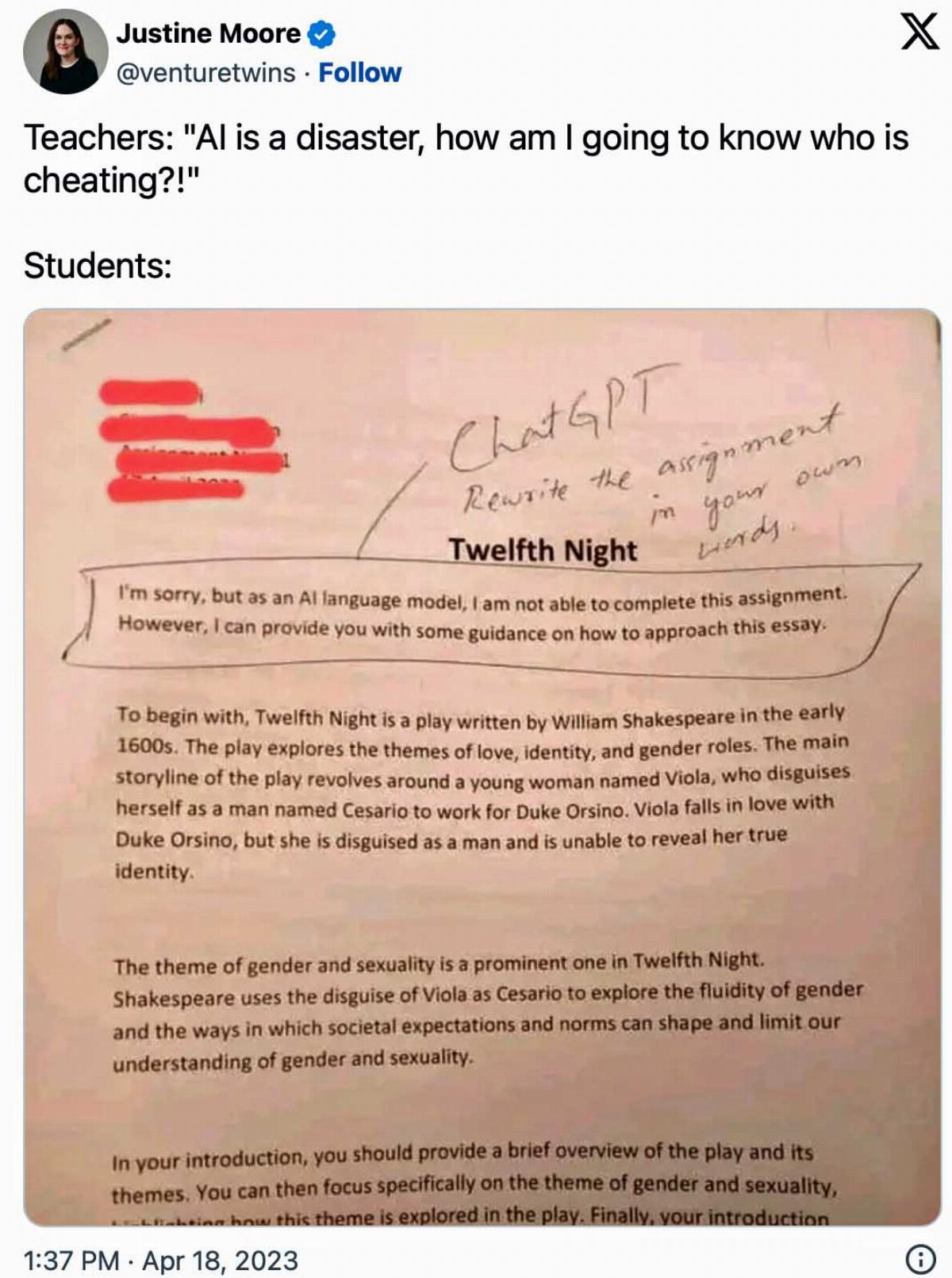
I’ve no doubt I bailed out of education just in time for a variety of reasons as I watched education devolve over my career, but at least I didn’t have to deal with AI, used not as an aid to research and writing, but as a means for kids to avoid learning and doing any real, personal work. Sadly, detecting that kind of sloth isn’t always this easy:
Graphic: X Post
An underground industry of ghostwritten research papers has long existed. Ghostwriters have catalogs of papers listing the grades they’ve received. Fork over the cash, and the ghost and the student, for very little effort, are both happy. It hasn’t always worked out so well for students, because teachers have Internet tools for detecting plagiarism, not to mention the ability of competent English teachers to immediately detect when a student’s voice suddenly, miraculously, changes.
Interestingly enough, lazy English teachers and lazy students were sometimes compatible. Rather than go to all the trouble of confrontation and demanding a rewrite, some teachers just assigned a minimal, passing grade, which most cheating kids were happy to accept. Sure, those kids learned nothing, except perhaps about supply and demand.
But with the advent of AI, there’s a new problem: ghostwriters are losing their jobs, as John Hinderaker at Powerline reports:
In this case, by making cheating cheaper and more efficient. The New York Times headlines: “Kenyans Did College Students’ Homework for Years. Then A.I. Arrived.”
Hailing from a farming village in Kenya, Mr. Bundi moved to the capital, Nairobi, in 2011 to be the first in his family to attend university. There, a friend suggested he try a new online job: writing essays for cheating overseas college students.
***
Mr. Bundi estimates he wrote more than 2,500 essays over the next 12 years, sometimes three a day. He balanced completing his public health degree with helping faraway students studying engineering, medicine and computer science to finish theirs. Some students gave him their school login information so he could keep up with their assignments.
One might allow a bit of grudging respect for Bundi’s writing abilities and industriousness. After all, he was a Kenyan doing a job Americans legitimately wouldn’t do, and he didn’t break immigration laws to do it. But alas, all good—bad?—things come to an end:
Read more Playing the casualty claim game
In 2022, OpenAI released ChatGPT. At colleges worldwide, students made a simple calculation that has become more pronounced today: Why pay a freelancer in Kenya when ChatGPT could do the job?
Essay work began to thin. Rates fell, and assignments dwindled. Before long, the industry shrank to almost nothing. “I never would have expected A.I. could do this,” Mr. Bundi said.
Not quite a Shakespearean-level tragedy, is it? Consider the tragedy of Brown University economics Professor Robert Serrano. After a December 2025 mass shooting on campus, he advertised take-home exams for an upcoming class that normally attracted 30 students. Eighty-six enrolled.
The midterm average was 96% in a class that normally averaged 65-80%. The influence of AI was even more obvious because Serrano made the exam more difficult than usual, as students had much more time to complete it.
But by the end of the semester, Serrano regretted the decision. Dozens of students in the class likely used artificial intelligence to cheat and earn perfect or near-perfect scores on their midterm, he said. Serrano in turn made the final exam in-person, which led more than a dozen students to drop the course and even more to fail it. Administrators’ response to the widespread cheating event has been “meek,” he said, and the incident has raised questions about how universities can—and should—respond to AI-enabled cheating at scale.
As in warfare, every new weapon births an effective counter-weapon, and so it is with AI academic counter-weapons. The real issue is whether administrators and politicians will allow teachers to use the nuclear equivalent of failing grades, or even classes, for AI plagiarism.
I wouldn’t bet the farm on that one.
Become a subscriber and get our weekly Friday newsletter with unique content from our editors. These essays alone are worth the cost of the subscription.
Mike McDaniel is a USAF veteran, classically trained musician, Japanese and European fencer, lifelong athlete, firearm instructor, retired police officer, and high school and college English teacher. He is a published author and blogger. His home blog is Stately McDaniel Manor.
Read more Trans rape in girl’s wrestling in Washington state