

As the United States marked its 250th year, the country quietly retired one of its longest-standing governing assumptions: that legitimacy flows downward, from party leadership, from institutional consensus, from corporate tax policy, and eventually reaches the people it is meant to serve. The working-class experience of the last generation told a different story. Real wages stagnated, manufacturing moved overseas, and both parties built policy apparatuses that seemed to answer to boardrooms and institutional continuity rather than kitchen tables.
Read more Apocalypse soon
This kind of rupture has precedent, and it is not uniquely American. In 1969, Indira Gandhi broke from the Indian National Congress’s entrenched “Syndicate” of party bosses, taking her anti-poverty campaign directly to voters rather than working through the establishment that had elevated her in the first place. The pattern repeats across democracies for a simple reason: party gatekeepers who grow more committed to institutional continuity than to the people they represent eventually get bypassed by leaders willing to go straight to those people instead. Trump’s early relationship with his own party followed a similar arc. Republican donors and officials largely treated his 2016 candidacy as a disruption to be managed rather than a durable realignment, and what changed their calculation wasn’t rhetoric. It was that his coalition proved more loyal to him than the party infrastructure that had underestimated him. Leverage moved from institutional brokers to a direct, personal mandate, and it stayed there.
The clearest economic expression of that mandate is the One Big Beautiful Bill Act, which inverts the standard conservative playbook. Rather than cutting corporate rates and hoping benefits eventually reach workers, OBBBA writes relief straight into paychecks.
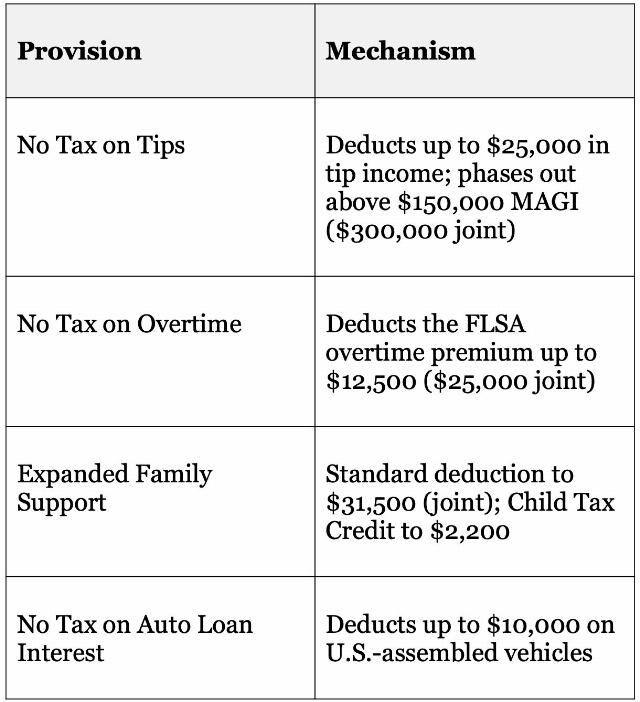
Image from author.
No Tax on Tips deducts up to $25,000 in tip income, phasing out above $150,000 in modified adjusted gross income for single filers and $300,000 for joint filers. No Tax on Overtime deducts the FLSA overtime premium, up to $12,500 for individuals and $25,000 for joint filers. The standard deduction rises to $31,500 for married couples, and the Child Tax Credit increases to $2,200. A new deduction covers up to $10,000 in interest on loans for vehicles assembled in the United States.
The overtime provision is worth sitting with, because it shows the design logic plainly. Only the legally mandated premium is deductible, the extra half in “time and a half,” not the base wage. That means the benefit scales with hours actually worked rather than with income bracket or job title. It reaches a line cook or an electrician pulling a double shift, not a shareholder collecting a dividend.
The same instinct shows up outside tax policy. At the June 2025 NATO summit in The Hague, member states agreed to raise defense spending to 5% of GDP by 2035, and in 2025 alone European allies and Canada increased real defense expenditure by close to 20% over the year before, after years of treating American backing as an open-ended commitment rather than a shared cost. Whatever one thinks of the pressure that produced that shift, the underlying logic matches the tax provisions: relieve the American taxpayer of a share of collective costs that had gone largely unquestioned for decades.
Read more Ceuta should be a warning for Spain, America, and the entire West
None of this is free, and pretending otherwise would undercut the argument rather than help it. The Congressional Budget Office projects OBBBA will add $3.4 trillion to federal deficits over ten years. The tips deduction alone is estimated at $32 billion over a decade by the Joint Committee on Taxation. Every worker-facing provision expires in 2028 unless Congress renews it, which is a real weakness in a policy meant to feel like permanent relief. Critics are right to raise these points, and a piece arguing this policy’s merits owes them a real answer rather than a dismissal.
Here is that answer: the deficit objection has rarely been applied evenly. Corporate tax cuts carry comparable price tags and routinely draw far less scrutiny than a $25,000 tip deduction aimed at waitresses and hairdressers. If deficit spending is happening either way, under whichever party governs, the more useful question isn’t whether it costs money. It’s who gets that money first. For most of the last forty years, the answer has been corporations and high earners, on the theory that the benefit would eventually trickle down. OBBBA answers differently.
This is a messy combination of instincts rather than a clean ideological package: protectionist trade policy, transactional diplomacy, and tax relief aimed narrowly at hourly and tipped workers. It will be argued over on every count for years, and it should be. But at 250 years, the shift is worth stating plainly. For the first time in a generation, federal policy is being written on the premise that the household, not the institution, is where legitimacy has to start.
Meda Parameswara Reddy, Ph.D. is Director of the Reddy Center for Critical and Integrated Thinking. A former R&D executive holding 30 U.S. patents, he focuses on the analysis of human behavior, public health, and global affairs, drawing on an interdisciplinary background. He published in multiple RealClear platforms, Proc. Natl. Acad. Sci., American Thinker, The Humanist, AFRO American, South Asia Monitor (on editorial board), and others.
Read more Electoral Science Deniers

Image generated by ChatGPT.