
A few days ago, I posited that St. Pete Beach in Florida is showing signs of strain, hinting at a lack of the resilience that was once part of its fabric. Given that hurricanes are inevitable, I worried that its general inability to cope with even minimal pressure put it at risk of collapse in the event of another natural disaster.
Read more Trump Is Right About Voting Machines
Some commenters thought I was exaggerating a bad restaurant experience and overextending it. It’s worth taking that criticism seriously because the objection shows that I failed to make myself clear.
I wasn’t claiming that a tight parking lot and cold fries add up to a verdict on the entire state, nor was I calling St. Pete Beach unlivable. Instead, I was arguing that a community’s standards—the small, unglamorous commitments to safety, accessibility, and basic care for the people you serve—are the first things to erode when an economy is stretched thin.
A restaurant cutting corners on parking striping and food quality isn’t a scandal. It’s a symptom. And symptoms are worth naming precisely because they’re small enough to dismiss and common enough to matter.
I spent a decade in a volunteer uniform enforcing exactly this kind of compliance for the City of Fort Lauderdale—the invisible scaffolding that keeps a community functioning for everyone, not just the people who can squeeze through a two-inch gap. I don’t think that standard should apply only to the public sector while the commercial sector gets a pass because the economy is tight and everyone’s in a hurry.
The public deserves better from both. If pointing that out counts as handing ammunition to the other side, the problem isn’t the observation—it’s how little tolerance we’ve built for anyone noticing that things are fraying at the edges.
This is exactly why the stakes in the upcoming Florida governor’s race are higher than the “free ride” framing suggests.
There’s a peculiar kind of danger that comes with success. When a governor spends years dominating the political landscape, shaping the state’s brand, and commanding the national narrative, he doesn’t simply vacate an office when term limits catch up with him. He leaves behind something closer to a gravitational field—a vacuum so pronounced that whoever fills it will be judged, fairly or not, against a standard that took nearly a decade to build.
That is the situation Florida Republicans now face. And the knee-jerk instinct among many in the party is to treat the governor’s mansion as a “free ride”—a prize to be handed to the most visible heir apparent before a single primary vote is cast.
That instinct is understandable. It is also a mistake, for the same reason a rock-hard basket of fries and a two-inch parking clearance were worth writing about in the first place: A state’s condition is measured in its unglamorous, unwatched details, and those are precisely what a coronation skips over.
Florida’s current success has created the impression that the state runs on autopilot—that the hard work has already been done and the next governor’s job is simply not to disturb a winning formula. Under that theory, the primary process becomes a nuisance at best and a threat at worst: something that risks “scratching the paint” before the keys are handed over.
Read more Marco Rubio: A war against domestic terrorism
But this reasoning mistakes a well-run state for a low-maintenance one. Florida is not coasting into its next chapter. It is inheriting a set of structural, slow-moving crises that no amount of press conferences or media savvy will resolve on their own:
The insurance market is buckling. Years of catastrophic storm activity—including the one-two punch of Hurricanes Helene and Milton—have pushed Florida’s property insurance sector to the brink. Reform efforts have helped stabilize things at the margins, but the underlying exposure to climate-driven catastrophic risk hasn’t gone away. Whoever sits in Tallahassee next will have to manage an insurance market that remains one bad hurricane season away from real trouble.
Growth has outpaced capacity. The same population boom that has fueled Florida’s economic story is now straining the infrastructure, public services, and cost of living that make the state livable in the first place. Housing costs, traffic, water systems, and school capacity are all being tested by a growth rate that the state’s underlying systems weren’t built to absorb. The macroeconomic wins mask a very real carrying-capacity problem at the local level.
Recovery is a grind, not a headline. Post-hurricane rebuilding is capital-intensive, bureaucratically complex, and inherently slow. Managing the distribution of state and federal recovery aid—keeping it moving, keeping it honest, and keeping displaced families from falling through the cracks—is unglamorous, detail-heavy work. It rewards competence, not charisma.
None of these problems will announce themselves on cue. They accumulate quietly, and they punish inexperience severely. A governor who knows how to command a camera but hasn’t been tested on the mechanics of governing a state operating near its physical and economic limits could watch the “Florida success story” come apart faster than anyone expects.
This is precisely why a rushed coronation—of Byron Donalds or any other favored successor—before voters have had a chance to see candidates challenged, questioned, and pressure-tested is such a risky bet. The stakes here aren’t abstract. They involve managing the third-largest state in the country through genuine structural strain.
A competitive primary is not disloyalty to the party or sabotage of the coming general election. It’s due diligence.
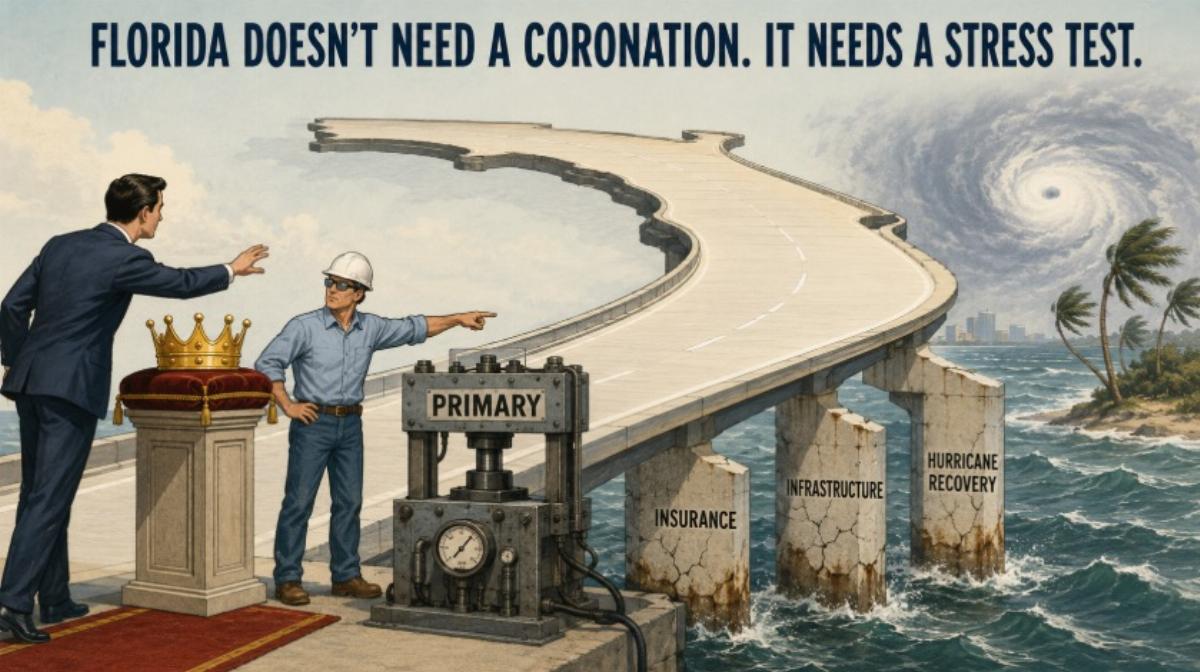
Engineers don’t certify a bridge for public use without first testing its load-bearing capacity. Police departments don’t put rookies on high-stress beats without evaluating their judgment under pressure. Why would Florida Republicans treat the governorship—an office with life-and-death consequences for a state facing hurricanes, an insurance crisis, and unprecedented growth—with less scrutiny than we’d apply to a bridge inspection?
The fear driving calls for an early coronation is understandable: Nobody wants to see a hard-won political brand damaged by an ugly primary fight. But that fear has the causality backward. It is precisely because the vacuum is so large and the inheritance so consequential that the process of filling it needs to be rigorous rather than reflexive.
A true heir to Florida’s recent success won’t be chosen by acclamation. He’ll be the one who survives the stress test—who gets pushed, questioned, and vetted by his own party and comes out the other side having proven that he can do more than hold a lead in an uncontested race. Florida’s next governor doesn’t need a coronation. He needs to earn it!
Read more Joisey on the Ropes
Image created using AI.