
Two nights ago, President Trump went on national television and again called out the vulnerability of electronic voting machines to manipulation. The White House election-integrity page puts it bluntly: “For years Americans were blatantly lied to about the security of our election infrastructure, including electronic voting machines and ballot-counting systems.”
Read more Marco Rubio: A war against domestic terrorism
In its typical smokescreen tactic to distract the public from the facts, the left immediately dismissed the concerns as conspiracy theory.” But in this case, not so fast… The left should have asked federal democrat Judge Amy Totenberg first.
In October 2020—just weeks before the presidential election—U.S. District Judge Amy Totenberg of the Northern District of Georgia issued a lengthy opinion in Curling v. Raffensperger. The case was brought by progressive groups, including the Coalition for Good Governance, challenging Georgia’s new Dominion ballot-marking device (BMD) system.
That system, selected under then-Governor Brian Kemp, puts a Dominion machine in every county in the state. Before the 2020 election turned the issue partisan, left-leaning organizations and even Rachel Maddow’s MSNBC praised the lawsuit for highlighting serious problems with Georgia’s voting equipment.
Judge Totenberg is no conservative. She is a Democrat appointed by Barack Obama. She is the sister of longtime liberal NPR legal correspondent Nina Totenberg. Yet her October 11, 2020, Opinion and Order contains some of the most devastating judicial findings ever written about the reliability of Dominion’s QR-code-based ballot-marking devices.
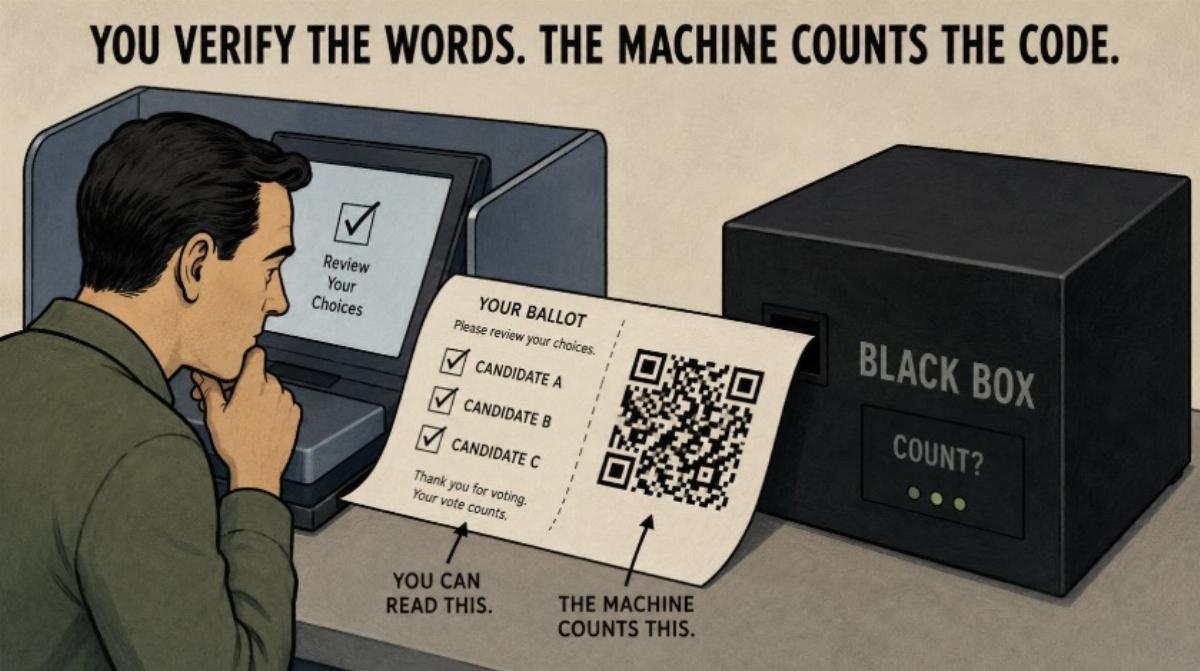
The core problem Totenberg identified is simple and profound: voters never get to verify the votes that are actually counted.
She wrote that “the tabulation of the vote is actually based on the ballot’s non-encrypted QR barcode on the ballot—designed to summarize the voter’s ballot selections in code—that by itself is not voter reviewable or verifiable.” The human-readable text on the paper is irrelevant. The scanner “tabulates the ballot votes solely based on the QR code—and not based on the human readable text on the printed ballot.”
The Court laid out the evidence in stark terms:
(1) The QR barcode-based BMD voting system does not produce a voter-verifiable paper record of the votes cast. Therefore, voters will be unable to conduct any verification of the information encoded in the non-human readable barcode, will have no way of knowing what votes they are actually casting, and will instead be forced to trust that the barcode accurately conveys their intended ballot selections. Both the QR barcode recording of votes and the text summary of ballot selections are subject to being accessed and manipulated through hacking…
(2) The QR barcode-based BMD voting system poses major security and fidelity of vote issues because the BMD system is susceptible to significant cybersecurity risks and manipulation through hacking access to any one of its multiple components (BMD, printer, scanner) and through untraceable manipulation or alteration of code. The QR barcode is not encrypted and may also be a vector of data system manipulation.
(3) The QR barcode-based BMD voting system is incapable of being meaningfully audited for a variety of reasons: (a) the QR code cannot itself be verified by a voter…
University of Michigan computer scientist J. Alex Halderman’s testing, accepted by the Court,
Read more Joisey on the Ropes
…indicated the practical feasibility through a cyber attack of causing the swapping or deletion of specific votes cast and the compromise of the system through different cyber attack strategies, including through access to and alteration or manipulation of the QR barcode.
Totenberg quoted the National Academies of Sciences, Engineering, and Medicine:
[A]ll digital information—such as ballot definitions, voter choice records, vote tallies, or voter registration lists—is subject to malicious alteration; there is no technical mechanism currently available that can ensure that a computer application—such as one used to record or count votes—will produce accurate results; testing alone cannot ensure that systems have not been compromised; and any computer system used for elections—such as a voting machine or e-pollbook—can be rendered inoperable.
Later in the opinion, she summarized the constitutional injury: voters are forced
…to cast a ballot on the BMD system that cannot be confirmed or verified as reflecting their actual vote choices because the votes are tabulated solely from a computer generated QR barcode that is not human-readable and is vulnerable in the current system to failure or breach.
Votes cast on these machines “pose the significant risk of having the votes altered, diluted, or effectively not counted.” Plaintiffs had shown “demonstrable evidence” that the system puts voters “at imminent risk of deprivation of their fundamental right to cast an effective vote (i.e., a vote that is accurately counted).” The Court viewed that burden as “significant.”
Totenberg ultimately declined to order a statewide switch to hand-marked paper ballots for the 2020 election. She cited the Purcell principle—the danger of court-ordered changes so close to an election.
But she did not walk back her findings about the machines themselves. She noted that the Secretary of State and State Election Board still had the opportunity to strengthen verification and auditing for future cycles. The problems she identified did not vanish after Election Day. Subsequent CISA advisories and further expert analysis only reinforced them.
This is not a right-wing judge or a Trump-appointed judge. This is an Obama appointee, the sister of Nina Totenberg, writing in a case brought by progressive plaintiffs who were once celebrated on MSNBC. Her own words establish that Georgia’s Dominion system—used in every county—relies on an unverifiable, non-encrypted QR code that voters cannot check, that is vulnerable to manipulation, and that cannot be meaningfully audited.
President Trump is not inventing a problem. A federal judge who is nobody’s idea of a conservative already put it in the Federal Reporter. The only question left is whether the country is finally willing to listen.
Image created using AI.
Don Brown is a former Navy Judge Advocate who served at the Pentagon. A graduate of the University of North Carolina at Chapel Hill and the international law program at the Naval War College, he is a nationally bestselling author of 16 books and commentator on national security, military justice, and foreign policy. He previously served as a Special Assistant United States Attorney and was a candidate for the United States Senate from North Carolina.
Read more When socialists tell you who they are, believe them