
I do not often write about movies. In fact, I have not written an essay about one in more than thirty years.
Read more ‘Patch and Pray’ IT Culture is a Dangerous Game
The last time I did so followed a two-night movie binge in the winter of 1996, the first night of which began with my date and me in what we call in the Carolinas a snowbank—and what those north of the Mason-Dixon Line would more accurately describe as a roadside ditch with some frozen precipitation on it.
And no, Mom and Dad, if you happen to be reading this—and that is more likely you, Dad—it was not “my” car.
And, Dad, you may recall that it was your idea to buy my grandmother’s rear-wheel-drive 1987 Ford LTD Crown Victoria two-door sedan—yes, apparently “two-door sedan” was a thing—and this one came complete with a plaque dedicating the car to my grandmother.
My grandfather, I can only assume, was in the doghouse when he bought it. All the same, the Blue Bomber was absurdly ill-suited to a winding winter road.
Back to the story: After a brief spell of industrious problem-solving involving floor mats and a questionable grasp of mechanical engineering, we were back on our way to what passed for movie theaters in the Year of Our Lord 1996.
Had that relationship lasted, we would have had one heck of a first-date story to tell the kids. As it happened, I was left with something less romantic but still useful: one heck of a tangent for this column.
Being, at the time, a starving, sardonic young writer trapped in a 3L’s body, I decided after that episode to leave movie criticism to the self-appointed expert class.
Which makes it fitting, I suppose, that I should wander back into those waters with a film approaching a century old.
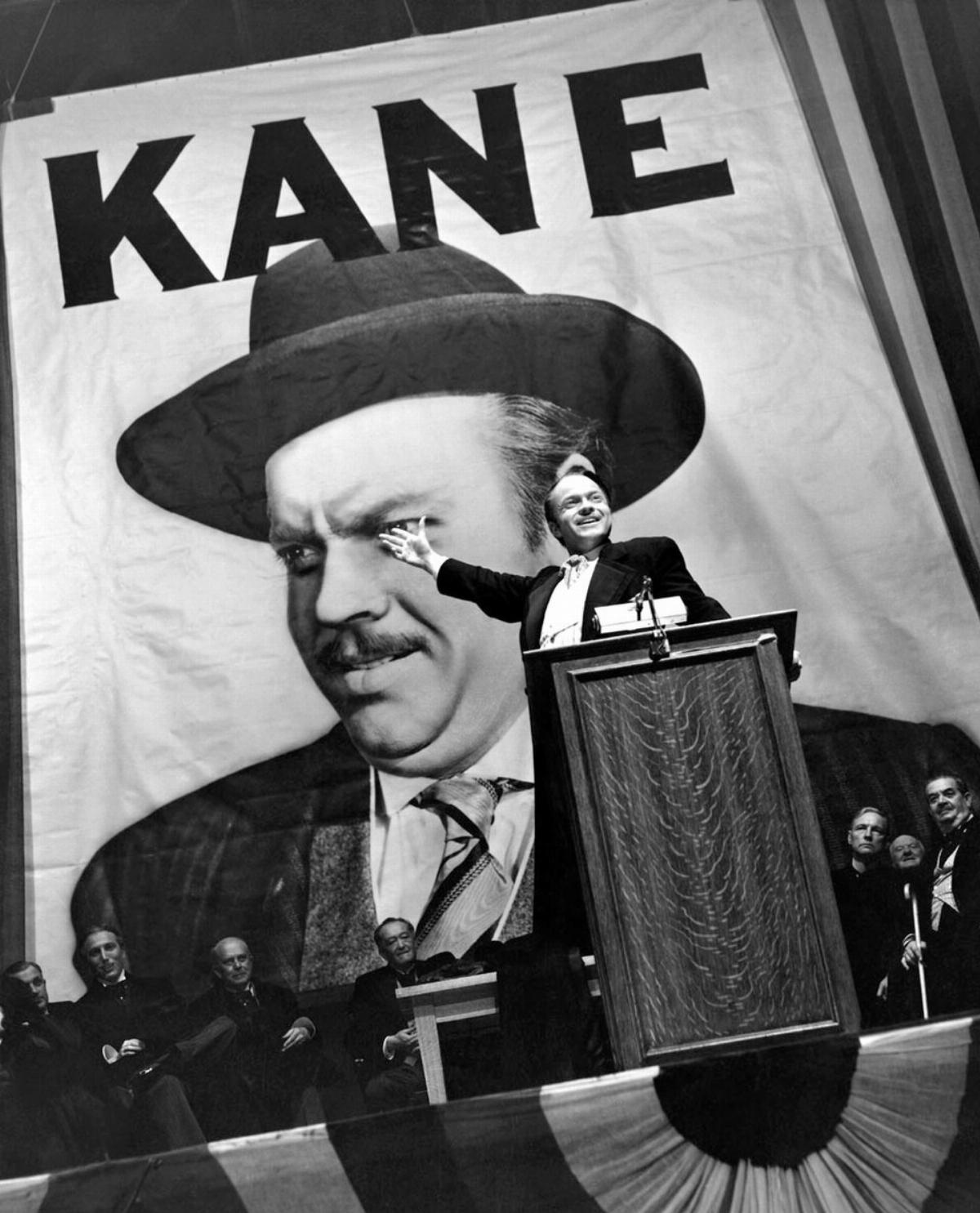
That film, of course, is Citizen Kane, returning this week for a commemorative limited engagement in theaters across the fruited plain.
Does Citizen Kane live up to the hype? Of course not—not eighty-five years later, at least. But that is precisely the point.
The picture was so different, so audacious, so avant-garde in 1941 that calling it “groundbreaking” understates the case. And because so much of filmmaking since has descended from it—or from films that themselves descended from it—it is easy now to miss the treasure hiding in plain sight. What once looked revolutionary has, by sheer force of influence, become part of the cinematic lexicon.
That is not Kane’s burden alone: it happens to every masterpiece that overturns the furniture, which the protagonist does quite literally near the end of the film.
Other filmmakers take what it did and make pieces of it their own. Then another generation borrows from them. Eventually the once-startling thing no longer looks startling at all.
It just looks like how movies are made. We still recognize the language. We do not always remember who taught us to speak it.
To appreciate just how transformative Citizen Kane was, it helps to compare it not to the films that came after it, but to the great classics that came just before.
Think of The Wizard of Oz. Think of Gone with the Wind. Think of The Philadelphia Story. These are not minor pictures, nor am I interested in diminishing them. They are classics for a reason. But place Citizen Kane beside them, and the difference becomes unmistakable.
Through that—wait for it—lens, you can see it almost immediately: in the use of light and shadow, in the use of sound and echo, in the startling deployment of deep focus, in the low and high angles and cavernous interiors, and in the determination to use the entire frame rather than treating the camera as a mere recording device.
Citizen Kane does not feel like a polished studio picture pushed to a slightly higher level. It feels like somebody came in and changed the language of cinema.
And perhaps the most remarkable thing is that this revolution in cinema was wrought not by some patient studio veteran who had climbed the conventional ladder, but by the creative team behind the Mercury Theatre on the Air—avant-garde radicals in the medium of radio who came to Hollywood as outsiders.
Read more A Fatal Rivalry — Hamilton vs. Burr
After the wildly inventive War of the Worlds broadcast took America by storm, Orson Welles and his merry band of theatrical and radio troubadours landed a movie contract. They came to film armed with the habits of another medium: sound, rhythm, atmosphere, narrative fragmentation, and a showman’s instinct for misdirection.
A good friend of mine, who shares my love of classic cinema, recently observed that “Rosebud” is about as subtle as Chekhov’s gun. She is right, of course. It is not exactly hidden in the wallpaper.
But if “Rosebud” is obvious, it is also a little misleading. The mystery of Citizen Kane is not really the mystery of Rosebud. It is the mystery of Kane himself.
Kane dies in the opening sequence, whispering that famous word. The film then pivots to a reporter trying to reconstruct him by speaking with the people he left behind. Each person provides a piece of the puzzle, but the pieces never quite fit together.
And Citizen Kane is a political allegory as well—one that feels strikingly modern. Kane is a particular American archetype: the political liberal—“liberal” being the film’s own word for him—as media baron, the self-appointed tribune of the people who claims to speak for the common man while reserving to himself the right to tell the common man what to think.
Kane makes the point plainly enough: press barons can move from reporting events to shaping them, from shaping them to distorting them, and from distortion to outright fabrication. What begins as journalism can become manipulation with scarcely a pause in between.
Charles Foster Kane’s “Declaration of Principles” is full of high-minded promises, almost ostentatiously altruistic in tone. Yet the tragedy of the film is that Kane spends the rest of his life, knowingly or not, eviscerating nearly every principle he once proclaimed. Voters, readers, friends, wives, and employees all become supporting players in the great production of Charles Foster Kane.
And then there is Welles himself.
Yes, we know the trajectory did not continue upward in a straight line. Orson Welles never again quite stood on the same summit he reached with Citizen Kane.
But then, what exactly should we expect from a man who had already conquered the two great mass-entertainment mediums of his age before, by today’s standards, he was even old enough to rent a car? Once a man has scaled Olympus twice by twenty-five, it seems a little unreasonable to fault him for never doing so again.
As a member of Generation X, my first sustained exposure to Welles was not as the boy wonder of the Mercury Theatre or the auteur of Kane, but as the older, heavier, and at times besotted figure hawking cheap California wine on television.
It was difficult, seeing that version of Welles, to imagine that he had once been a singular titan of American entertainment—an artist of swaggering ambition and transformational confidence. But he was.
Perhaps the mistake is expecting a life to continue rising after such an ascent. Most people are fortunate to produce one work of lasting consequence. Welles produced several before many of his contemporaries had fully found their footing. What came afterward may have been uneven, unfinished, compromised, or misunderstood. None of it diminishes what he had already done.
My taste in cinema and art has certainly evolved in the decades since I first saw Citizen Kane, especially since that winter of ’96, and perhaps that is one reason the film struck me differently this time.
It is one thing to encounter it young, when one is mostly aware of its reputation and perhaps dimly aware of its daring. It is another thing to see it again after years of watching more movies, reading more history, and thinking more seriously about politics, myth, memory, and ambition.
Now Kane no longer appears merely as “the famous old movie everyone says is great.” It appears for what it is: a masterpiece of American art, and a work whose fingerprints are still all over the culture that followed it.
That, in the end, may be the surest measure of Welles’s achievement. He made a film so radical that later generations can watch it and fail, at first, to notice how radical it was—because the rest of the medium spent the next eighty-five years catching up to it.
It is time to give the old film its due, along with the never fully resolved architect of the masterpiece. Cinema owes Orson Welles a debt that can never be repaid. American culture—yes, there is such a thing—does too.
Charlton Allen is an attorney and former public servant who writes on policy and history. He is the nominee of President Donald J. Trump to serve as General Counsel of the Federal Labor Relations Authority, pending Senate confirmation. The views expressed are solely his own and do not necessarily reflect those of the president or his administration. If his fellow traveler from that winter of 1996 happens to read this, she will know who she is. And he is sorry about the floor mats.
Read more The EU says keep your eyes on the road, because big brother’s eyes are on you
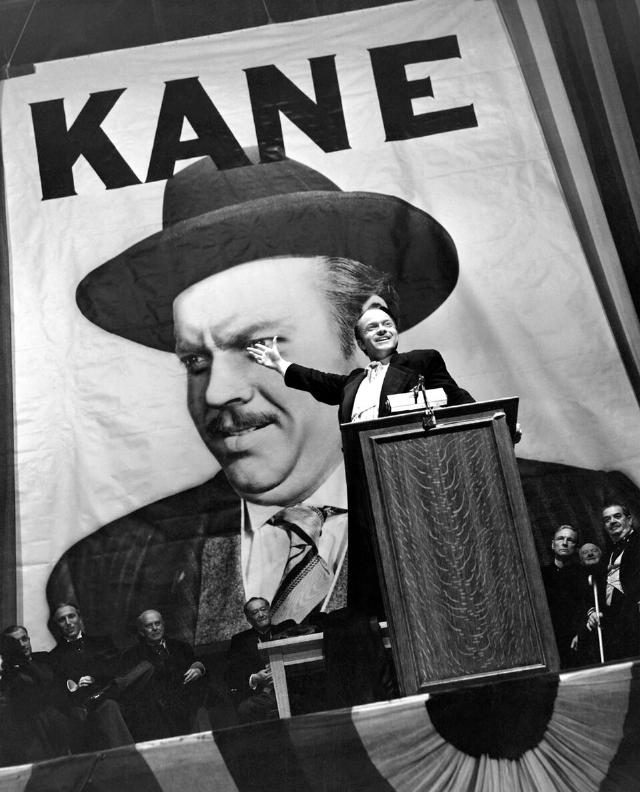
Image: Public domain.