
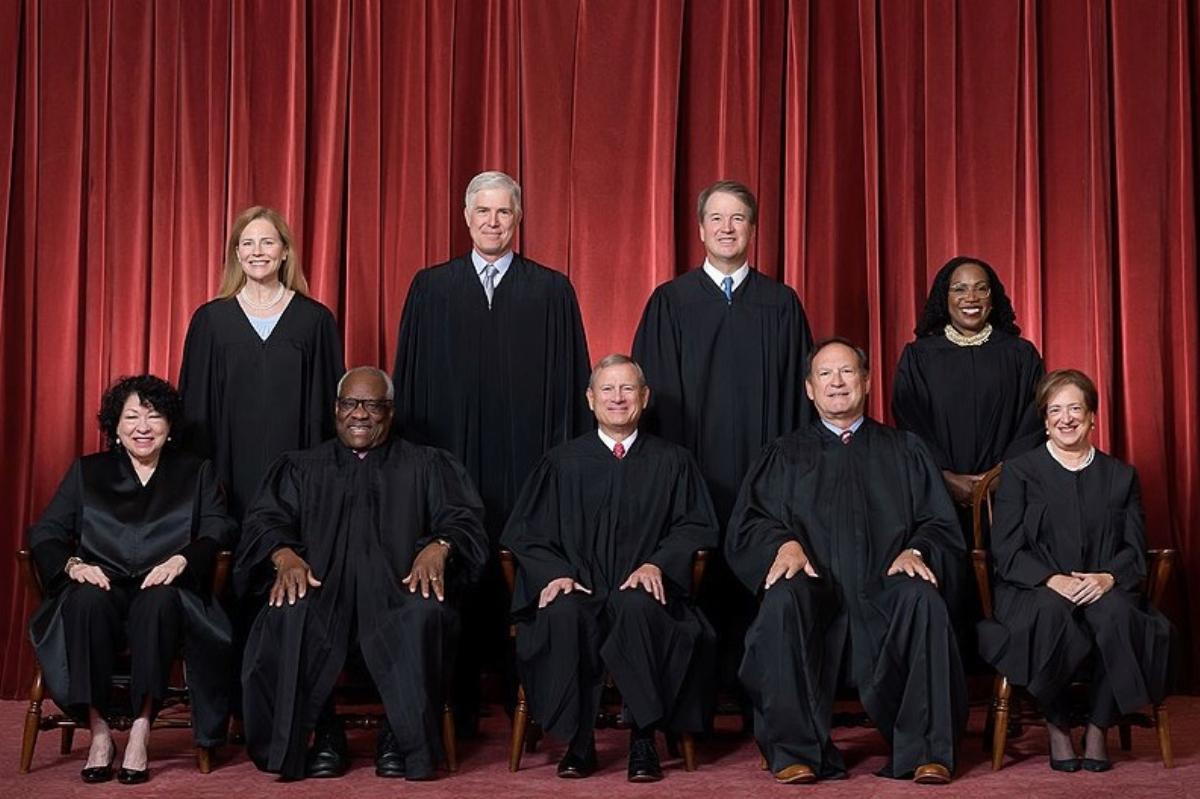
The Supreme Court’s just-concluded term produced several important victories for constitutional principles. Unfortunately, two catastrophic failures on issues central to the integrity of our elections and the preservation of the republic dragged the Court’s overall performance down to a C-minus at best. Had the justices gotten those two cases right, the term would have been remembered as a strong one. Instead, it will be remembered for what the Court refused to do.
Read more In San Diego, invasion of the Chiclet sellers
On the Second Amendment, the Court earned a solid A-plus. In Wolford v. Lopez, the justices struck down Hawaii’s law that effectively banned licensed concealed-carry permit holders from bringing firearms onto private property open to the public — grocery stores, restaurants, gas stations — without the owner’s express consent. This was a clear and correct extension of the right to keep and bear arms into the daily lives of law-abiding citizens.
The Court also handed down a strong decision in the case challenging the broad application of federal firearms prohibitions based on use of controlled substances. The government’s theory was breathtakingly expansive, and it wasn’t just about marijuana. Even minor Schedule V substances or prescription medications (such as Ambien taken by one spouse that belonged to the other, or shared antibiotics like penicillin or amoxycillin) could potentially disqualify a person from owning a firearm. The Court correctly rejected this vague and overbroad approach. These rulings reaffirm that the Second Amendment protects the right to keep and bear arms as a fundamental individual right, not a privilege subject to bureaucratic second-guessing.
The Court also deserves an A-plus for its decisions protecting women and girls in sports. In West Virginia v. B.P.J. and the companion Idaho case (Little v. Hecox), the justices upheld state laws that preserve girls’ and women’s sports for biological females. These rulings correctly recognize that Title IX was always intended to protect biological sex, not to erase it. Justice Kavanaugh’s analysis in these cases was particularly clear-eyed. Allowing biological males — regardless of how they identify — into girls’ locker rooms and onto girls’ teams is not inclusion; it is the erasure of women’s hard-won opportunities and a direct assault on their privacy and safety protected under the Constitution. The Court got this one exactly right.
On the unitary executive and separation of powers, the Court earned a respectable B-plus. It properly recognized the President’s broad authority to set immigration policy, including the termination of temporary protected status for large numbers of foreign nationals (including hundreds of thousands of Haitians and Syrians) as the President acted under congressional authority under the Immigration and Naturalization Acts. The notion that non-citizens present under temporary, discretionary programs enjoy the same due process rights as citizens or lawful permanent residents is constitutionally unsound. Due process under the Fifth and Fourteenth Amendments may apply to “persons” within the jurisdiction of the United States in certain contexts, but the power to deport those who are here only by executive grace belongs squarely to the elected President under Article II.
The Court also took a positive step in the case involving the President’s authority to remove the director of the Federal Trade Commission, reinforcing the principle that the executive branch must be under the control of the President. Harvard Law Professor Alan Dershowitz has long and correctly argued for a strong unitary executive. The Framers gave the President, not Congress or independent agencies, the power to execute the laws. Unfortunately, in the related case involving an attempt to reassign a member of the Federal Reserve Board of Governors, the Court punted the matter back to the lower courts rather than decisively resolving the separation-of-powers question. That hesitation cost the Court a higher grade in this category.
Read more With Iran firing rockets, Trump uses a smart approach to deal with them UPDATE
The most damaging decision of the term, however, was Trump v. Barbara. In a ruling that will stand as a stain on the Court’s legacy, Chief Justice Roberts and Justice Barrett joined the liberal justices to effectively preserve near-blanket birthright citizenship. This was a profound misreading of the Fourteenth Amendment’s Citizenship Clause. The authors of that Amendment, including Senator Lyman Trumbull of Illinois — a close friend and ally of Abraham Lincoln — made clear on the floor of the Senate that the clause was intended to secure citizenship for the children of emancipated slaves, not to create a magnet for illegal immigration or confer citizenship on the children of foreign nationals who owe no allegiance to the United States.
Not only the 14th Amendment, but the Civil Rights Act of 1866, passed by the same Congress, expressly limited citizenship to those “not subject to any foreign power.” That phrase, alone, signaled congressional intent to end blanket birthright citizenship.
The Supreme Court’s 1898 decision in United States v. Wong Kim Ark was a narrow holding involving the child of legal resident aliens. It was never intended to constitutionalize citizenship for the children of illegal entrants. By refusing to correct this decades-long distortion, the Court has handed future administrations and activist judges a powerful tool to continue the demographic transformation of the country through illegal immigration and chain migration. The Solicitor General, frankly, could have been a bit stronger in arguing Wong Kim Ark. But Chief Justice Roberts and Trump appointee Amy Coney Barrett should have known better. This disastrous decision alone tarnishes the Court’s constitutionally sound decisions, and justifies the C-minus grade.
To be clear, the Court did good work this term on gun rights, on protecting female athletes, and on reinforcing presidential control over the executive branch. Those victories matter. But when the Court refuses to enforce clear constitutional limits on election timing and declines to restore the original meaning of the Citizenship Clause, it fails in its most fundamental duty: preserving the republic and the integrity of the processes by which we choose our leaders. Congress has shown little appetite for fixing these problems, as evidenced by the repeated failure to pass meaningful legislation like the SAVE Act. The American people are left to hope that future appointments — and future cases — will correct the damage before it becomes irreversible.
Don Brown is a former Navy JAG officer, nationally bestselling author of sixteen books, and a constitutional attorney who has argued cases before federal courts across the country, and a former United States Senate candidate. He is a frequent commentator on national broadcasts involving legal, military, and national security issues.
Read more I’m not apologizing for America, or white people
Image: Supreme Court