
Today, Elon Musk warns Americans of a woke “mind virus,” the destructive ideologies spreading through censored societies much like contagious diseases—“the woke mind virus is pushing civilization towards suicide” and is “arguably one of the greatest threats to modern civilization.”
Read more Soccer players don’t want to play against the best soccer players
Whatever one’s political perspective, the EU’s communication pattern in attacking X’s free speech offerings is strikingly familiar to the lead-up to the American Revolution, when European bureaucrats believed certain American ideas were so dangerous that their spread must be censored, or at least quarantined to North America.
Indeed, in the years preceding the Revolution, British officials and Loyalists also described colonial freedoms and their resistance to the King in the language of contagion. The “spirit of rebellion” was spreading from colony to colony, infecting minds and threatening the stability of the Empire. Loyalist writers decried how “the violent Spirit in the Whigs… raged with… unbridled Fury,” while officials warned of rebellion as a contagion that could lead to “total Ruin and Destruction.”
The concern went beyond protests over taxes or Parliament. The greater fear in Britain was that the underlying idea of self-government might prove contagious.
Only a generation earlier, Britain had watched disease devastate its Caribbean expeditions against Spain, where tropical illnesses destroyed armies on a scale that shocked the Empire, altered imperial strategy, and contributed to political upheaval in London.
For Britain’s Atlantic leadership, contagion was not merely a medical problem. It had become a strategic one. This observation led me to reconsider one of the most recognizable flags in American history.
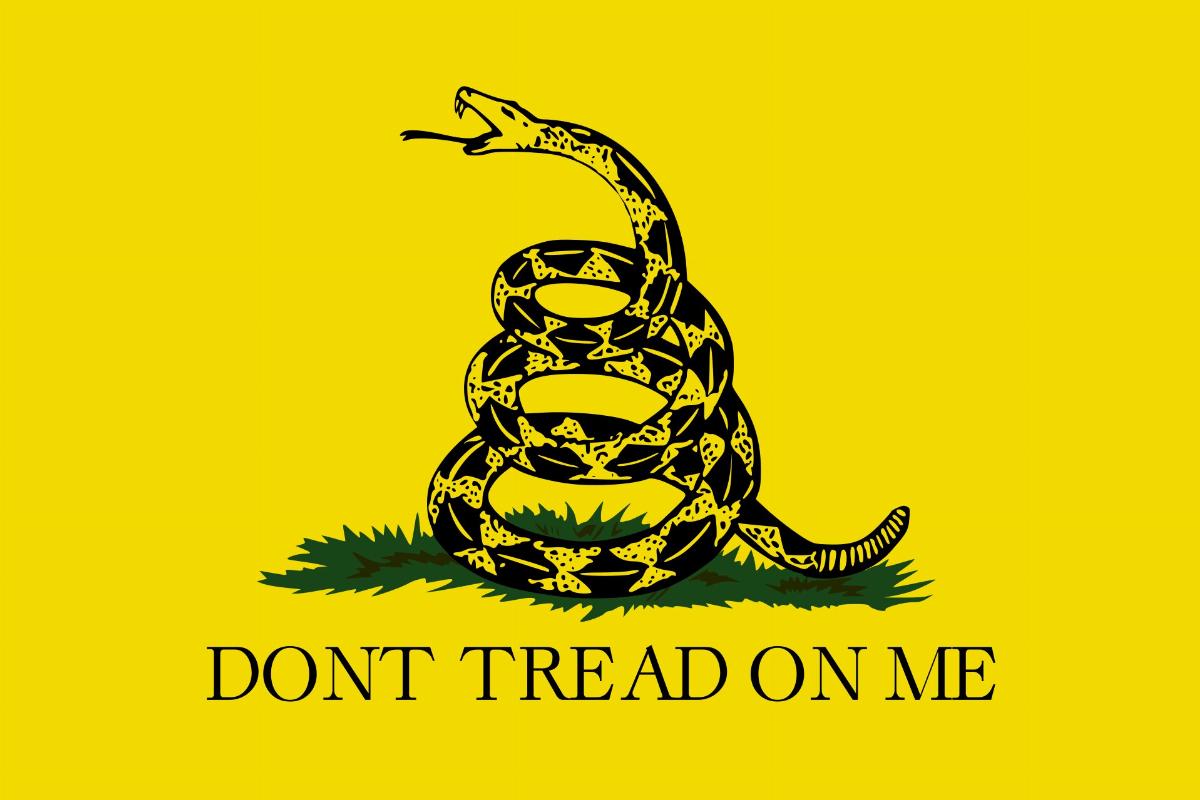
Historians have devoted generations to Christopher Gadsden’s coiled rattlesnake and his warning, “Don’t Tread on Me.” Yet no surviving document answers my question: Why yellow?
More specifically, why would a Charleston merchant and revolutionary choose perhaps the boldest, most unconventional field of any major patriot banner?
As a student of political communication and a retired mariner, I have learned that professionals notice what historians sometimes overlook: backgrounds matter, especially when they carry key context.
Gadsden lived in Charleston, one of Britain’s busiest Atlantic ports. There, communication by color, flag, and signal was everyday life for Royal Navy officers, merchant captains, harbor pilots, and sailors. Long before radio or telegraph, maritime colors conveyed identity, command, distress, danger—and quarantine.
To eighteenth-century admirals and sea captains, color was rarely decoration. It was information.
Historians focus on Gadsden’s rattlesnake because it commands attention. Yet on a battlefield or at sea, observers of his flag would first register the bold yellow field—visible at a distance like the largest letters on an eye chart—well before discerning the snake or slogan.
Also, mariners, soldiers, and sailors even today read signals in layers: what appears first carries immediate meaning. What historians treat as background, I see as yellow intended for primary communication.
John Adams called Gadsden “a man of clear and quick perception.” The same qualities define a successful nautical signal: immediate recognition, no explanation needed … this makes Gadsden’s yellow choice intriguing.
Long before the maritime world standardized the plain yellow quarantine flag—later known as the “Yellow Jack”—yellow was already associated with disease and caution in both Caribbean and Mediterranean ports.
What if yellow meant deadly quarantine? Here the historical record ends and my thought experiment begins.
Modern political communication offers a parallel to this suggestion. One of the quickest ways to weaken an opponent’s attack is to appropriate it. Labels become badges of honor.
Trump’s supporters embraced the “deplorables” label, and his campaign often answered criticism with this type of symbolic reclamation.
Another charged reclamation took place with Biden’s campaign “garbage” insult, which became the highly visible use of a garbage truck by Trump.
Read more Gavin Newsom signs bill to close California’s ‘Epstein loophole’
Moreover, he wore all white, signaling a longstanding sanitation overture where white—in that industry—represents cleanliness and public health, and the implied color message preceded any verbal one.
To this point, effective communicators rarely invent new meanings for colors—they redirect existing ones their audience already understands, much like martial artists recognize that judo seeks to redirect an opponent’s aggression rather than meeting force head-on.
The best political communicators of any generation do the same. So what if Gadsden understood this?
Let’s imagine the exchange.
The King and Parliament call revolutionary liberty a dangerous contagion spreading through the colonies.
A Charleston merchant, fluent in Atlantic port signals, raises a brilliant yellow banner beneath a coiled rattlesnake.
The accusation then is not denied. It is, like a garbage truck, appropriated.
Britain says: “Your liberty is contagious.”
Gadsden replies: “Exactly.”
Britain warns: “It threatens the established order.”
The yellow flag answers: “Then perhaps the established order has reason to worry.”
That is not a communications retreat. It is judo-like ownership.
No letter confirms my theory as Gadsden’s intent, and no responsible historian has claimed otherwise.
Yet the hypothesis merits consideration. Gadsden’s snake—borrowed from a Benjamin Franklin cartoon—has been investigated for generations while nobody I found paid much attention to the extraordinary and meaningful color beneath it.
Indeed, among the Revolution’s best-known banners—the Liberty Tree flags, Sons of Liberty stripes, Pine Tree flags, Grand Union, Moultrie, First Navy Jack, and others—only Gadsden’s used an uninterrupted field of brilliant yellow.
This fact alone raises the question: Why did the yellow choice carry such powerful maritime associations with quarantine? Why this color? Why this audience? Why this moment?
Notably, history shows that Britain had a real fear of ideological contagion, and it was not misplaced, as the Empire lost all thirteen colonies. But its greater defeat was failing to contain the virulent revolutionary idea that governments derive legitimacy from the consent of the governed.
After the Revolution, the freedom virus crossed oceans and inspired movements worldwide. It proved remarkably difficult to quarantine, which is why the yellow field deserves new attention.
Historians focus on the dramatic rattlesnake, but mariners know that colors are not always background—often they are also the message.
If Gadsden intentionally chose a color already linked to quarantine, his yellow flag may be more sophisticated than generally appreciated. It warned Britain not to tread on American liberty or risk acquiring rebellious “American Fever.”
It seems to me that Gadsden quietly answered the Crown’s own disparaging language and blunted it by owning the color of contagion itself.
Two hundred fifty years ago, the British feared liberty would spread, but the only thing they misjudged was whether it could ever be successfully quarantined.
Andre Billeaudeaux is a retired U.S. Coast Guard commander who later served as a strategic communicator for U.S. Naval Special Warfare Command. He is co-author of the peer-reviewed article U.S. National Identity, Political Elites, and a Patriotic Press Following September 11 (Political Communication, 2004), co-founder of the Native American Guardians Association (NAGA), and inventor of the Color Time™ patent, which explores the communication of information through color. His research focuses on strategic communication, historical symbolism, and the role of color in shaping human perception and political messaging.
Read more America’s path through evolutionary eyes
Image: Public domain.