
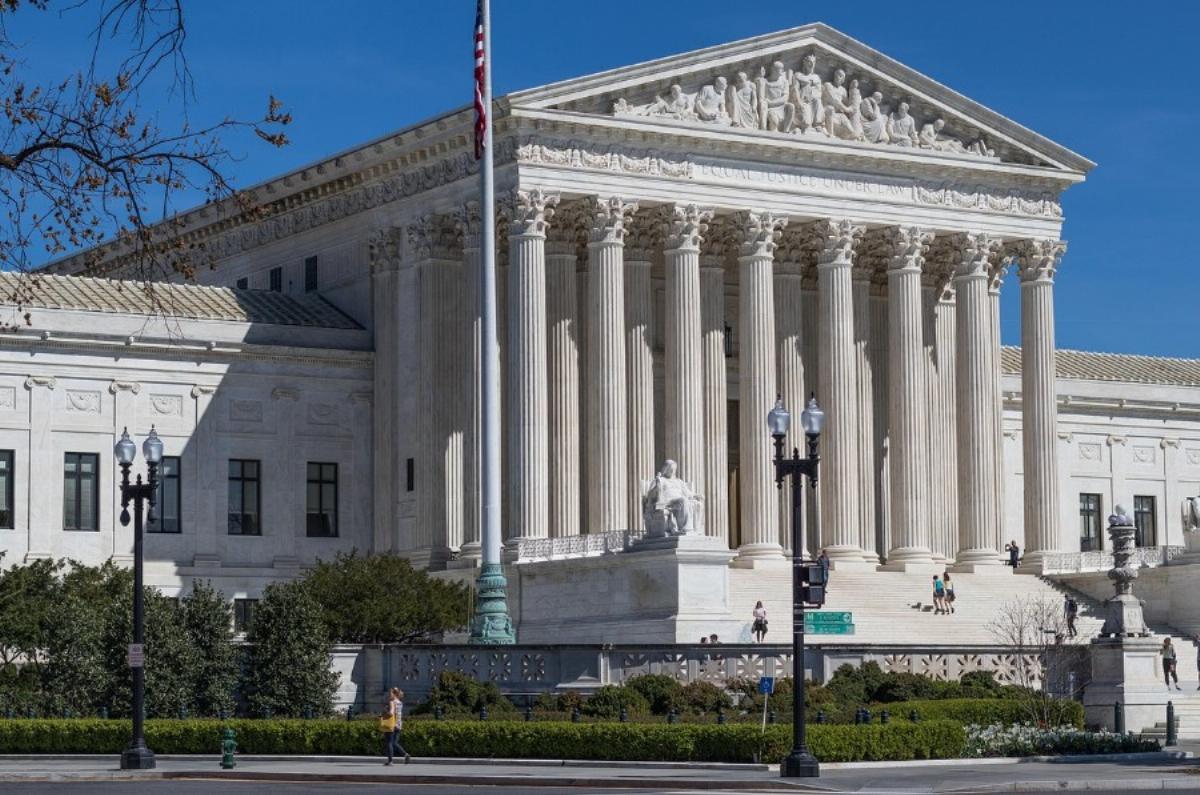
The recent Supreme Court decision on birthright citizenship is a fascinating legal artifact because it provides several lessons on how “law” can be abused by turning it into an exercise of wish fulfillment, instead of a responsibility for discipline.
Read more The most dangerous surveillance company you’ve never heard of
The Court majority writes as if it represents all of humanity, instead of U.S. citizens and their country.
They are turning the U.S. Constitution into an effective “one-world” United Nations charter, with no sovereign anchor.
Those lessons also include the limits of using legal arguments to confront problems that have nothing to do with law per se.
Giving U.S. citizenship to offspring of illegal invaders is not a legal consideration, and doesn’t belong in a court. It got there because the Left can only hide prior legal violations — illegal open borders — with subsequent legal machinery, by subjecting the certainty of national sovereignty to the uncertainty of courts.
Whether birthright is “legal” or illegal; or “constitutionally protected” shifts the original border violation to a subsequent legal controversy which then gets subjected to our adversarial common law system that softens, and even completely changes the nature of the transgression, by masking it with appeals to circumstances. How many rapes, murders, and armed robberies, get commuted to lesser charges or softer sentences, due to appeals to social circumstance, and the political, racial and ideological whims of judges?
This recent SCOTUS birthright decision also underscores that there are always two Supreme Courts operating in any given judicial period: one is focused on the narrow impact and larger effects of the case before it. Call it the “thinking half” of the Court.
The other side focuses on ideology and emotional fantasy. Call the “feeling half” of the Court.
How this birthright case even got into the Court in the first place is another issue, but it did, and the Court opinion majority took it up as a cause, forgetting once again that courts are at their best when they stay out of most matters that belong to other branches, public forums, private society, or other countries.
Illegal birthright is instead a matter of vital presidential judgement over national security that was appropriated by false appeal to judicial review.
There was also an insidious influence in this case because it was psychologically set up as a personal complaint that symbolically pits men against women — or at least it was easy for some to see it that way. The defendant wasn’t just “Doe” but “Barbara,” (and the counterparty not the “President” but “Trump”), and in effect making her the “mother of birthright,” and a subtle plea on behalf of birthing mothers as a global class. The four female Justices arguably acted in solidarity under a potent ideological mix of female liberation, and race. Interestingly, there was no apparent judicial reference to abortion right, live birth, or natal care. Birth is strictly a political event.
If you read the Court’s entire decision, which is worthwhile, you can’t miss the incredibly labored arguments centered around case precedents, and U.S. history concerning slavery.
Read more Americans should cool it on knighting Harry Kane
For the majority this was a chance to further ratify their sentiments of racial oppression, white supremacy, and class prejudice, by ruling for “Barbara” as if she was a symbol for indentured servants wrongly shipped across our border, and deserving of freedom and “rights.” The majority seemed to be motivated to define birthright not only as a vague human right, but as an act of defiance against their object of contempt, especially the US “empire.” The Court majority sounds like a voice acting on behalf of all peoples where “jurisdiction” becomes “beneficence.”
While the Court’s minority made mature, if not technically important arguments, it was Alito who never lost sight of what the case was actually about, and said it directly with the fewest words: US national sovereignty.
He also reasoned accurately about the key technical issue — jurisdiction — and how such powers are formed. Several amicus briefs also addressed the vital jurisdiction issue (law professor Richard Epstein is one, and his ability to reason appears in this case, greater than the majority justices combined).
The minority opinions, and some amicus briefs, reminded the public that it is a fundamental grand hypocrisy to even entertain a plea for U.S. constitutional rights from individuals who stand as U.S. constitutional law breakers. It’s like someone breaking into your house, demanding a right to stay, and then putting their name on your deed as co-owner while you pay the bills.
Birthright also falls into the larger question of what “rights” are.
To the progressive Left, the concept of a right is thought to exist without qualification except circumstances. Rights in modern liberal political discourse are of course not rights, but economic claims made on other parties. It doesn’t occur to the Left that birthright is a claim for benefits made by individuals who want something from someone else: you.
What is birthright to the Left, but a bundled benefits package?
It has nothing to do with asserting any birth safety for example: a pregnant mother giving birth here is not systematically denied human respect, due care or even public safety in our medical system, as a matter of our general shared principles of fellowship, compassion, and practical generosity from our vast public infrastructure. Mothers aren’t being forced to deliver babies in an open field like a herd of animals. But the Left likes to make the denial of birthright seem like an infliction of neglect and cruelty. By mixing human compassion with legal privilege, the judicial left is corrupting earned constitutional rights into unearned rewards, and an expression of their judicial self-importance.
Economist Thomas Sowell referred to this behavior in his book “The Vision of the Anointed: Self-Congratulation as a Basis for Social Policy,” when he noted that the progressive Left are “promoters of a worldview concocted out of fantasy impervious to any real-world considerations,” and that such “Teflon prophets” like to predict universal demise but for their generous intervention. What Alito and his minority opinion colleagues focus on instead, is what their decisions mean to the US, to U.S. citizens, and to the future integrity of a nation.
This makes the SCOTUS more than a bicameral body of idealists and pragmatists, but a Court that contains members who actually have no constitutional right to even be there, if by constitutional right is meant a responsibility and duty to narrowly construct opinions by reference to their impact on U.S. national interests.
The Constitution continues to be stretched into an effective global international charter by pulling the 14th Amendment out of its limited context, and signaling to the world that it can blanket humanity with rights that they haven’t earned. The 14th Amendment has been misleadingly singled out as a unique part of the “American Charters of Universal Freedom.” But that is an indulgence of vague thinking. There is no such right as “universal freedom” except by its attachment to a long list of responsibilities in order to create it, and then to protect it.
That points to perhaps the greatest human tragedy created by the political and judicial left concerning birthright: their refusal to acknowledge that “rights” come from responsibility, and responsibility comes from each individual’s own powers of reason, and conscience. Is it right to traffic in birth? The Court just said it is. It is telling illegals that their rights come instead from surrendering the basis of all rights — their own internal, self-directed “court of conscience” — and that a government court is their provider, and ultimately, their jailer.
Matthew G. Andersson is the author of the forthcoming book “Legally Blind,” and is a graduate of the University of Chicago, and University of Texas at Austin. He has been featured in the Wall Street Journal, the New York Times, and the National Academies of Science, and has testified before the U.S. Senate.
Read more At age 250, is America facing a bump in the road or permanent reroute?
Image: Pixabay // Pixabay Content License