
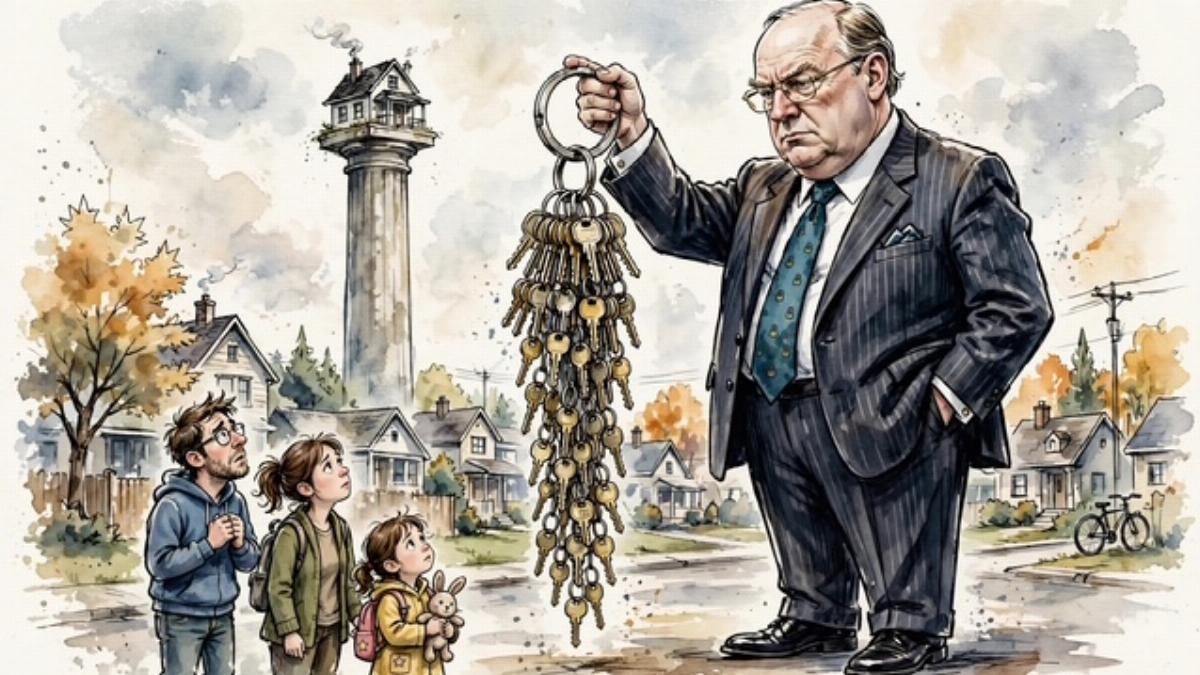
We keep hearing that America is engaged in a class war—the rich at war with the poor, workers at war with corporations, Millennials at war with Baby Boomers—but I think they’re missing the real divide.
Read more Charter schools keep making the case for school choice
The next American class war may not be primarily between rich and poor. It may be between owners and dependents, because ownership is about more than wealth.
Ownership is autonomy. Ownership is leverage. Ownership is the ability to make decisions without constantly asking permission from somebody else.
A person who owns a home has a different relationship with his community than someone permanently at the mercy of a landlord. A person who owns a business has a different relationship with his employees than someone whose entire livelihood depends upon keeping one supervisor happy. A family with savings has options that a family living paycheck-to-paycheck simply doesn’t.
Ownership gives people room to breathe, and increasingly, ordinary Americans are struggling to obtain it.
For generations, the American Dream was understood largely through ownership. Work. Save. Buy something. Pay it off. Build equity. Pass something to your children. The principle was simple: your labor should eventually produce something you control.
That model is becoming increasingly difficult for millions of Americans, and when ownership becomes inaccessible, dependence becomes structural.
You don’t have to be poor to be dependent.
A person earning $100,000 a year while carrying enormous debt, possessing little savings, and owning few meaningful assets may have considerably less economic freedom than someone earning less while owning a home, operating a small business, and maintaining an emergency reserve.
Income tells you what someone earns. Ownership tells you what someone controls.
If conservatives want to become the champions of economic independence, they should become the champions of ownership. Not just corporate ownership, not just Wall Street, not just the wealthy, but ownership for ordinary people.
Homeownership. Business ownership. Land ownership. Investment accounts. Retirement assets. Intellectual property. Skills. Trade licenses. Equity.
Anything that gives a person economic leverage rather than simply another paycheck.
Read more Jeff Bezos talks about growing the population but tip-toes around the obvious
Because a paycheck can disappear.
A job can be terminated.
A rental contract can expire.
But a home can become an inheritance.
A skill can become a business.
An investment can become generational wealth.
That’s why ownership matters politically.
This becomes particularly important when we talk about young men and family formation. We keep asking why young Americans are delaying marriage and children, but perhaps we should also ask a brutally practical question: How do you build a family when you can barely build a balance sheet?
A young man who cannot imagine buying a house, cannot accumulate savings, and is drowning in debt is going to approach marriage differently than his grandfather did. Family formation requires stability—an increasingly elusive privilege, but which becomes easier when people possess assets.
This is where conservatives need to stop confusing low taxes with economic freedom. Taxes matter. Regulation matters. Government spending matters. But economic freedom isn’t simply about what government doesn’t take. It is also about what individuals are capable of owning.
Imagine an economic agenda built around one question: How do we help more Americans become owners within the next generation?
Make it easier to build starter homes. Reduce unnecessary regulatory barriers that inflate construction costs. Encourage apprenticeships and skilled trades. Make it easier for small businesses to form and survive. Promote financial literacy. Encourage saving. Make retirement ownership more accessible.
We spent decades telling young Americans that the path to prosperity was a college degree. Millions followed the advice, often borrowing enormous sums to do it. Then we acted surprised when they emerged into adulthood with credentials, debt and no house. Meanwhile, the trades are screaming for workers, and there is something wonderfully conservative about a person who can look at a broken machine and know how to fix it. There is something even more conservative about a person who can build a house and eventually own one.
I want more people to become wealthy. Not because money is the meaning of life, but because economic independence creates options. Ownership creates civic investment because people become stakeholders. And that is exactly what America needs more of: stakeholders.
Not permanent clients. Not permanent victims. Not permanent dependents.
Stakeholders.
People with enough skin in the game to care whether the game survives.
We need a complete rejection of the dependency mindset.
A government can make people dependent while claiming to help them.
A corporation can make people dependent while paying them well.
A culture can make people dependent while telling them they’re free.
If we want to rebuild the American middle class, perhaps we should stop measuring success exclusively by how much people earn and start asking the more consequential question: How much do they own?
A nation of workers can be economically productive; a nation of owners is politically independent and economically productive.
Read more Americans deserve accurate voter rolls
I would much rather live in the latter.
Image generated by ChatGPT.