
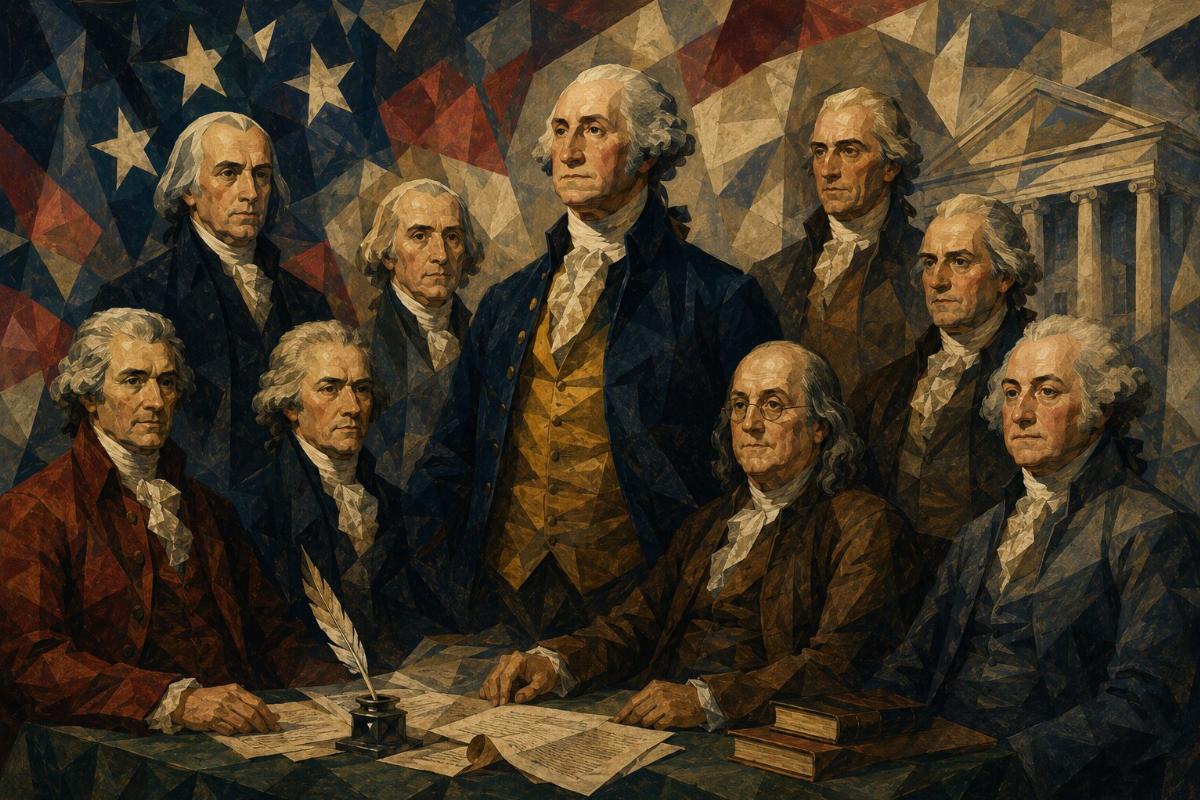
I was eleven at the bicentennial and have been a patriot ever since. Seven years living overseas only strengthened my patriotism. I first lived in Singapore when Saddam Hussein’s Iraq swallowed Kuwait, and a Singaporean asked me, an American, what we were going to do about it. If I had been French or Australian, I would not have gotten such a question. I met U.S. Marines in Singapore on their way to Iraq. When I lived in Ethiopia, I met U.S. soldiers doing “demining”—helping remove landmines. There were no Russian or Chinese troops doing that work. When an ingrate Filipino letter-writer to Singapore’s newspaper complained about American intervention in Asia, I wrote a letter to the editor reminding readers that the U.S. sacrificed our blood to make good on MacArthur’s promise to return and free them from Japanese occupation. When China was rattling its sabers, the U.S. sailed its aircraft carrier, the USS Nimitz, between China and its intended victim. A judge in Singapore exclaimed to me, “Thank God for the Nimitz!” No other nation could do that.
Read more Land of the Free Because of the Brave
Now, many pseudo-sophisticated people look down on celebrating America’s role in the world. Many on the ideological Left treat American history chiefly as a source of shame, as though our country’s story were mainly one of oppression, hypocrisy, and exploitation. That is part of the Left’s larger project: to instill in us a revulsion at our history so we will be willing to embrace a revolution. As George Orwell said, “The most effective way to destroy people is to deny and obliterate their own understanding of their history.” But what is worse is when ostensibly conservative folk join in the sneering. Even some on the right, like Tucker Carlson, now mock ordinary patriots as gullible, flag-waving dupes, people who supposedly lack the real knowledge of American history, while they insinuate that they possess the gnostic insight into how depraved America really has been.
Admittedly, the U.S. has done wrong. The founders should have pushed harder at the point of the Declaration of Independence to denounce slavery. The expulsion of nearly all natives was too ham-fisted. The Chinese Exclusion Act of 1882 was foolish, as Christian Chinese immigrants make good Americans. Japanese internment during World War II was wrong. Worst of all was Roe v. Wade, which allowed the killing of preborn people. But greatness is not sinlessness. The good the USA has done is weighty, and it is not mythology concocted for jingoistic nationalists. It is real. America’s 250th is a great moment to stop and review some of our greatest hits.
Pilgrims really did come to Plymouth to worship God, planting the 1620 Project, the font of real American greatness. A decade later, John Winthrop, while en route to America, really did declare that the colonists would plant “a City Upon a Hill.” Two generations later, Increase Mather really wrote of those founders, “It was a great and high undertaking of our fathers when they ventured themselves and their little ones upon the rude waves of the vast ocean that so they might follow the Lord into his land.” America really did have a Christian founding.
Washington really was great. He may not have chopped down a cherry tree and refused to tell a lie, but he really was a man of integrity. He really did ride his horse between advancing British lines and faltering American ones to rally his troops at the Battle of Princeton on January 3, 1777. He really did step aside from the presidency, creating a precedent for the peaceful transfer of power. Power was there to be grasped, and he relinquished it.
Read more Venezuela quake rescue: Maduro needs a bunkmate
Abraham Lincoln really did save the country and free the slaves. He had to resort to extreme, but constitutional, measures; but he did it so that a government of the people, by the people, and for the people might not perish from the earth. Far from being a “tyrant,” Lincoln allowed a free and fair election in wartime in 1864. He won.
World War II may have been, as Churchill said, Britain’s “finest hour.” But for America, it was even finer. The USA really did put down two fascist enemies at once. It really was so relatively humane and just that German soldiers by the hundreds of thousands, and Japan as a nation, hurried to surrender to the Americans rather than fall into the hands of the alternatives. The U.S. decision to drop atomic bombs on Japan really was best, as Eugene Sledge, a US Marine in Okinawa, himself testified: “The A-bombs saved my life, saved my buddies’ lives, and most decidedly saved the lives of millions of Japanese, civilian as well as military.”
At the end of the war, the USA alone held the atomic bomb. The world was there for the taking, yet America chose to let peoples be free. The USA stared down the Soviets at Berlin, Korea, Vietnam, and Reykjavík, and Reagan’s challenge to tear down “this wall” was ultimately realized. When Iraq invaded Kuwait, the USA defended its treaty partner. We created a global Pax Americana. Singapore’s Lee Kuan Yew celebrated it in his farewell National Day Rally speech in 1990. When China threatens Taiwan, the U.S. sails its warships between them, telling them to settle down. When Israel is attacked by Hamas barbarians, the U.S. sends bombs and vetoes anti-Israel UN resolutions. When Iran pursues nuclear weapons, the United States alone has the reach to force the issue. Todd Beamer really did say, “Let’s roll,” and, with the other heroes of United 93, thwarted the terrorists.
Meanwhile, we really did move toward justice at home for the descendants of slaves, and now we can do so for the preborn. American greatness does not mean American sinlessness. It means that, by God’s providence, this nation has repeatedly used extraordinary power to preserve ordered liberty, correct its own injustices, and defend weaker peoples from tyrants. That is not propaganda to be sneered at. It is a legacy to be celebrated, guarded, and handed on.
Read more Europe’s Boiling Frogs
Image generated by ChatGPT.