
The other day, I argued that the modern panic industry has mastered a single, lucrative trick: detect something, strip away all quantitative context, and declare a crisis before the science can deliver a verdict. The mold-sniffing dog and the Florida government’s botched candy arsenic announcement were my examples. I suggested the playbook was institutional and repeatable.
Read more The New Moral Orthodoxy
I did not anticipate how quickly the next example would arrive—or how much larger it would be.
The plastics-in-blood story is now everywhere. Microscopic images circulating in journals, documentaries, and social media feeds show strange, alien-looking geometric fragments suspended in human blood samples—translucent shards and angular clusters that look less like anything biological and more like debris from a factory floor.
Researchers at the University of New Mexico, peering at brain tissue, described objects so unfamiliar they couldn’t immediately name them. “I’m seeing these things in the microscope that I can’t figure out what they are,” one pathologist reported. “They’re strange brown lumpy things.”
The images are genuinely arresting. The detection is real. Microplastics have been found in human blood, brain tissue, placentas, and arterial plaque. Nobody credible is disputing that something is being seen.
What is being systematically ignored is the question that actually matters: Does seeing it mean it is harming us?
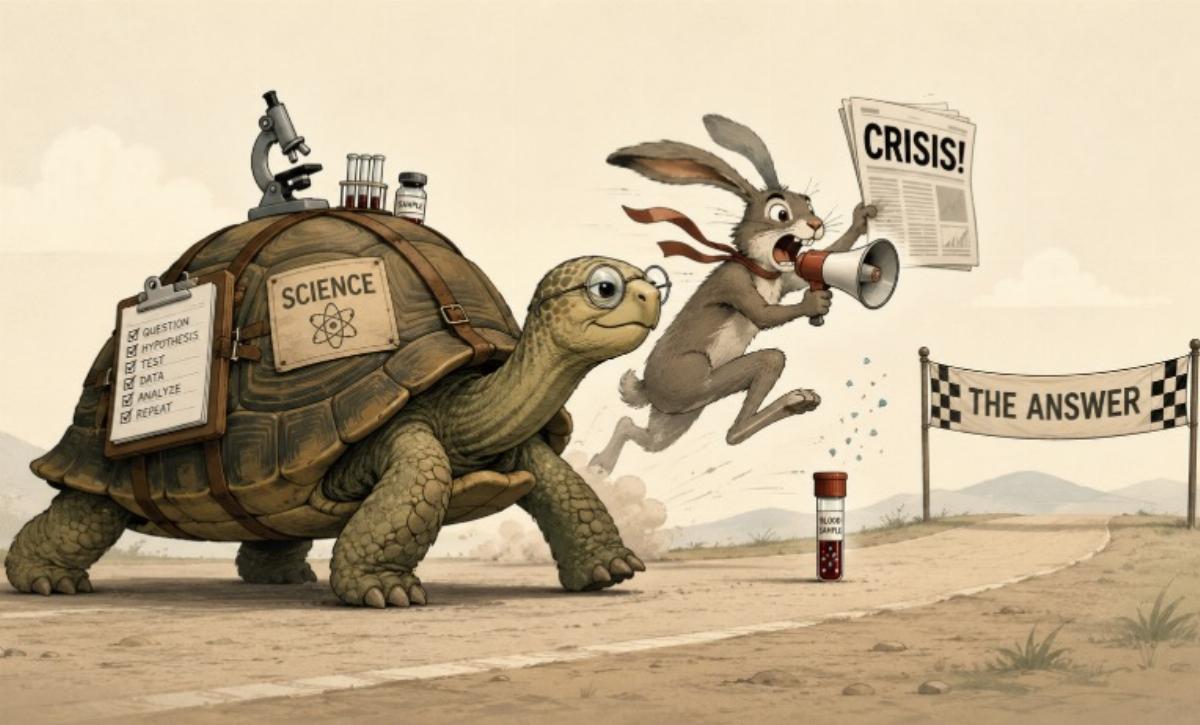
Here is where Aesop becomes relevant. The media covering the plastics-in-blood story is the hare—fast, confident, already well ahead, pausing to nap in the certainty that the conclusion is obvious. The science is the tortoise—methodical, slow by design, and nowhere near the finish line. The hare has already declared a crisis. The tortoise is still carefully placing one foot in front of the other, and all serious attention should be on it.
Consider what the tortoise has actually established so far, and what it has not.
The high-profile studies that drove the public narrative—including a February 2025 paper in Nature Medicine claiming rapidly rising microplastic levels in human brains, and studies suggesting human tissue may contain up to half a percent plastic by weight—have run into significant scientific headwinds.
In January 2026, we learned that nine credentialed measurement specialists published a formal challenge in Nature Medicine itself, arguing that the brain study had insufficient contamination safeguards and inadequate validation protocols. “This paper is really bad—and it is very explainable why it is wrong,” said co-author Dr. Dušan Materić, an analytical chemist at the Helmholtz Centre for Environmental Research.
The methodological problem is specific and serious. The primary detection technique used in many of these studies—pyrolysis gas chromatography mass spectrometry—produces chemical signatures for plastics like polyethylene that are nearly identical to the signatures produced by the fatty acids naturally present in human tissue.
A University of Queensland environmental chemist concluded in a peer-reviewed 2025 paper that the technique “is not currently a suitable technique for identifying polyethylene or PVC due to persistent interferences.” The Breakthrough Institute’s 2026 review of the field found that the field is currently in what researchers themselves describe as a “Wild West” phase—every laboratory using different digestion protocols, different instruments, and different standards, making results between studies almost impossible to compare.
In plain language: some of what is being photographed and reported as plastic in human blood and brain tissue may be the tissue itself, misidentified by instruments not yet refined enough to tell the difference reliably.
Read more The DSA Takes Over The Democrat Party
None of this has slowed the hare.
The EPA and HHS announced joint regulatory actions on microplastics in April 2026. The Lancet Commission estimated the health costs of plastic contamination at $1.5 trillion annually before a peer-reviewed consensus on actual human harm thresholds existed.
Class action lawsuits are already in motion against bottled water companies, food container manufacturers, and baby bottle producers—with plaintiffs’ firms having identified “we found it in your body” as perhaps the most powerful opening line ever delivered to an American jury, regardless of whether causation has been established.
The tortoise, meanwhile, is doing what tortoise science always does: raising its hand and asking the uncomfortable questions. What concentration is harmful? Compared to what validated baseline? Measured by what verified and reproducible methodology?
As the FDA and World Health Organization have both noted, it remains genuinely unclear whether the levels currently being detected in human tissue are sufficient to cause clinical harm. That is not a corporate talking point. That is where the peer-reviewed science actually stands today.
There is a profound irony buried in the geography of this story. The 2022 study that first definitively identified and quantified microplastic particles in human blood was conducted at Vrije Universiteit Amsterdam—Dutch researchers, Dutch laboratory, Dutch lenses trained on something nobody had clearly seen before.
This is precisely what Antonie van Leeuwenhoek did in Delft in the 1670s, when he ground his own glass, peered into a drop of pond water, and became the first human being to see microorganisms. As someone of Dutch descent, I find a certain wry pride in that four-century continuity of careful observation.
But Leeuwenhoek’s real contribution was not simply that he looked closer than anyone before him. It was that he then spent years—decades—measuring, documenting, and verifying before making claims that overturned the known world. He did not call a press conference after the first strange thing swam across his lens. He did not file a lawsuit. He kept looking.
We may indeed be standing at a genuine Leeuwenhoek moment with plastics in human blood. The detection technology has, for the first time in history, become sensitive enough to find particles measured in nanometers inside living tissue. That is a remarkable and possibly world-changing capability. It may ultimately reveal a serious and previously invisible threat to human health. The tortoise may eventually cross the finish line carrying genuinely alarming news.
But the distance between seeing something for the first time and understanding what it means has always been measured in years of patient, rigorous, replicable science—not in media cycles, not in regulatory press conferences, and certainly not in class action complaints filed before the toxicology has delivered a verdict.
All eyes on the tortoise. That is where the real answer lives. The hare has already put us through enough.
Read more ‘A Few Men Well Conducted’
Image created using AI.