
There are different types and degrees of peace between people and between governments. Here, our view will be simplistic. Peace is good for “stayin’ alive” and raising children. However, surprisingly, ordinary peace is a net loss for the individual and the culture, for it causes our brains to atrophy.
Read more The Thing
Ten to twenty thousand years ago, people’s brains were 20 percent bigger, which makes perfect sense. Walking on the uneven forest floor or running across the savannah to catch lunch, all without shoes, places stress on the body and brain that walking on sidewalks does not.
Our brains rose to the challenge of being barefoot. If people are lucky, today they walk on sidewalks and wear shoes. But then our brains shriveled for lack of challenge. The “peace” granted to us by sidewalks has allowed a few people to make progress in other areas, such as mathematics. These very bright people can buy their lunch at the university cafeteria.
If we are without pressing problems to focus on, we can become both ignorant and stupid, either slowly or very quickly. We may think of ignorance and stupidity as arising in less than a minute if one takes comfort from abused drugs.
The rule of arrested development holds true for every activity and for every creature. In fact, this might be an opportune moment to remind the reader of his high school quantum mechanics course: what we call intelligence—the ability to solve a problem in more than one way—preceded humans, preceded multicell organisms, preceded single-cell organisms, preceded slime molds, and probably permeated the universe at its creation.
Each paramecium, creature, and person is tied to the problem-solving nature of the universe. But here is the paradox. Today’s paramecium is just as good as a paramecium from millions of years ago, but it also is not a hair’s breadth better.
The paramecium solved all its problems and stopped developing. Is that to be our fate? Are we due to atrophy because we have limited ability to solve increasingly difficult problems, or because there are fewer problems worth solving?
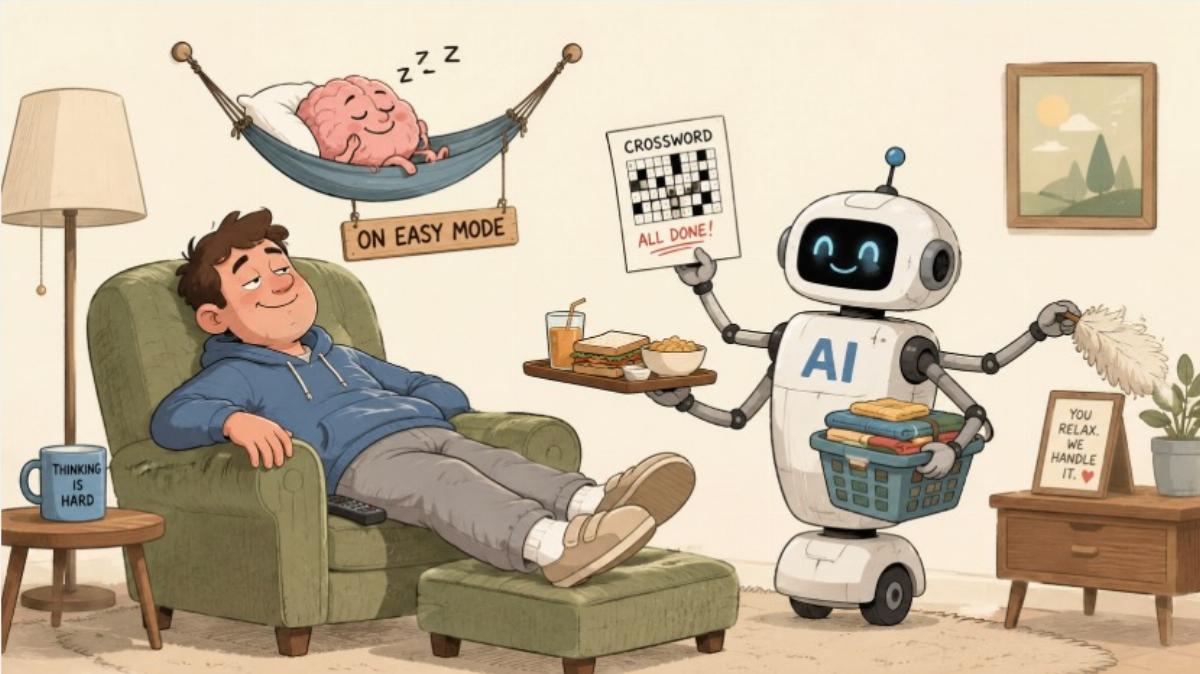
How does artificial intelligence (AI) amplify this problem? Why is AI a threat to humanity? We can see the process is already in full swing as we become dependent upon ChatGPT.
In the coming epoch, when AI solves problems that did not at least originate in a person’s mind, we will become no different from any other creature that has stopped evolving. Any mechanism or construct that operates among people to make us more comfortable also makes us less adaptable.
A mundane example: kids can no longer tie their shoelaces because Velcro is quicker and takes less brainpower—literally, uses fewer calories.
Does that mean we should return to walking barefoot? No, but it may mean that some of us should preserve our brains by learning, not just how to tie, but also how to make our own shoes. Power and money make people fat and lazy. If we had to grow the cow to get leather for our shoes, that might work to our brains’ advantage.
A critical example: school used to be hard. No more! In junior high school in the 1960s, there were special progress (SP) classes where students with IQs of 130 or higher would complete three years of work in two. An IQ of 130 made the difference between being kicked upstairs or held down.
Of fourteen 7th-grade classes in one junior high school, two were designated SP. Overall, the demanding system at least helped define the direction we were expected to push.
Schooling can always be designed to challenge us, but it can also be used to degrade us. It is not only a moral value to stretch each child to his upper limit; it turns out to be a survival mechanism for the species. Shakespeare is not merely great literature. It is a tool for preserving and developing human neurology.
In the end, peace as a soporific undermines human existence. It has transformed us into the litter in the litter box that services the AI monsters we have now taken into our homes as pets.
People who still lack access to sources of clean drinking water have cell phones, though their babies still die at a higher rate than the world average. That is bizarre!
Word is that an AI data center (Google) to be built in Texas plans to drain part of the Rio Grande, which is important for agriculture, to feed its cooling units. That too is bizarre!
But thanks to these strange proclivities and priorities, the future is becoming clearer: human mediocrity does not require much improvement as long as it controls tools that are already excellent. This inclination to seek power that requires little of our personal effort will continually make us weaker and less human than we are today.
However, in this observation lies the hope. By recognizing the problem of mediocrity within us, we have at least given voice to a problem worth addressing and perhaps resolving, at least in part.
Read more Scott Wiener’s horrible Humpty Dumpty take on what the rainbow means
Image (ironically) created using AI.