
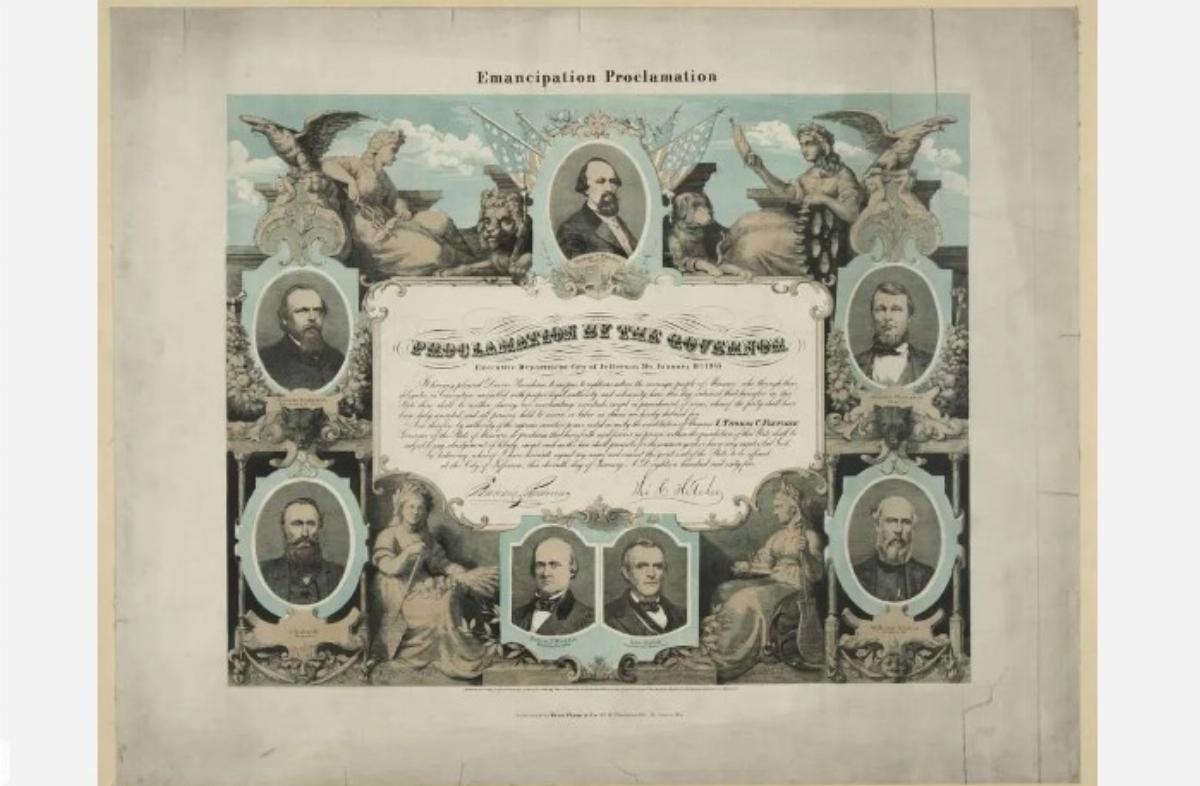
On June 19, 1865, two months after Confederate leader Robert E. Lee surrendered at Appomattox, Union Gen. Gordon Granger arrived in Galveston, Texas and announced that enslaved people in Texas were henceforth and forever free under Lincoln’s 1863 Emancipation Proclamation.
Read more Should cops be feared or respected?
Today Juneteenth is celebrated as a federal holiday and widely portrayed as marking the end of slavery in America.
The modern celebration of Juneteenth arose largely from the Black Liberation movement of the 1960s, when activists sought distinct black cultural institutions, traditions, and holidays.
Unlike the earlier civil rights movement, which emphasized that blacks were fully American and entitled to equal treatment under the Constitution, the Black Liberation movement increasingly stressed a separate cultural identity and historical experience. One result was a search for uniquely African-American symbols and commemorations.
In that search, Juneteenth eventually moved to the front of the line.
Until then, Juneteenth had received relatively little national attention because, in practical terms, the Emancipation Proclamation initially freed very few people. It is often remembered as a document that instantly ended slavery. In reality, it was largely a wartime proclamation directed at slaves living in territory beyond Union control. Its purpose was to encourage slaves to abandon their masters and undermine the Confederate war effort.
This 2010 song, by the bluegrass ensemble The Steeldrivers, co-written sung by then lead-singer Chris Stapleton, is illustrative:
Because that objective largely failed, history has elevated the Proclamation into a symbolic event comparable in importance to the Declaration of Independence.
Yet emancipation proclamations were a common wartime tactic. Before the Industrial Revolution replaced slave and serf labor with machines, opposing governments frequently attempted to weaken enemies by encouraging slaves or serfs to flee, rebel, or otherwise disrupt the opposing society.
In that regard, Lincoln’s proclamation was disappointing. No large-scale slave uprising followed its issuance. Indeed, Ida B. Wells, while defending black men against charges used to justify lynching, noted that during the Civil War, many Southern plantations were left largely in the hands of enslaved blacks while white men went off to fight. Yet there was no widespread pattern of violence against the families left behind.
While the Emancipation Proclamation failed to generate a major slave uprising in the South, what followed almost turned it into a political disaster in the North.
Instead of causing an insurrection in the Confederacy, it helped provoke resistance among some Northern soldiers who had enlisted to preserve the Union rather than abolish slavery.
It wasn’t all of them, but many soldiers reacted negatively when Lincoln announced the Preliminary Emancipation Proclamation in September 1862. Contemporary accounts describe protests by soldiers and officers who believed they had enlisted to save the Union, not to fight an abolitionist war.
In the 20th New York Infantry, approximately 200 men refused orders before the Battle of Chancellorsville in 1863. Although their dispute involved enlistment terms, it occurred amid widespread dissatisfaction over the changing goals of the war.
A number of Northern officers resigned rather than continue serving in what they viewed as an abolitionist war. Resistance was particularly noticeable in parts of the Midwest. Some soldiers threatened not to reenlist, while many wrote angry letters home.
The violent reaction expected in the South instead appeared in the North. The 1863 New York City Draft Riots were fueled in part by opposition to emancipation and fears that freed slaves would compete for jobs. Hundreds were killed and many more injured in one of the worst episodes of civil unrest in American history. Many black residents fled portions of the city to escape the violence.
Lincoln’s generals warned that support within the army could erode if the conflict came to be viewed primarily as a crusade against slavery. Gen. George McClellan’s Harrison’s Landing Letter urged Lincoln not to transform the war into a revolutionary struggle against Southern institutions. Gen. Don Carlos Buell voiced similar concerns.
Ironically, one earlier emancipation proclamation did produce the type of response Lincoln hoped to achieve.
On Nov. 7, 1775, Virginia’s royal governor, John Murray, the 4th Earl of Dunmore, issued a proclamation offering freedom to enslaved people owned by Patriot masters if they escaped and joined the British cause.
The response was immediate. Tens of thousands of slaves fled Patriot-controlled areas during the Revolutionary War. Several thousand served with the British in military units such as the Ethiopian Regiment and the Black Pioneers. The possibility of slave revolts spread fear throughout the Southern colonies.
The fear became so intense that when the Revolutionary War ended, Britain evacuated tens of thousands of Black Loyalists rather than leave them to the mercy of their former owners.
The irony is difficult to miss.
Lincoln’s Emancipation Proclamation is celebrated as the document that freed the slaves even though it produced no large-scale slave revolt and had little immediate effect in Confederate-controlled territory. Juneteenth commemorates the delayed announcement of that proclamation in Texas more than two years later.
Meanwhile, Lord Dunmore’s Proclamation of 1775 produced exactly the kind of response emancipation proclamations were designed to create. It encouraged large numbers of slaves to flee, contributed manpower to the British war effort, spread fear throughout the South, and directly affected the course of the Revolutionary War.
Yet today it is largely forgotten, while Juneteenth has become a national holiday. History sometimes remembers symbols more vividly than results.
Image: Library of Congress, via Picryl // no known copyright restrictions