
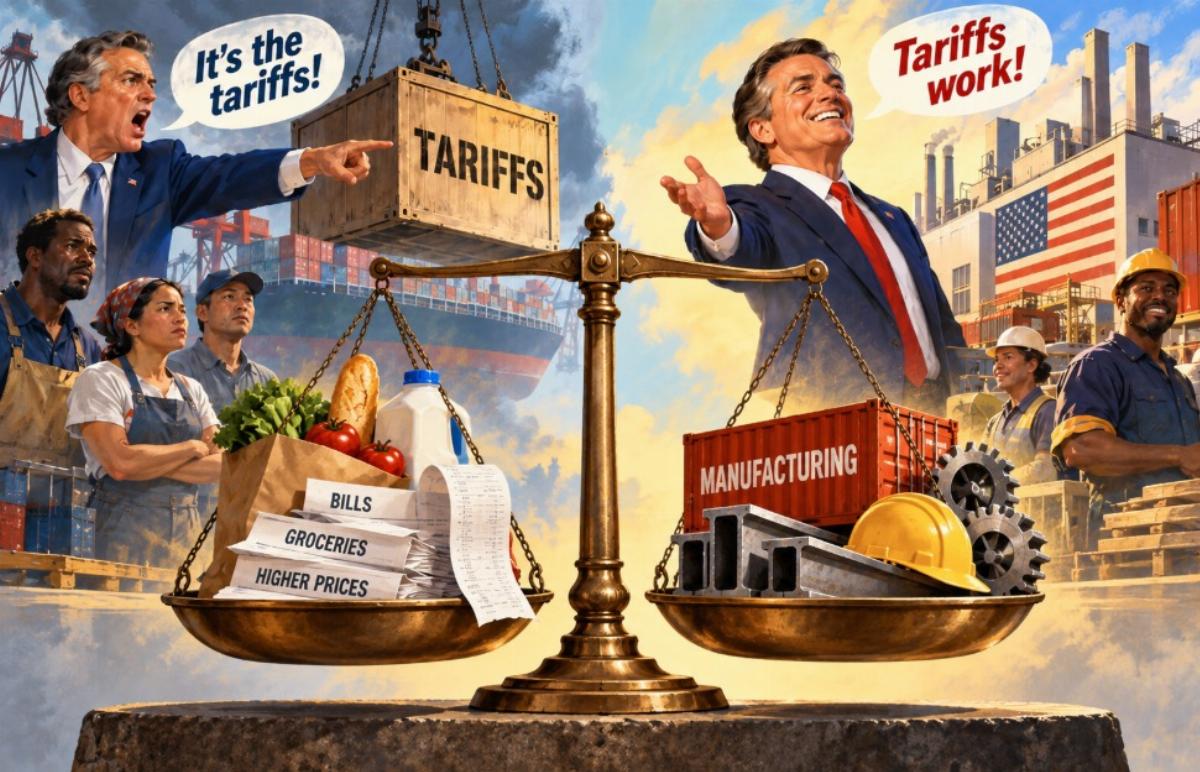
President Trump’s “Liberation Day” tariffs, introduced on April 2, 2025, shortly after he took office, are central to the fall congressional campaign. According to the , 33% of the nation’s voters identify tariffs as the leading cause of inflation, followed by government spending at 24% and the war in Iran at 23%. In Michigan, a key battleground state, a Democratic Party press release says that the tariffs have cost the state’s families up to $5,600 a year. Trump and his America First MAGA Republicans counter that the tariffs have been good for the economy because, they say, manufacturing is booming, employment is growing, and the economy is getting into high gear.
Read more The Blank Stares Of America’s Future
The strongest evidence suggests that tariffs increased inflation by about 0.8 percentage points and increased taxes on U.S. household income by roughly $800 in 2026, according to the Tax Foundation. An increase in tariffs is a reduction in take-home pay. By this past July, the latest month available, the inflationary effect had fallen to somewhere between 0.2 and 0.4 percentage points, according to research from the and the Federal Reserve Bank of Minneapolis. No Michigan-specific estimate is available.
Why is each party so far off the mark? Because neither is willing to follow a fundamental requirement of economic analysis: holding all other explanatory factors constant—the principle of ceteris paribus.
The Michigan Democratic Party press release attributes the full cost of the tariffs to Michigan families. But dividing a state’s total importer tariff burden by its number of households does not accurately estimate the average household’s actual tariff costs. This calculation ignores refunds issued after the Supreme Court ruled in February that Trump’s “reciprocal tariffs” were unlawful. According to The Wall Street Journal, Walmart plans to use much of its nearly $3 billion in tariff refunds to lower prices.
Higher transportation costs driven by rising energy prices will likely offset much of those savings. However, inflation-adjusted prices for new motor vehicles have fallen 4.3%, suggesting that other market forces have at least offset some of the upward price pressure from tariffs. The calculation also fails to exclude tariffs on those goods that Michigan manufacturers and resellers ship to other states, where buyers bear those costs.
Offsets matter. Correlation is not causation. The counterfactual must be considered.
MAGA Republicans also fail to account for the offsets.
Independent Federal Reserve economists have done just that, finding that President Trump’s 2018–19 tariffs resulted in lower manufacturing employment and higher producer prices. They estimated that his tariffs raised core goods PCE prices by 3.1% through February 2026, accounting for all excess inflation in that category relative to pre-pandemic rates, according to a Federal Reserve analysis and research from the .
Read more What The Latest ‘No Kings’ No Show Told Me
Following Trump’s “Liberation Day,” the nation’s average effective tariff rate rose from 2%–2.5% to a peak of 11% in late 2025, then fell to just below 7% in May 2026—still nearly three times the rate Trump inherited from Biden, according to the Federal Reserve Bank of St. Louis. Although tariffs can cause a lasting increase in the price level, their contribution to inflation ordinarily diminishes once that increase has worked its way through the economy.
Inflation remains a concern, but Trump’s tax and regulatory reforms appear to have strengthened the economy. Based on Motio Research’s estimates, annual growth in inflation-adjusted median household income averaged approximately 1.5% over the past five quarters, compared with 1.1% in the preceding five quarters. The Census Bureau’s latest publication reported a 3.1% increase in median after-tax household income in 2025, up from 1.8% in 2024. Year-over-year inflation was 2.6% in both years.
The Federal Reserve Bank of Atlanta projects annualized real GDP growth of 3.6% for the third quarter, above the 2.0% long-term trend, and growth of 4.6% in consumption plus nonresidential investment. These are key indicators for American consumers and investors.
Tariffs are no longer a significant source of inflation. Energy prices will fall once the conflict with Iran is over. Government spending is the problem, running at $7.4 trillion a year—28% above the pre-pandemic 2019 level. The Democrats’ Medicare for All proposal would add more than $4 trillion a year to government spending, according to analyses from the American Action Forum and the Urban Institute, as reported by Newsweek, while their Net Zero auto regulations would add thousands of dollars to the price of a car.
But Trump and the MAGA Republicans have gained nothing by touting imaginary benefits of his tariffs. They should stop defending the indefensible.
Image created using AI.
Tom Walton, Ph.D., retired as General Motors’ Director of Economic Policy Analysis. He previously served as an economist at the Federal Trade Commission and was Assistant Professor of Finance at New York University’s Graduate School of Business.
Read more Good Guys With Guns Are Nightmare Fuel For Gun Grabbing Ghouls