
This journey of life is a complicated path filled with choices and unexpected variables that often confront us without warning. Our formative years are spent in structured learning environments tailored to meet community expectations or, at the very least, geared toward imparting foundational skills. Boundaries are generally established because even the most extreme elements of our culture recognize that total anarchy is unsustainable. However, as cultural norms have shifted dramatically over the past few decades, introducing moral standards, especially those denoting religious conformance into the minds of our youth, is increasingly framed as regressive or malevolent. Hypocrisy runs rampant in this discourse: those most opposed to instilling traditional moral or spiritual guidance turn around with unmasked exuberance to exert their own form of unbridled inculcation.
Read more Nidal Hasan: An eye for an eye
This dynamic represents a crisis of identity perpetrated upon society’s most vulnerable class: our youth. A controlled propaganda apparatus purports to protect young people from a perceived bureaucracy of religious and conservative ideals, while carrying out the exact form of narrative mind-control it claims to oppose. While most citizens went about their daily lives, raising families and building careers, a left-wing intelligentsia executed a wide-reaching cultural strategy, embedding its worldview through state-provided education and academic institutions.
The results are now on full display in the widespread tolerance for radical ideologies, often presented beneath a thin veil of social progressivism. Yet a new dimension has emerged alongside these traditional political dynamics: an unexpected convergence among groups seeking to disrupt existing civilizational structures. In a striking geopolitical irony, an alliance has formed between radical left-wing elements and fundamentalist Islamist movements. While the latter seek the total dominance of strict religious law over secular state structures, the former often champion individualized hyper-progressivism, failing to recognize the contradictions inherent in this partnership. Bound by shared opposition to Western institutions, traditional Judeo-Christian values, and constitutional conservatism, these groups have formed a tactical bloc, even as their underlying worldviews remain fundamentally incompatible.
On paper, these two factions could never coexist. Yet, united by shared adversaries, their agendas have converged around a single objective: the dismantling of established Western governance and social norms. It is a strange alignment, particularly given that strict interpretations of Sharia law mandate severe penalties, including execution, for same-sex relationships and non-conforming social identities. According to recent human rights tracking data, approximately 64 countries globally continue to criminalize same-sex activity with imprisonment or the death penalty. Unsurprisingly, most of these jurisdictions are in parts of the Middle East, Africa, and Asia where forms of Sharia law predominate, alongside extremist non-state actors like ISIS and al-Qaeda that enforce these codes ruthlessly.
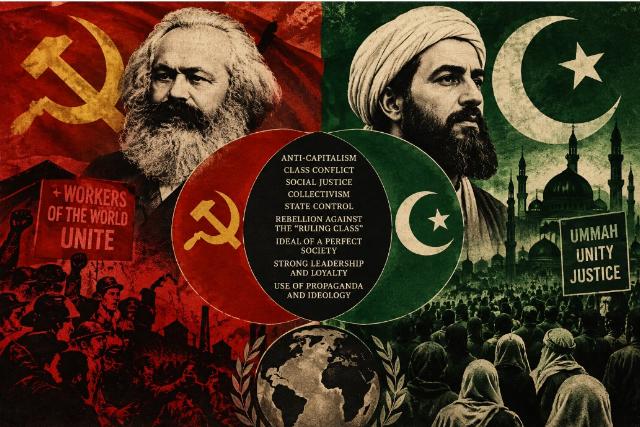
A central state actor in this broader geopolitical push is Iran. Tehran fuels hostility toward Israel and the West while conducting regional warfare through its network of proxies, including Hezb’allah, Hamas, and the Houthis, under the banner of the “Axis of Resistance.” In recent years, this strategy has gained passive support from radicalized elements within Western universities and activist circles. Many within these movements, often insulated from the harsh realities of governance or economic production, demand sweeping state-driven redistribution, including guaranteed wages, government-provided healthcare, and subsidized housing. Rejecting free-market capitalism as inherently oppressive, they have embraced identity politics, dividing society into rigid categories of oppressors and victims. Guided more by emotion than historical literacy, they overlook a critical precedent: this exact dynamic has played out before, most notably in Iran itself.
In 1979, widespread popular unrest against the authoritarian rule of the Shah culminated in a national referendum establishing the Islamic Republic. Power was consolidated under a constitution that placed supreme religious and political authority in the hands of ruling clerics. Later that year, radical students seized the United States Embassy in Tehran, holding 52 American diplomats and citizens hostage for 444 days. Once in firm control, Ayatollah Khomeini instituted rigid religious rule. In a move that modern secular leftists would do well to study as a warning, the regime swiftly turned on the secular socialists, left-wing reformers, and student activists who had helped overthrow the Shah. Through mass executions, academic purges, and the systematic suppression of civil liberties, the new theocratic state eliminated the very allies who had enabled its rise.
Read more Our experiment in republican democracy
Today, similar currents of unrest manifest across Western nations, from civil disorder in European capitals to high-profile protests and campus occupations across major universities, where activist groups denounce everything from free-market institutions to traditional religious identities. This volatile mixture of radical ideology and political agitation risks destabilizing the foundations of open societies. If left unchecked, the internal momentum of this movement threatens to consume the very factions driving it forward, leaving little room for moderate or open governance to survive.
Europe is already struggling to address the consequences of ideological appeasement and porous borders, finding its cultural identity and public safety eroded. The United States faces a similar inflection point; without decisive leadership, comparable instability will continue to encroach on domestic life.
The paralysis of appeasement, fueled by a reluctance to identify threats clearly, leads toward institutional decay. Failing to confront radical ideologies, whether hardline fundamentalism or authoritarian collectivism, jeopardizes the protections that open societies rely upon. Totalitarian systems, regardless of their branding, seek complete control over public and private life, threatening freedom of thought, expression, and religious practice.
When movements demand the protection of free speech while systematically suppressing opposing viewpoints and shutting down debate, they undermine the core tenets of pluralism. Similarly, when political factions rely on aggressive identity politics to marginalize and intimidate opponents, they erode the democratic norms that safeguard individual liberty.
Courageous, disciplined leadership is urgently needed. Ideologies and organizations committed to destabilizing constitutional republics must be met with accountability and firm resolve. Across the political spectrum, leaders must look beyond routine partisan disputes to defend the foundational rights of free citizens. The challenges facing Western institutions will not dissipate through passive avoidance; addressing them requires a clear-eyed defense of liberty, order, and constitutional principle
John Stephen Frey is a writer and commentator focusing on culture, geopolitical dynamics, Christian faith, and constitutional principles. He is the author of Beyond the Broad Path: Embracing the Narrow Way of Certainty in Christ. Read more of his essays on politics and Christian thought at www.lifebeyondhorizons.com.
Read more Survey says nearly half of college students think ‘hate speech’ should be met with violence