
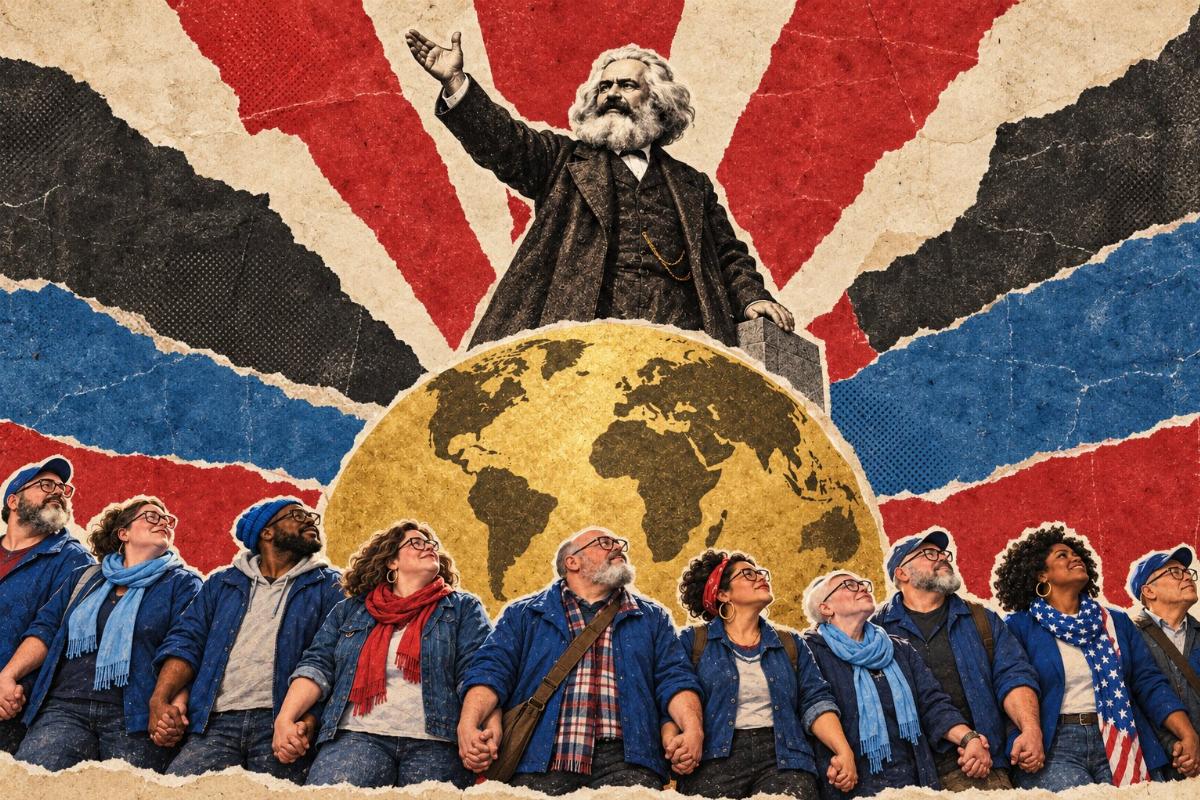
The recent socialist renaissance spearheaded by Mamdani and his DSA cohorts is not as surprising to me as it is to others. Although to date, America has been fortunate enough to avoid the excesses of socialism and communism, widespread unsound economic thinking persists and leaves it vulnerable to promises of something for nothing from demagogues. One measure of that thinking is the widely held opinion that labor unions are not only beneficial to their members, but also to industry and the economy.
Read more Iran’s Ring of Fire Now Ashes
Collective labor bargaining takes two forms. One in which employers act in concert as members of an employers’ association to affect wages and working conditions; the other in which employees act in concert as members of an employees’ union to do the same. We have laws expressly forbidding the formation of the former, while there are laws that foster the formation of the latter. This asymmetry alone should spark intellectual curiosity.
The subject of labor unions sparks a highly emotional response from many Americans who might be union members themselves or have parents who were once members of a union. My point is not to stir up emotions about what is fair, but instead to assess dispassionately the economic consequences of unions and their effect on industry.
One example of their effect on industry is demonstrated through the history of the United Automobile Workers (UAW) which was highly successful in securing better wages, greater job security, and more favorable workplace rules for its members. Over time, however, these added labor costs, contributed to higher automobile prices and made American-made cars less competitive with Japanese and other foreign vehicles, both in the United States and abroad.
In 1950, the United States produced roughly three-quarters of the world’s automobiles, while Japanese production amounted to less than one percent of the American total. By 1970, Japan was producing nearly two-thirds as many vehicles as the United States, and within another decade its production had surpassed that of the United States. By 1990, Japanese manufacturers accounted for about one-third of all cars sold in the American market. In subsequent years, models such as the Honda Accord and Toyota Camry at times outsold every passenger car produced by an American automaker.
These changes also affected employment. By 1990, the American automobile industry employed about 200,000 fewer workers than it had in 1980. Political pressure on Japan to restrict automobile exports to the United States encouraged Japanese manufacturers to establish production plants in America, where they hired U.S. workers to manufacture vehicles that otherwise might have been imported. By the early 1990s, these Japanese-owned American plants were producing roughly as many vehicles as Japan was exporting to the United States.
Read more Leftist Palestinian commentator calls Hakeem Jeffries ‘an AIPAC monkey,’ but not ‘in a racist way’
Many of these Japanese-owned plants operated with non-union workforces, and employees voted against union representation in government-supervised secret-ballot elections. By the early twenty-first century, the contrast was striking as Detroit automakers were laying off workers by the thousands while Toyota and other foreign-owned manufacturers were hiring thousands of American workers. The declining share of unionized employees in the automobile industry reflected a broader decline in union membership among American industrial workers.
As was the case with the UAW, a union can hobble an employer’s ability to readily adapt to competitive challenges in the market. The constraints imposed by a union on wages, staffing, hours, and working conditions undermine an employer’s need for flexibility in addressing challenges. Moreover, unions tend to promote the false dichotomy that the interests of workers and employers are at odds, a stick it to the man attitude, instead of fostering a culture that aligns interests.
Public service unions have an even more disastrous effect on governments’ ability to perform prudently in the interest of the public. An inherent conflict of interest exists because public employee unions finance and support political candidates that serve their needs, which may contrast with the wishes of voters at large.
When Karl Marx proclaimed, “Workers of the world, unite! You have nothing to lose but your chains,” in the Communist Manifesto (1848), he had no real idea of how a successful business operates. In fact, he was living in Brussels with his wife Jenny and their children, drawing sustenance from a mixture of family money and assistance from his friend, Friedrich Engels, whose income came from the profits of the Engels family’s capitalist textile business. His understanding of business was almost non-existent, and connection with the working class was only in spirit. However, Marx, like many who have come after him, had a flair for the dramatic. Sadly, that same theatrical showmanship still influences the thinking of what we would otherwise consider as sober and prudent individuals in our midst.
Read more How environmentalists have overplayed their hand in arguing economic externalities
Image generated by ChatGPT.