
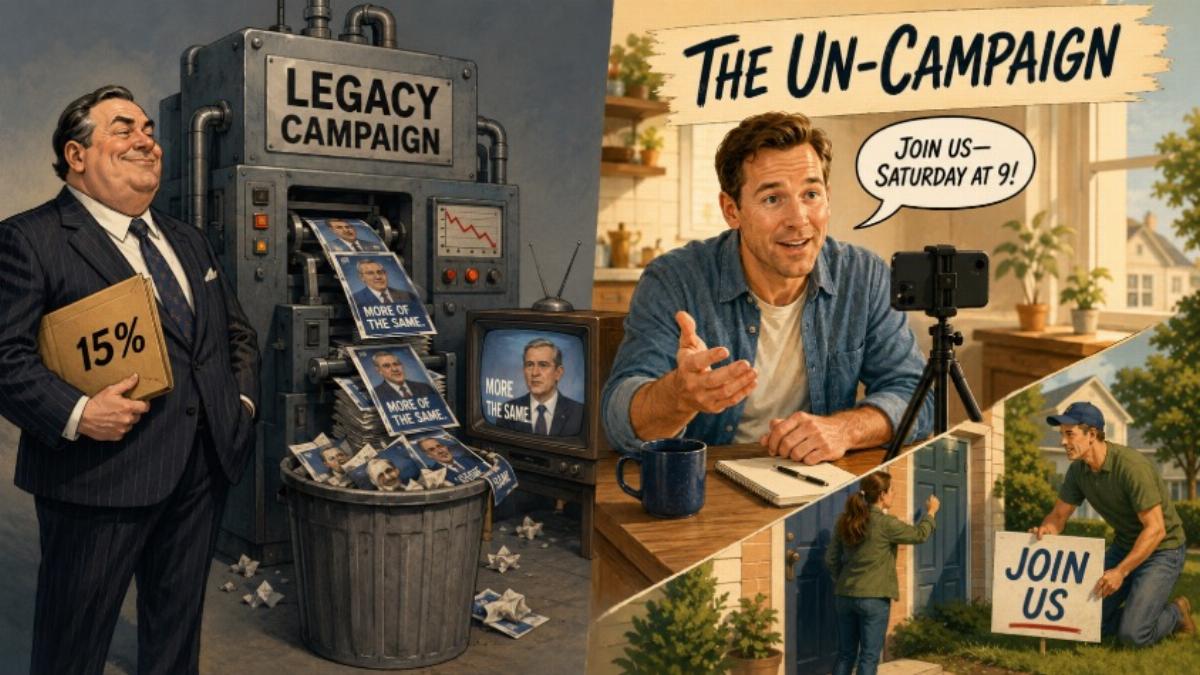
The multi-billion-dollar political consulting industry is running on borrowed time. For decades, the playbook for seeking public office barely changed: raise an eye-watering sum of money, hire beltway strategists, flood mailboxes with glossy cards that go straight into the trash, and buy airbrushed 30-second TV spots that no one under fifty ever sees.
Read more AI companies are buying up rare and out-of-print books and shredding them
It was expensive, slow, and remarkably predictable. It was engineered by consultants, for consultants—ensuring that regardless of which candidate won or lost, the ad buyers and handlers walked away with their 15% cut.
That legacy system is collapsing.
We are witnessing the rise of the Un-Campaign—a lean, asymmetric, feed-first strategy that strips away the middleman, bypasses establishment gatekeepers, and communicates directly with voters…on their phones.
Voters are now immune to traditional political advertising. They spot canned talking points a mile away and swipe past staged photos in milliseconds. What grabs attention in today’s digital ecosystem isn’t slick flyers; it’s raw, unscripted authenticity.
The Un-Campaign operates on a simple premise: high-frequency, low-cost engagement beats low-frequency, high-cost advertising every single time.
Instead of spending $30,000 on a single TV ad taking three weeks for committee approval, Un-Campaign candidates produce three raw videos a day on their iPhone. They don’t issue formal press releases; they react to breaking local news in real time from their kitchen table or their truck. They skip speechwriters for honest answers and studio lights for sunlight.
Consider how outsiders are proving you don’t need a million-dollar war chest or an army of strategists to crash the political party. Spencer Pratt’s media-first run in the Los Angeles mayoral primary spent zero dollars on legacy television advertising, while his social-first strategy generated tens of millions of organic views and built a massive small-dollar donor base purely through raw video clips, direct livestreams, and long-form podcasts. For everyday citizens and conservative outsiders who feel locked out by million-dollar buy-ins, his campaign serves as an inspirational blueprint, telling them that you don’t need the blessing of party bosses to force your way into the conversation.
Across current state houses, primary fights, and national circuits, this asymmetric shift is taking root among conservative and independent candidates.
- Nick Freitas (Virginia State House): A pioneer of clean, direct-to-camera state politics. Instead of relying on traditional mailers, Freitas built a massive national following through short policy breakdowns, bringing fiscal conservatism directly to digital feeds with a simple smartphone setup.
- Vivek Ramaswamy (GOP Circuit): Mastered the modern digital circuit by skipping traditional ad-buy formulas in favor of long-form podcasts, town halls, and rapid-response short video clips that communicated a positive vision directly to grassroots voters.
- Dan Osborn (Independent Senate Campaigns): Showed how an independent candidate can connect with working-class families by talking straight to the camera from job sites and local community events, bypassing party gatekeepers entirely.
- Kari Lake (Arizona Republican Campaigns): Leveraged a media-first approach, turning press interactions and public rallies into immediate, highly accessible video content that energized conservative voters across the state.
Even political opponents have been forced to adopt this exact playbook to stay relevant. Left-wing figures across the aisle now rely heavily on low-budget smartphone videos to bypass their own establishment gatekeepers. When your opponents are forced to adopt your communication model, you know a permanent shift has occurred.
The Un-Campaign isn’t just cheaper. It’s also structurally superior in today’s media environment. To do this, it relies on three operational shifts:
Read more The middle class isn’t really a class at all
1. Feeds Over Fliers: A direct video costs nothing to produce and reaches an audience consisting of people already tuned into their feed. A direct mailer costs thousands in design, printing, and postage, and then voters discard it before it reaches their front door.
2. Speed as a Weapon: Traditional campaigns move at the speed of political bureaucracy. Un-Campaigns move at the speed of the news cycle. By jumping on local issues immediately, the Un-Campaign candidate drives the narrative while the establishment campaign is still scheduling a conference call.
3. Relatability Over Perfection: Voters don’t want a sanitized statue. Instead, they want a human being who understands their day-to-day frustration. An unscripted moment proves you are a real person, not an AI spokesperson engineered by a focus group.
One problem for the Un-Campaign, taking place as it does on phones and social media, is that “likes” don’t vote. Without voter organization being attached to that attention, all the candidate has is noise. The true engine of a successful Un-Campaign lies in converting digital engagement into a physical ground game.
A common feature in winning campaigns is that they use high-frequency content as the top of a direct-response funnel. Every candid reel and direct Q&A is paired with a specific call to action: sign up for door-knocking, host a backyard coffee, or join a precinct captain list. This creates a personal connection between the public and the candidate. This means they’re not just voters; they’re activists, knocking on doors, placing yard signs, and dragging their neighbors to the polls.
The era of buying elections through sheer ad-spend dominance is ending. The political establishment will continue to pour millions into legacy media because that’s what legacy consultants know how to sell. But the candidates who win going forward will be those who recognize that the gatekeepers are gone.
You don’t need a million dollars, a high-rise strategy room, or a flock of consultants to run for office anymore. You just need a clear message, a relentless work ethic, and the courage to strip away the political theater.
The campaign is dead. Long live the Un-Campaign.
Image created using AI.
Jack Gleason is a conservative, common-sense, political consultant at the municipal, state, House, Senate and presidential level since 2009. His email is [email protected] and his always-free Substack is jackgleason.substack.com
Read more Taxed out of house and home