
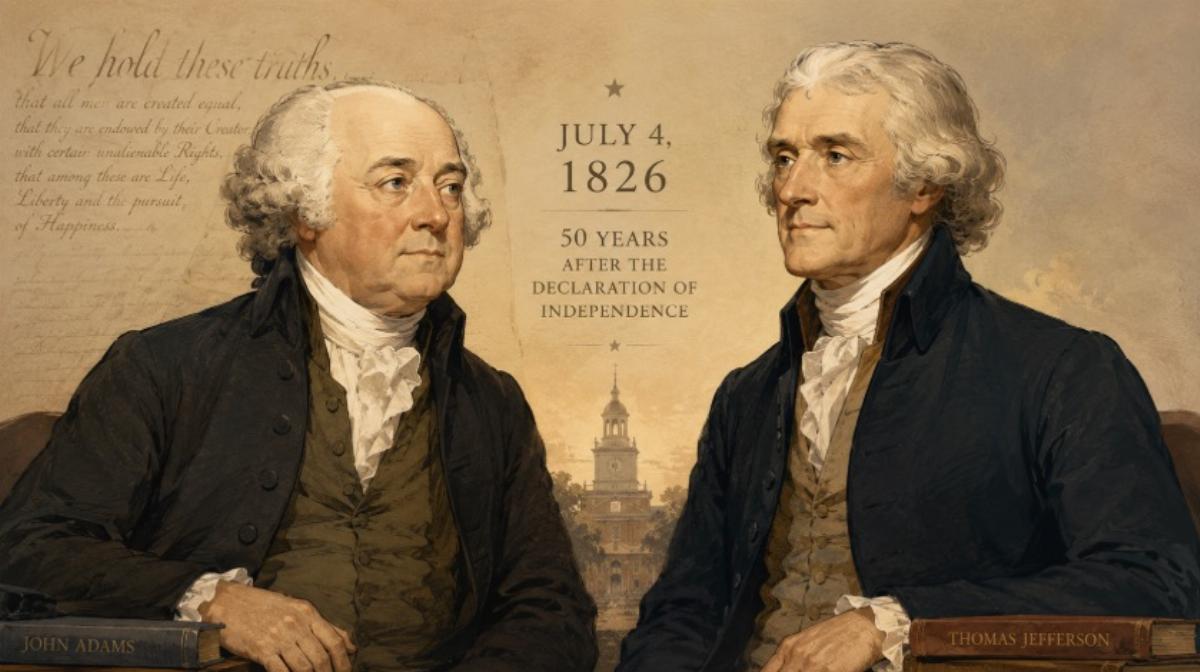
On July 16, 1826, 200 years ago today, the Reverend William Staughton delivered a solemn and powerful sermon in the United States Capitol in honor of Thomas Jefferson and John Adams—two towering figures of the American founding who had passed from this life just days earlier.
Read more Why the Left Hates Idling Cars
Their deaths occurred on July 4, 1826, exactly 50 years after the Declaration of Independence came into being. This profound and unmistakable act of Divine Providence formed the central theme of Rev. Staughton’s message and stirred the conscience and imagination of the entire nation.
The Astonishing Providence of July 4, 1826
At the heart of his sermon lies a single, breathtaking fact: Jefferson and Adams—once collaborators, later political rivals, and ultimately reconciled friends—both died on the same day, on the same sacred national anniversary, and even near the same hour. Staughton presents this not as a coincidence but as a deliberate and sovereign act of God.
The date itself carried immense symbolic weight. July 4 marked not merely a political milestone but what the preacher calls a “jubilee”—a term drawn from biblical tradition that denotes a sacred 50th year of celebration, restoration, and divine favor.
That these two principal architects of American independence should leave the earth on that exact jubilee anniversary struck the nation with awe. It was as if, Staughton argued, God Himself was speaking to America and commanding the people to “hallow the fiftieth year.”
Staughton insists that this event stands nearly without parallel in human history. Nations have often regarded simultaneous events as meaningful, but rarely has such a precise and significant convergence of lives, dates, and national identity occurred.
The Jefferson’s and Adams’s deaths became, in his words, a historical fact that would “astonish future ages” and remain forever woven into the story of the American republic.
A Nation in Awe and Reflection
This providential occurrence immediately produced a profound emotional and spiritual response across the United States. Twelve million citizens, Staughton notes, received the news with a mixture of grief, reverence, and wonder. The nation “wept, adored, and sought to interpret” what it had witnessed.
This was no ordinary mourning. The nation had not simply lost two elder statesmen. Rather, the people sensed that God had orchestrated their departure in a way that affirmed the divine origin and guidance of the American experiment.
The people exclaimed, in language drawn from Scripture, “Great and marvelous are thy works, Lord God Almighty.”
Staughton emphasizes that such moments are neither random nor purposeless. God designs them to awaken a people and remind them that chance does not govern history. Instead, a sovereign hand directs the affairs of nations.
The Lives and Character of Jefferson and Adams
Although the extraordinary nature of their deaths takes center stage, Staughton also reflects on the lives of these two men. He presents them as instruments whom Providence raised up for a specific historical mission.
He portrays Jefferson as the elegant and forceful writer of independence—a man of intellect, principle, and deep commitment to liberty. His authorship of the Declaration and his lifelong advocacy for freedom of conscience placed him among the foremost champions of human rights.
By contrast, Staughton depicts Adams as the bold defender and tireless advocate of independence—the “animating soul” of the Continental Congress, whose courage and conviction sustained the revolutionary cause during its darkest hours.
Together, Jefferson and Adams embodied the intellectual and moral strength necessary to secure the nation’s birth. They were not merely political leaders. In Staughton’s view, they were providentially appointed agents—”pillars of the dome of our Republic”—whom God raised up at the precise moment the nation needed them.
“In Their Death They Were Not Divided”
Staughton also invokes an interesting biblical phrase: “Lovely and pleasant were they in their lives, and in their death they were not divided.” Originally spoken of Saul and Jonathan, Staughton applies it to Jefferson and Adams.
Despite their political differences and years of estrangement, the two men ultimately reunited through their reconciliation in later years and their deaths on the same day. Their simultaneous passing symbolizes not division but unity: unity of purpose, unity of legacy, and unity under God’s providential plan.
This unity carried powerful meaning for a young nation still navigating political tensions. It reminded Americans that personal rivalries must give way to higher principles and that a life’s ultimate measure lies in its contribution to the common good.
The Moral and Spiritual Lessons for the Nation
Beyond commemorating Jefferson and Adams, Staughton issues a deeply exhortative call. He urges his listeners to draw moral and spiritual lessons from both the lives and deaths of these men.
Read more All Socialists are Ignorant… But Some are More Ignorant Than Others
First, he emphasizes the inevitability of death. No greatness—whether intellectual, political, or moral—can shield a person from the final summons. Despite their immense contributions, Jefferson and Adams shared the same mortality as all humanity.
Staughton offers this truth to humble the nation and call individuals to reflect on their own lives and eternal destiny.
Second, he highlights the central importance of virtue. True greatness, he argues, rests not in power or fame but in moral character—justice, truthfulness, humility, and charity.
Jefferson and Adams exemplified these qualities in their finest moments. Such virtues remain essential not only for individuals but also for the health of the republic itself.
By contrast, Staughton describes vice as corrosive because it destroys both personal usefulness and national stability. A republic cannot endure through laws and institutions alone; it requires a virtuous citizenry.
Providence and the Destiny of the Nation
One of the most powerful themes Staughton develops is the idea that God actively governs the affairs of nations. Just as He raised up leaders such as Moses, Joshua, and David in biblical history, He also raised up figures such as Jefferson and Adams for the American cause.
Staughton presents the precise timing of their deaths as further evidence of this divine governance. God not only appoints leaders but also determines the span of their influence. He removes them when they have completed their work and raises up others to take their place.
This perspective instills both confidence and responsibility. On the one hand, it reassures the nation that it remains under divine care and guidance. On the other hand, it calls the people to faithfulness by reminding them that their blessings depend upon obedience to moral and spiritual principles.
A Warning and a Call to Faithfulness
Staughton does not end with mere admiration. He issues a clear warning: Nations rise and fall according to their adherence to righteousness. History, he argues, provides ample evidence—from ancient Israel to Rome—that moral decay inevitably leads to national ruin.
He cautions that the United States could suffer the same fate if its people abandon virtue and disregard God. No statesman, however wise, can save a corrupt nation.
The responsibility lies with the citizens themselves. They must live justly, uphold truth, and walk humbly before God.
At the same time, Staughton offers hope. The same God who guided the nation’s founding and marked its jubilee with such a striking providence remains able to sustain it.
If the people remember His works, seek His guidance, and uphold His principles, they may trust that He will continue to raise up leaders and preserve the republic.
A Providential Legacy
The deaths of Thomas Jefferson and John Adams on July 4, 1826, stand as one of the most remarkable Providences in American history—not merely because they coincided, but because of their meaning. In the eyes of Reverend Staughton and his contemporaries, this was a divine sign: a testament to God’s hand in founding, sustaining, and guiding the United States.
This extraordinary event transformed a moment of mourning into one of national reflection and spiritual awakening. It reminded citizens that their nation had arisen not through human effort alone but through Divine Providence. It also reminded them that the nation’s future would depend on their continued faithfulness to the principles of virtue, liberty, and reverence for God.
In this way, the passing of these two great statesmen became more than an accident; it became a message. That message echoed across the land then and continues to speak to future generations: “There is a God who rules in the affairs of men and nations,” and His Providence, though often mysterious, is always purposeful.
You can read the whole sermon and others like it in either of these two books – Courageous Pastors: 7 Sermons That Ignited and Sustained the American Revolution or God’s Providence in the Affairs of Men and Nations.
Image created using AI.
Craig Seibert is the director of www.UnitedStates250.org , www.DeclarationOfIndependence250.org, and www.ChristianCivicsTraining.org, where you will find an abundance of free resources and books. Craig also serves as a Coach Mentor for www.PatriotAcademy.com, and www.ServeGodDefendLiberty.com. Learn more about free Patriot Academy Courses here Rebuilding Liberty Here.
Read more Big Blue Cities Threaten Red-State Liberty. Do GOP Voters Care?