
Richard Condon’s The Manchurian Candidate was published in 1959 during the Cold War. The novel told the story of an American soldier whom the Chinese and North Koreans brainwashed into becoming a political assassin as part of their attempt to overthrow America. Its power came from a simple but frightening idea: the greatest threat to a nation doesn’t necessarily come from outside its borders; sometimes a country can be manipulated into tearing itself apart.
Read more The continued decline of the morally bankrupt Church of England
In 2026, America may not be facing a single Manchurian Candidate but, instead, something more consequential: the metamorphosis of the Democrat party into a Manchurian Party.
The Democrat party shows no signs of disappearing. Instead, I’m concerned that it is becoming something fundamentally different from the institution Americans have known—and many respect and are loyal to—for generations.
That matters because America’s political system has always depended on constructive competition between parties that, despite deep disagreements, accepted the legitimacy of our constitutional underpinnings and at times even worked collegially with one another. Republicans and Democrats frequently argued over the proper role of government, even as they generally agreed on our constitutional framework.
It’s an open question whether that agreement still exists.
The Democrat party is undergoing a sharp break from its traditional platform. Leadership has stopped acting as the institution’s steward and now chases tactical wins, distorting the party’s long-term identity. Formerly fringe factions have been absorbed, supplying energy, money, and turnout. What started as Big Tent tolerance has morphed into reliance, and that reliance is now allowing those factions to consume the old party.
Leadership can’t merely be campaign managers. Party leaders are custodians of an institution that existed before them and should outlive them. When winning is the only objective, stewardship becomes disposable. Outside fringe movements infiltrate key roles. Positions roundly rejected become mainstreamed. Over time, activists no longer influence the party from the outside; they are the party.
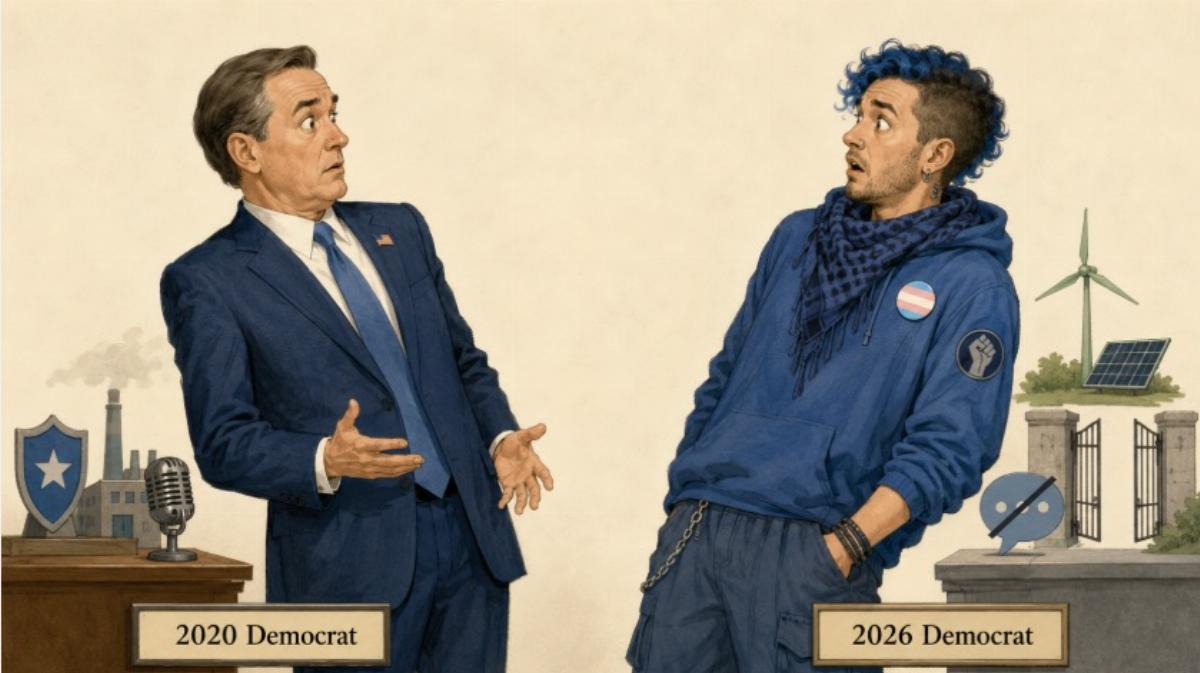
I believe that is what has happened—and is accelerating—inside today’s Democrat party. The Democrat party of John Kennedy, Bill Clinton, and even Barack Obama isn’t evolving. Instead, since 2020, it has changed in a way that makes it increasingly unrecognizable to many Democrats.
Previous Democrat administrations often pursued sweeping reforms, but they generally did so through the constitutional process. Even Obama’s promise to “fundamentally transform America” was pursued through elections, legislation, and executive authority within the existing system.
It’s different today. Democratic Socialists of America (“DSA”) members and their supporters within the Democrat party are increasingly willing to jettison institutions, from the Senate to the Department of War and more. The debate is no longer confined to policy but has instead become a referendum on America’s legitimacy.
Ideas and candidates once considered outside the party’s mainstream are moving at warp speed toward positions of influence. That’s currently limited to blue states and cities, but that may change. Democratic socialism, identity-based politics, expanded administrative authority, and cultural ultra-progressivism increasingly dominate the party.
How did this happen so quickly? I believe the pandemic was the great accelerant.
Opposing ideological movements already existed, so the pandemic did not create them. However, it dramatically enhanced their ability to influence institutions and public perception. Institutions that traditionally moderated political change weakened as government authority expanded rapidly, while civic life became fragmented.
We witnessed closed schools, empty churches, and widespread disruption everywhere. Millions spent their formative years cut off from normal experiences, while the government assumed powers few Americans had previously witnessed or believed could happen.
That changed expectations and led many young Americans to emerge from the Pandemic more comfortable with government intervention and skeptical of traditional institutions, which they believed had failed them. All this created an opening.
Periods of disruption rarely remain unexploited. When established institutions weaken, organized movements prepared and predisposed to act quickly gain influence beyond what their numbers alone would suggest. Seemingly overnight, we’re witnessing previously unknown people dominate public policy debates.
The Russian Revolution provides one historical example. The collapse of the existing order created an opening that the Bolsheviks seized. The lesson? Moments of instability can accelerate changes that previously seemed unlikely.
I believe something similar happened during and after the pandemic.
The most important question shouldn’t be whether participants shared the same motivation or whether it was centrally planned. The question should be whether groups with similar objectives recognized an extraordinary opportunity and moved aggressively to take advantage of it organically.
Whether coordinated or simply pursued by organizations sharing similar ideological objectives is an open question. We can’t see connections between every activist organization, donor, media platform, political operative, NGO, and influence campaign, but there is a recognizable pattern.
Astronomers cannot directly observe dark matter. They infer its existence because galaxies behave as if they were being influenced by unseen forces. Politics can be seen as working the same way. We cannot see all the connections between organizations and individuals, but when actors reliably move in the same direction seeking complementary outcomes, it is reasonable to ask whether we are seeing coincidence, shared ideology, coordinated action—or some combination of the three.
We can see this happening in real time today in the Democrat party when one compares its positions now versus twenty years ago. There’ve been massive policy flips on immigration, energy policy, criminal justice, free speech, identity politics, federal authority, and constitutional interpretation. So, ask yourself: how could this happen so quickly?
Taken together, they represent a tectonic shift in how many within the party understand the historical relationships and history of America’s institutions and our role in the world.
This is why the Democrat party’s transformation matters. A political party is not merely an election machine. It is an institution. When one of America’s two major political parties fundamentally changes its institutional loyalties, the consequences reverberate all across the land.
The larger question is not simply who wins the next election. It is whether we have two parties actually supporting the continuation of our Republic.
In The Manchurian Candidate, the greatest danger was never only the manipulated individual. The greater threat was the failure of those responsible for protecting the system to recognize the danger in time.
I don’t anticipate an overnight coup, but weakened institutions and leaders who are expedient rather than good stewards may achieve the same end.
Actual Democrats, not socialists or would-be communists, must ultimately decide the future of the Democrat party. Regardless, the consequences will not remain within the Democrat party; those consequences will affect us all.
America’s constitutional system depends on institutions and political parties that understand their responsibilities extend beyond the next victory.
Countries lose themselves one compromise at a time. The question facing our generation is: how much can America compromise its institutions and values before it becomes something unrecognizable from what it was?
The answer depends on whether enough Americans still believe the institutions that made this nation exceptional are worth preserving—or merely obstacles to be overcome in pursuit of a radically different vision.
God Bless America.
Image created using AI.
Author, Businessman, Thinker, and Strategist. Read more about Allan, his background, and his ideas to create a better tomorrow at 1plus1equals2.com.