
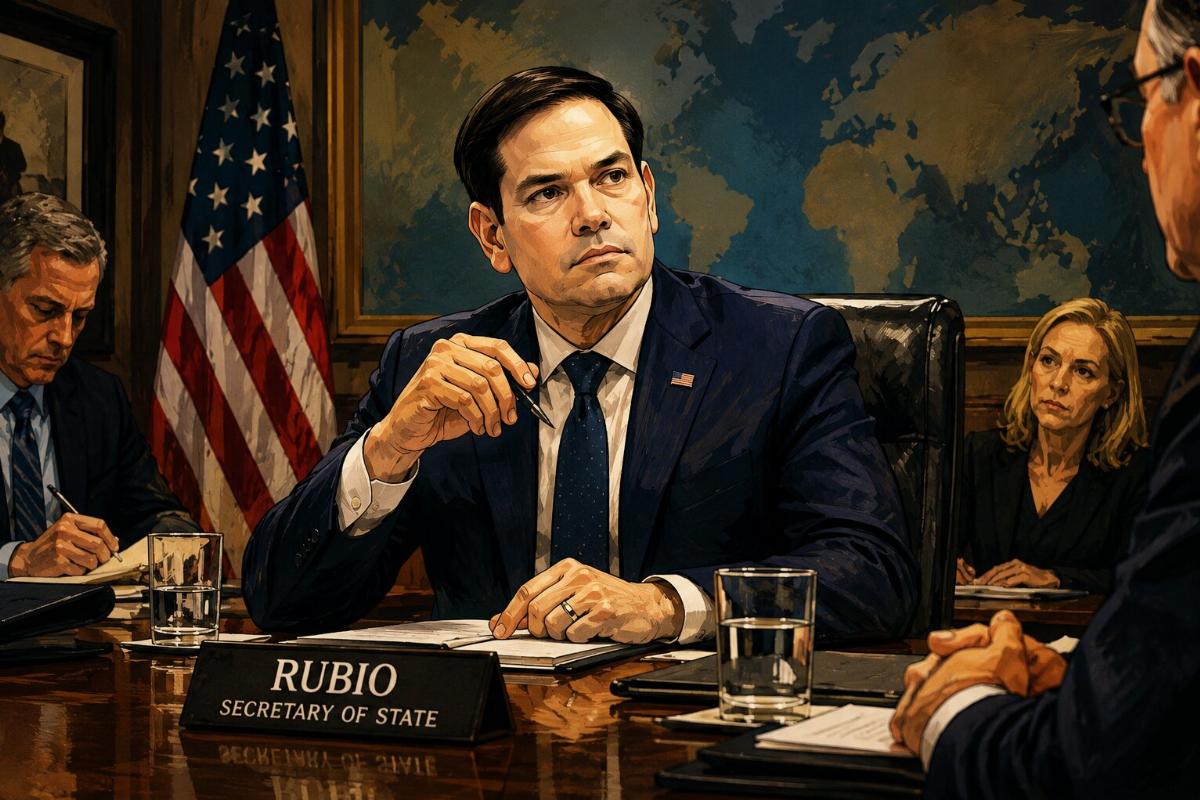
Secretary Marco Rubio has called for a high-level conference next week to tackle the growing threat of transnational far-left terrorism. With violence and terrorist acts breaking out all over the world, you’d think that the global community would be thrilled that someone is stepping up to take a unified approach to the problem. Mostly, the response has been “meh.”
Read more Belgium’s Car Toll Desperation Move
Just because countries have not responded with overwhelming enthusiasm, we shouldn’t assume that countries are not interested. But in the articles I’ve reviewed, most people said their countries don’t have a problem with Antifa (which was singled out); others said they didn’t have a high-level person available to send to the conference scheduled for July 16; and still others in our own country said it would be setting a precedent:
‘The idea is you’re setting a precedent for a future Gavin Newsom administration to turn these authorities on conservatives,’ one current administration official told the Post.
The White House disputed that characterization, saying the concerns did ‘not represent the prevailing feeling’ and pointed to the administration’s national counterterrorism strategy released in May, which states: ‘We will not permit the weaponization of America’s unparalleled CT capabilities for partisan purposes.’
For those of us who recognize the dangers of leftism, Rubio’s decision was timely and encouraging. A recent case of Antifa violence illustrates the concern:
The administration’s argument that far-left violence has moved beyond graffiti and broken windows gained its sharpest real-world evidence last month. Several defendants received lengthy prison sentences for their roles in a violent protest outside an Immigration and Customs Enforcement facility in Texas where a police officer was shot. Prosecutors described the defendants as members of an ‘antifa cell.’
For years this country has ignored the violent activity of the Left. The mainstream media has collaborated in creating this illusion. When property was destroyed, it was described as over-zealous protestors. Street violence was blamed on law enforcement, even though many incidents were instigated by the protestors. Support from the drug cartels was downplayed as a drug issue, not terrorism practiced in our nation. The truth is finally coming out, and the violence is finally on the main screen.
But there are still those who think this new focus is political:
Terrorism analysts quoted by the Post were blunt in their skepticism. Bruce Hoffman, a senior fellow for counterterrorism at the Council on Foreign Relations, said: ‘We have to be objective about identifying threats, not politically selective.’ Colin P. Clarke, executive director of the Soufan Center, went further:
Read more How Government Created a Nation of Conspiracy Theorists
‘If I were to rack and stack priorities, left-wing terrorists wouldn’t be in my top three.’ Those are credible voices. But ‘not in my top three’ is not the same as ‘not a threat.’
[snip]
The question is whether this particular meeting is calibrated to produce actionable cooperation or designed primarily as a political statement.
This conference will be a powerful opportunity to commit to sharing data and law enforcement coordination. For some reason some of the countries that have been invited don’t see the value of Rubio’s proposal. I think their reaction is not only foolish, but short-sighted. Some of them claim that there is not a current problem with far-left terrorism; that is no surprise, since many of those governments are ruled by the left and prefer to blame the right for everything. Some countries over the last couple of years may have felt resistant to joining the U.S. in strategic efforts: their reluctance to help with the Iran war; their sometimes ambivalence about acting on their NATO promises; their unhappiness with the current status of Hamas in Gaza. All of these factors may be contributing to their reluctance to participate. Finally, due to Europe’s ambivalence toward its Muslim population, they may fear that this focus may attract a spotlight to their dilemma.
Certain actions can help encourage the global community to participate: President Trump needs to emphasize the importance of their involvement; Secretary Rubio needs to provide more detail about “what’s in it for those countries.” And this first conference needs to have actionable outcomes to ensure a positive assessment:
Several questions remain unanswered. How many of the 60-plus invited nations will send senior officials? Will the meeting produce concrete intelligence-sharing agreements, or will it end with a communiqué and a photo? What specific foreign terrorist designations, if any, is the administration prepared to pursue, and through what legal mechanism?
Those answers could provide a new, innovative approach to tackling global leftist terrorism. Let’s hope Europe wakes up.
Read more Remembering Lindsey Graham’s finest hour
Image generated by ChatGPT.