
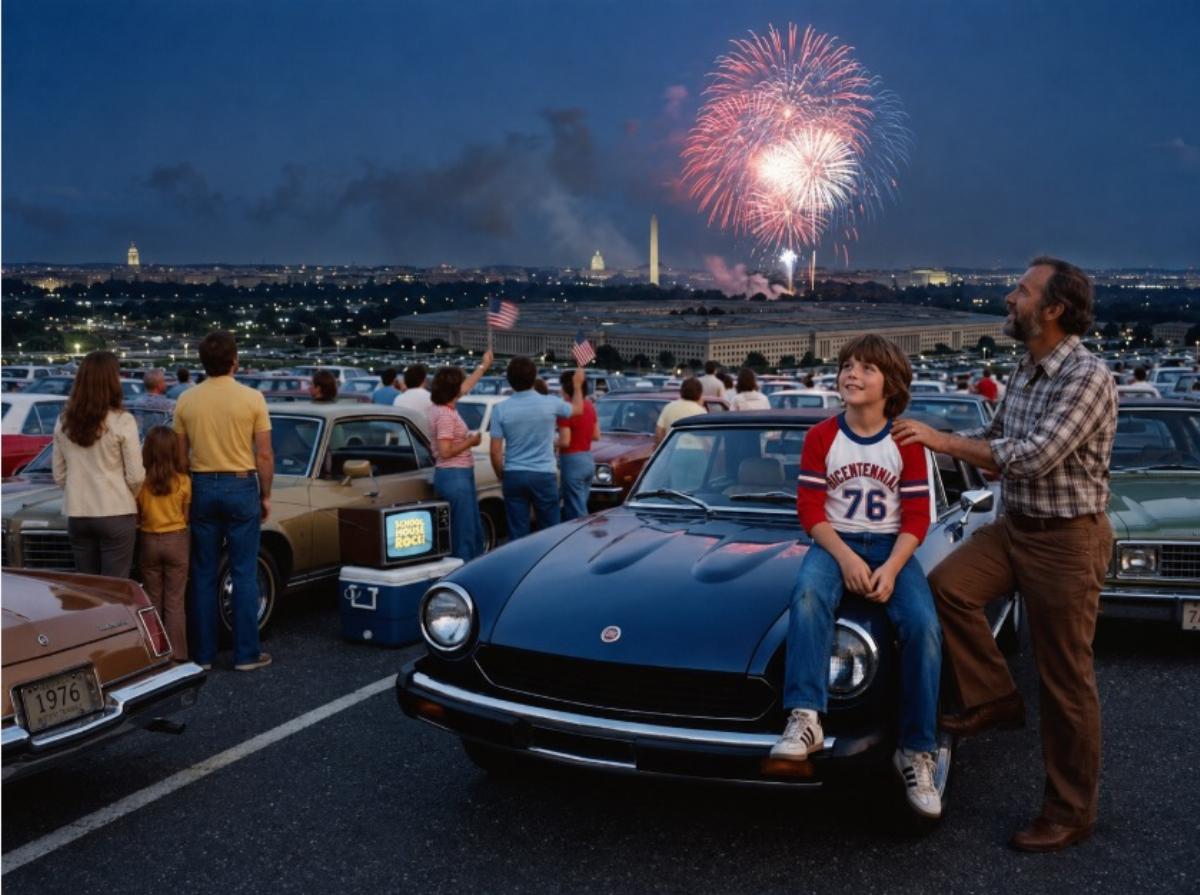
I’d wanted to write a post for July 4th, but as so often happens, life got in the way, and I wasn’t able to get to it. So this is my belated 4th of July post, remember a magical Bicentennial.
Read more Did JD Vance just attack meritocracy and Milton Friedman?
The year 1976 was chock-full of patriotism. My elementary school made matching red, white, and blue baseball jerseys for every one of us. In TV commercials, Red, White, and Blue were everywhere, with everything from Coke to savings bonds to God—yes, really—represented. And of course, there was the Schoolhouse Rock series that ran for much of the decade, including my favorite, “I’m Just a Bill.”
On the actual 4th of July, I remember sitting on the hood of my father’s Blue FIAT 124 sports car beside the Pentagon and watching the most amazing fireworks over Washington, D.C.
It sounds cliché, but it was a magical time. Patriotism was simply everywhere, with pretty much everyone. Back then, in contrast to the Zohran Mamdani approach, it wasn’t about disparaging our history or challenging our leaders; it was about celebrating America. And contrary to 2026, when TDS has afflicted Democrats, only 27% of whom are proud of being American, with eight states refusing to participate in celebrations on the National Mall, no one had to be convinced to celebrate America.
And there was a lot to celebrate. The truth is that we had no idea how good we had it. Not that everything was perfect, because it wasn’t, but at least back then, we were actually free, largely because government was a relative guppy compared to the leviathan it’s become.
The reality is, Americans in 1976 knew we lived in the greatest country on Earth, and most were proud to call themselves Americans.
And there was much truth to that. I often talk about Western civilization and all that it has brought to the world. And that is true: Western civilization has done tremendous things for humanity. But the truth is, even within Western civilization, the United States has been far and away the single biggest driver of prosperity and freedom in all of human history.
And it started from the very beginning. The United States was the first nation in history to be established based on individual rights from God. “We hold these Truths to be self-evident, that all Men are created equal, that they are endowed by their Creator with certain unalienable Rights, that among these are Life, Liberty, and the Pursuit of Happiness.” What’s more, our founding document explicitly stated that government power came directly from the consent of the governed “That to secure these Rights, Governments are instituted among Men, deriving their just Powers from the Consent of the Governed…”
While that was a turning point for the 13 colonies and the beginning of a new nation, in reality, it was much more: a watershed event in human history.
The United States would go on to shape the world as no nation ever had, not even the Romans or the British, and it would become the most powerful nation the world had ever seen. And while some of that power derived from military might, the bigger and more consequential impacts came far from the centers of martial power.
From early on, the differences between America and what had come before were clear to see.
Alexis de Tocqueville said:
The federal system rests upon a theory which is complicated at the best, and which demands the daily exercise of a considerable share of discretion on the part of those it governs… In examining the Constitution of the United States, which is the most perfect constitution that ever existed, one is startled at the variety of information and the amount of discernment that it presupposes in the people…
Read more They like it like that: Drug fueled homeless encampments set to grow in New York and Los Angeles
As grand as the Constitution was, its greatness didn’t come from the government it established, but from the people it empowered. Capitalism, which coincidentally was articulated by Adam Smith in The Wealth of Nations in 1776, found fertile ground in America, something that happened nowhere else.
America was, by definition, a nation where men were free to capitalize on their own efforts, be they physical or intellectual. And it didn’t take long for that reality to pay dividends. Robert Fulton developed the first commercially successful steamboat, which revolutionized shipping, facilitated a rapid increase in trade among the states, and allowed the new country to grow at an almost unprecedented pace.
A generation later, Cyrus McCormick would become the most important inventor in human history with his mechanical reaper in 1831. His farming machines would allow the American plains to flourish and feed the rapidly growing nation. More importantly, his machines and their progeny would make farming far more efficient, eventually freeing up 80% of the population to do something other than work on a farm. Everything that came afterward was made possible because McCormick lifted the yoke of farming from man’s neck.
The 19th century would end with more American innovations that changed the world. Rockefeller’s rationalizing of the petroleum industry through private enterprise, Edison’s invention of the light bulb, Morse’s invention of the telegraph, Bell’s invention of the telephone. And the 20th century would pick up right where the 19th left off, from Baekeland’s synthetic plastic to the Wright Brothers’ plane to Ford’s automobile assembly line to Carrier’s air conditioning.
The line of inventions and innovations would continue for the next century and beyond, with the United States capturing by far the most Nobel Prizes, having the most valuable companies in the world and a GDP that by 1960, with only 5% of the world’s population, had the highest share of world GDP, 40%, a number greater than any nation ever in all of human history. And along the way, the United States would save the world twice, send men to the moon, invent the PC, the Internet, and the mobile phone, along with tens of thousands of other things.
The bottom line is that the United States, with the rights of citizens coming from God, with the power of government coming from the citizens, and government’s primary role being to protect said rights in the “Pursuit of happiness,” is indeed the most perfect union thus created on God’s green earth.
Add to that the geography and other natural resources America has, and you have the recipe for an unprecedented impact on mankind. A measure of that impact is that global life expectancy remained flat until the middle of the 19th century, when it began a steady march upward and doubled over the next two centuries.
While all of that is accurate, from the rights from God to the individual freedom to the unprecedented entrepreneurial and economic success…none of that is what makes America spectacular.
No, the singular thing that makes America extraordinary is…opportunity. Building on all the above, America is first, middle, and last, the land of opportunity. It’s a place where any man, from any level of society, can become a success, however he defines it. Whether it’s to have a steady job, buy a house and raise a family, or start a company whose products are used around the world, the characteristic that defines America, both at home and abroad, is opportunity.
No place on Earth, today or ever in history, has upward mobility been more accessible to more people from more backgrounds than is found in America. Sure, some claim it’s no longer true, and the leviathan of government certainly makes it more difficult, but at the end of the day, America remains, as it has been for most of its 250 years, the land of opportunity.
The American Constitution doesn’t guarantee any American happiness. That’s impossible. But by providing a framework for the “Pursuit of Happiness,” it gives every one of us the opportunity to find it. And this side of Heaven, I think that’s the most we can ask for. And I, for one, am grateful for it.
Read more Dallas Fed finds that illegals are behind 30 percent of home price spikes
Image created by Vince Coyner using AI.
Follow Vince on X at @ImperfectUSA.