

Seeking to counter what it called a decade-long “revisionist movement” to “rewrite our Nation’s history,” the Trump administration issued , directing federal officials to review Smithsonian exhibits and programs for ideological content. Pursuant to that order, the , “Saving America’s Story,” on America’s 250th anniversary of Independence Day arguing that the Smithsonian Institution’s National Museum of American History has strayed from its core public mission: telling America’s story with honesty, seriousness, and civic pride.
Read more Birth tourism is fraud and needs to stop
Its core claim is that the Smithsonian’s flagship history museum has been ideologically captured by leadership that treats history not as a record of national inheritance, but as a vehicle for activism. Central to the report’s findings is its assertion that NMAH
fails in the basic task of illuminating our heritage. Our central finding is not that the Museum has simply added overlooked stories, corrected perceived errors, or broadened its historical scope. Rather, it is that Museum leadership has explicitly adopted an ideological framework that no longer treats the American story as a shared national inheritance to be taught or celebrated, but as a political instrument to divide, dispirit, and discourage our citizens.
The report points to current director Anthea Hartig, the first woman to hold the position since the museum opened in 1964, as central to the problem. Hartig was appointed in 2019, and the report notes that she “has explicitly stated that she sees history as a ‘prime tool of social justice,’” and that one of her roles is to connect “research and scholarship to activism and advocacy.” In a November 2020 speech at U.C. Riverside, Hartig said she “will always be in a state of becoming a historian, propped up as I was and I am by the cushions of whiteness and the pillows of the bourgeoisie.” According to the report, under Hartig, the museum even removed explicit references to American history from in its mission statement as part of an effort to — in Hartig’s words — “get out of the America First mentality.”
During the same 2020 UC Riverside discussion, Hartig spoke about the upcoming 250th anniversary of Independence Day in terms of “commemorating” or “problematizing” the history surrounding the signing of the Declaration of Independence. Arguably, problematization is at the heart of Critical Theory and generally means challenging or “deconstructing” accepted historical narratives by questioning assumptions and “critiqu[ing] power structures.”
Examples of politicization of the museum’s content cited in the report include:
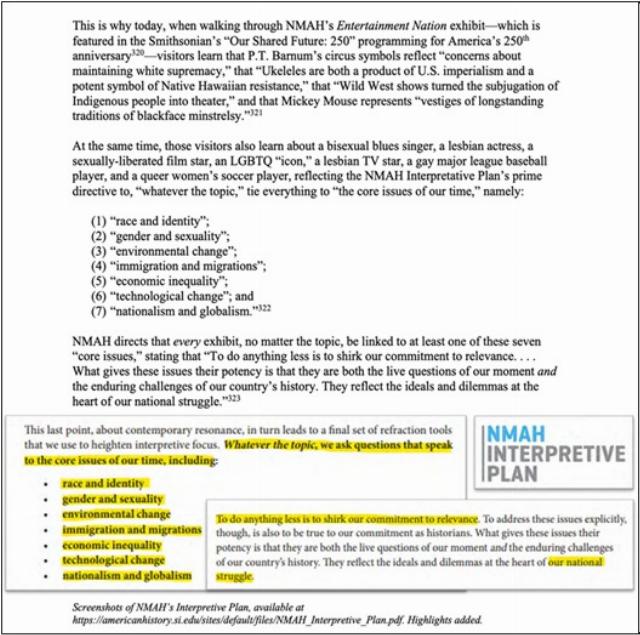
- Creating exhibits that tie history “to core issues of our time,” including race and identity, “gender and sexuality,” “immigration and migrations,” “nationalism and globalism,” and “environmental change.” (An example from report below.)
- Launching a Center for Restorative History “to encourage systemic change” for the purpose of “transforming the national historical narrative, restructuring institutional priorities, and privileging knowledge production in the communities that have been silenced or overlooked by museums and other educational institutions.” (Example below.)
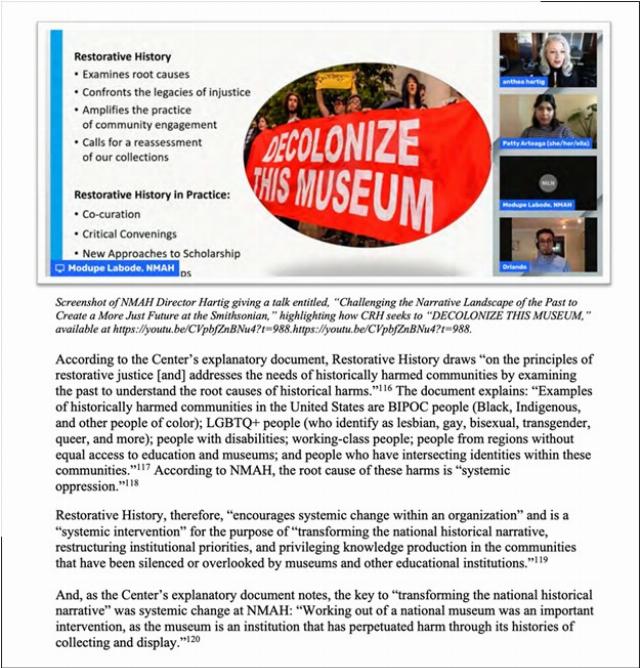
- The drafting of a museum-wide “Decolonization/Restorative History Plan.”
- Using its National Youth Summits to discuss issues “ranging from Teen Resistance to Racism and Gender Equity” to “Elections and Politics.” Democrat party operatives were invited to speak about the question “How can young people engage in political action and influence elections?” These summits are aimed at K–12 learners, are often blatantly activist in nature and frequently reflect the premise that “white audiences have an empathy gap” that makes it difficult for them to relate to black people, immigrants, and other allegedly disadvantaged groups.
The 162-page report includes numerous other examples that support the troubling claims put forward by the investigation. The months-long review found that the museum has reshaped much of the nation’s history through “materials intended to undermine faith in American institutions and longstanding ideals of the American people.”
Read more The DSA devours the Democrats, so of course it’s Trump’s fault
The report’s most important charge is omission, a concept Hartig references in some of her talks. She believes that history is as much about what we choose to include as it is about what we choose to omit. For that reason, it is arguably no mistake that the museum has no major exhibit directly dedicated to a full account of George Washington, Thomas Jefferson, the Founders, the Continental Congress, the American Revolution, the Declaration of Independence, or the constitutional achievement of self-government during the 250th anniversary period. According to the report,
the Pledge of Allegiance is treated as a tool for instilling nationalism without serious engagement with its rich meaning. And the Declaration of Independence and U.S. Constitution are quoted selectively in ways that mute their claims about equality, ordered liberty, natural rights, and the divine source of those inalienable rights. Museum materials repeatedly suggest that Christianity functioned principally as an instrument of conquest, exclusion, or cultural erasure, while the constructive role of Christian belief and Christian institutions in shaping the Nation and its freedoms receives scant, if any, attention. White, male, and Christian Americans are regularly denigrated as the alleged embodiment of oppressive power structures.
The Trump administration seeks not to erase the difficult chapters of the nation’s history, but to “tell the American story clearly and fairly.” It seems that the National Museum of American History has strayed from its original purpose, which, in the words of its founding director, Remington Kellogg, was to “awaken in citizen and foreigner alike a clear understanding of the inspiring history of the United States — its origins, struggles, development, traditions, strength.” The NMAH, said one of its , was intended to be “proudly patriotic.”
According to Trump administration policy, the purpose of the museum is to “tell the truth, including of the Nation’s mistakes and injustices, but it should do so within a coherent account of a people striving, often imperfectly but more often nobly, to live up to our founding principles of liberty and equality under a republican form of government. It should especially teach the history of an American nation that is worthy of our affections and worth passing along to future generations.”
Read more New report shows sanctuary city policies still wrecking American life
Why has this become so hard?
Image via Picryl.